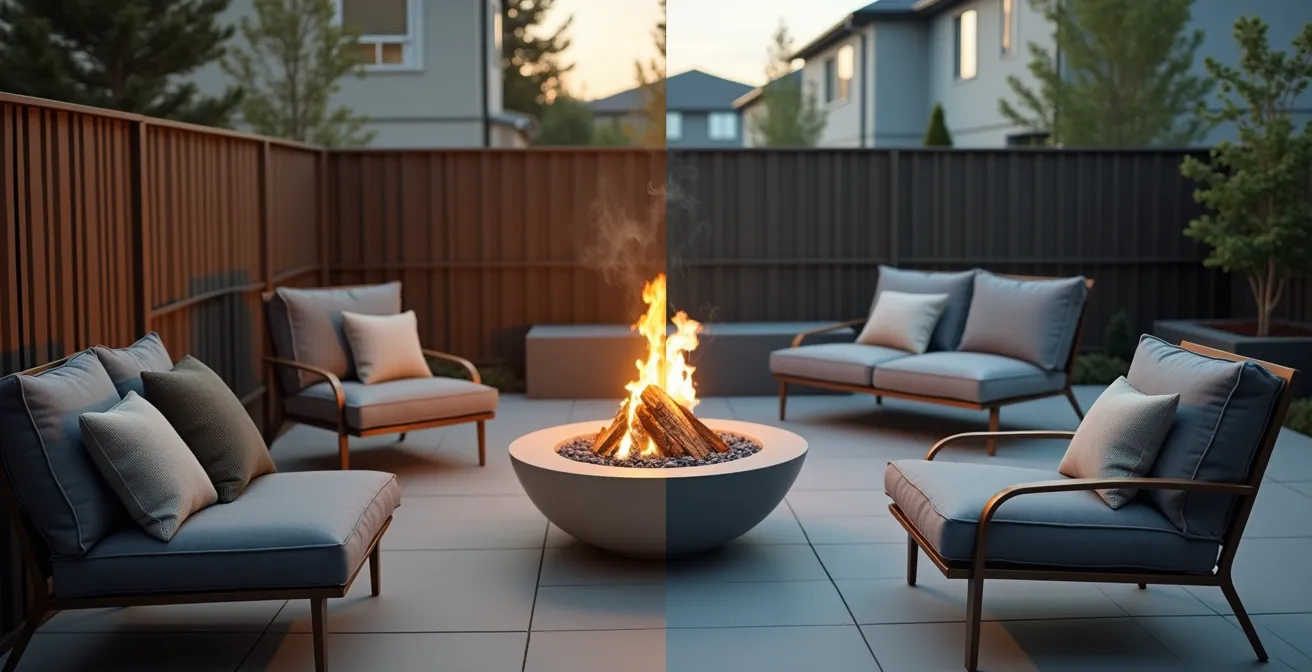
The key to enjoying a fire pit in a UK urban garden isn’t just choosing wood or gas; it’s understanding that gas is the only guaranteed legal and neighbour-friendly option in a Smoke Control Area.
- Wood-burning fire pits produce smoke, which can be classed as a “statutory nuisance” and lead to significant fines under the Clean Air Act.
- Gas and bioethanol fire pits are smokeless, making them compliant by default and eliminating the primary source of neighbour complaints.
Recommendation: For peace of mind in a town or city, opt for a propane or bioethanol fire pit to ensure full compliance with air quality regulations and maintain good relationships with your neighbours.
The desire for the warm glow of a fire in the garden on a cool evening is a common dream for many homeowners. Yet, for those living in towns and cities, this simple pleasure is fraught with anxiety. The fear of breaking complex council rules, creating a nuisance with drifting smoke, or even facing legal action can extinguish the idea before it ever sparks. Many believe the solution lies in using “smokeless” fuels or well-seasoned wood, but this often misses the fundamental point of the legislation.
The regulations, particularly the Clean Air Act, are not just about reducing visible smoke; they are designed to control the emission of fine particulate matter that harms air quality. This distinction is crucial. While you might not get a knock on the door for a single fire, repeated instances of smoke drifting into a neighbour’s property can be deemed a “statutory nuisance,” leading to formal complaints and penalties. But what if the real solution isn’t about trying to make a wood fire “less smoky,” but about fundamentally rethinking the source of the flame? This guide moves beyond the simple wood-versus-gas debate to explore the principle of ‘atmospheric responsibility’—balancing legality, safety, and consideration for your neighbours to achieve warmth without the worry.
In this article, we will dissect the legal framework governing garden fires in the UK, provide practical safety guidance for installation, and compare smokeless alternatives to help you make an informed, future-proof decision for your outdoor space.
Summary: Navigating Fire Pit Regulations and Choices in Urban Gardens
- Why Smoke from Fire Pits Causes 50% of Garden Complaints
- How to Build a Fire Pit Base on a Wooden Deck Safely
- Bioethanol vs Propane: Which Offers More Heat Output?
- The Lava Rock Danger You Must Check Before Lighting
- When to Stop Burning: Understanding Summer Curfews
- Why Your Pergola Cannot Be Taller Than 2.5m Near a Boundary
- Heat Pump vs Gas Boiler: How Loud Is the Outdoor Unit?
- Air Source Heat Pumps: Are They Viable for Older UK Properties?
Why Smoke from Fire Pits Causes 50% of Garden Complaints
The core issue with traditional wood-burning fire pits in residential areas is not the fire itself, but the smoke it produces. In the UK, especially within designated Smoke Control Areas, smoke emissions from domestic properties are strictly regulated by the Clean Air Act 1993. Emitting smoke from a chimney of a building, or from a furnace or any fixed boiler, is an offence. While a garden fire pit isn’t a “chimney,” the smoke it creates can be classed as a “statutory nuisance” if it unreasonably interferes with a neighbour’s enjoyment of their property. This is the most common trigger for formal complaints.
The definition of a nuisance is subjective but is influenced by factors like frequency, duration, and the time of day. A one-off bonfire is different from a fire pit lit every weekend. The consequences for creating a smoke nuisance can be severe; under the Environmental Protection Act 1990, councils can issue an abatement notice. Failure to comply can be a criminal offence, and recent guidance confirms that homeowners can face fines up to £1,000 for breaking smoke control rules. The most reliable way to avoid any risk of creating a statutory nuisance is to eliminate the source: the smoke itself. This is why gas and bioethanol options are increasingly seen as the only truly safe choice for urban and suburban gardens.
Even if you use dry, seasoned wood to minimize visible smoke, you are still releasing particulates. It is this invisible pollution, along with the odour, that can permeate a neighbour’s home through open windows, impacting their health and comfort. Ultimately, the risk of a complaint comes down to whether your fire is negatively affecting those around you, a risk that smokeless alternatives completely remove.
How to Build a Fire Pit Base on a Wooden Deck Safely
Placing a fire pit on a wooden or composite deck is a common desire for urban homes where patio space is limited, but it introduces a significant fire hazard if not managed correctly. The intense heat radiated downwards from a fire pit can easily scorch, char, or even ignite the decking material beneath it. A simple metal stand is often insufficient. The key to safety is creating a non-combustible thermal barrier that insulates the deck from the heat source. This involves using specific protective layers to create a safe and stable base.
The first line of defence is a purpose-built fire-resistant deck mat or a heat shield pad. These are designed to reflect radiant heat and catch stray embers. However, for heavier fire pits or for maximum protection, a more robust solution is required. This often involves laying a base of concrete pavers or flat stones on top of a protective mat. This elevates the fire pit further and dissipates heat over a wider area. Another professional approach is to build a platform using cement backer board topped with ceramic or stone tiles, creating a permanent and aesthetically pleasing hearth.
This cross-section shows the essential layers for protecting a wooden deck. Notice the air gap and multiple non-combustible materials which work together to prevent heat transfer and ensure safety.
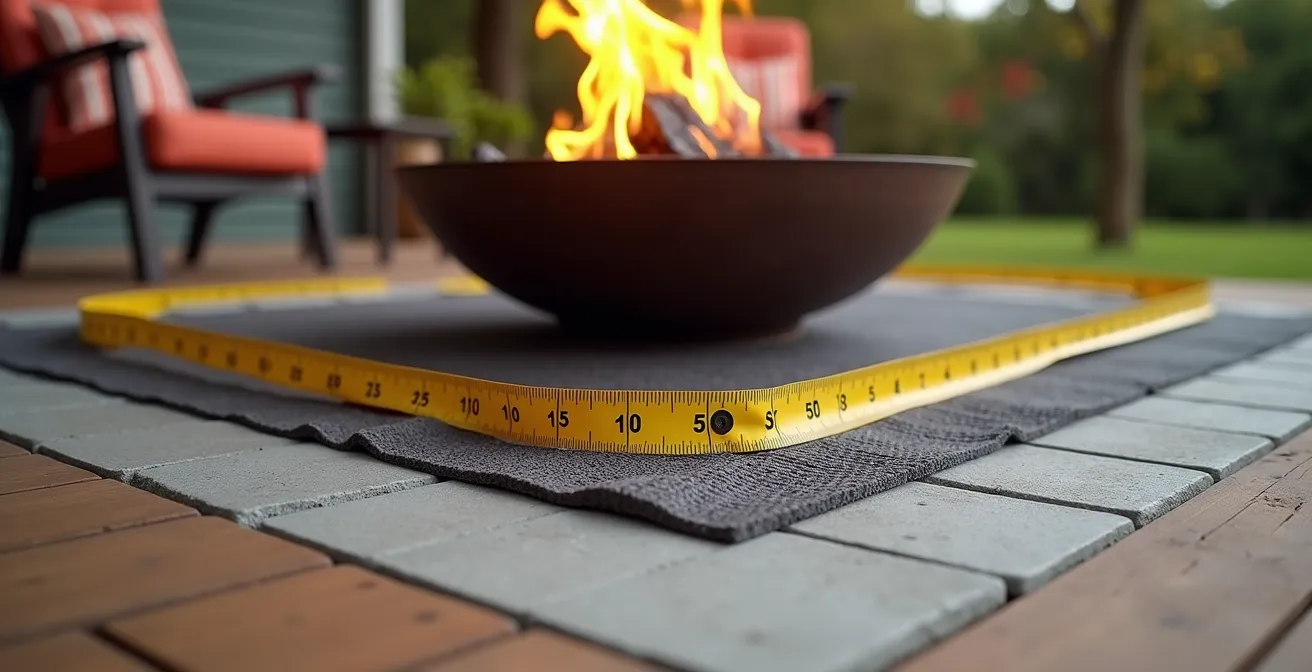
Beyond the base, maintaining safe clearances is non-negotiable. The fire pit should be positioned well away from railings, walls, overhanging structures, and outdoor furniture. Insurance experts also warn that an improperly installed fire pit could potentially void a homeowner’s insurance policy in the event of a fire. It is crucial to document the installation and adhere strictly to the manufacturer’s safety guidelines, as this will be essential evidence for any potential claim.
The table below compares common materials for creating a safe fire pit base on a deck, helping you choose the best option for your budget and needs. A fire-resistant mat is a good starting point, but a multi-layered approach using pavers or a heat shield offers superior protection.
| Material | Heat Protection | Weight | Cost | Aesthetics |
|---|---|---|---|---|
| Fire-Resistant Deck Mat | Excellent | Light | $50-150 | Professional |
| Concrete Pavers | Very Good | Heavy | $30-80 | Rustic |
| Backer Board + Tile | Excellent | Medium | $100-200 | Custom |
| Heat Shield Pad | Superior | Light | $75-200 | Minimal |
Bioethanol vs Propane: Which Offers More Heat Output?
When moving away from wood to a smokeless alternative, a key question arises: can it still provide substantial warmth? The answer depends heavily on the fuel you choose. Bioethanol and propane are the two leading smokeless options, but they serve very different purposes, primarily distinguished by their heat output, measured in British Thermal Units (BTU). Understanding this difference is crucial for matching the fire pit to your expectations.
Propane is the undisputed champion of heat. A standard propane fire pit can generate anywhere from 40,000 to over 150,000 BTU. This is more than enough to provide significant warmth for a group of people, making it a true outdoor heating appliance. It’s the ideal choice if your primary goal is to extend your time outdoors on a chilly evening. The flame is often adjustable, allowing you to control the heat level and fuel consumption. A 20lb propane tank can provide 8-10 hours of burn time, at a relatively low cost per hour.
Bioethanol, on the other hand, is all about ambiance over raw power. While clean-burning and producing a beautiful, lively flame, bioethanol fire pits produce significantly less heat, typically in the range of 20,000-28,000 BTU. This is enough to take the edge off the cold in a small, sheltered space or provide a cosy focal point, but it will not warm a large, open patio area. The fuel is more expensive per hour of use, and a litre of bioethanol may only last for 3-5 hours. Therefore, bioethanol is best suited for smaller balconies, indoor use (in certified units), or where the visual appeal of the flame is more important than its heating capability.
The Lava Rock Danger You Must Check Before Lighting
Switching to a gas fire pit eliminates the risks associated with smoke, but it introduces a different, often overlooked, hazard: exploding lava rocks. This danger is most acute when a fire pit is new or has been exposed to rain. Lava rock is porous by nature, meaning it can absorb and trap significant amounts of moisture. When the fire pit is lit, this trapped water rapidly turns to steam. With nowhere to go, the pressure builds inside the rock until it violently fractures, sending hot, sharp fragments flying out of the fire pit.
This is not a minor issue; these projectiles can cause serious burns or eye injuries. The “popping” sound might seem normal at first, but it can quickly escalate into dangerous explosions. The key to preventing this is ensuring the lava rocks are completely dry before the first use and after any exposure to moisture. This involves a simple but critical “curing” process. If the rocks are new or have been rained on, they should be allowed to air dry in the sun for at least 24-48 hours before lighting the fire pit.
When you do light it for the first time after they’ve been wet, you must start with the flame on the lowest possible setting. Let it burn for at least 30-45 minutes. This gentle heat will slowly evaporate any residual moisture. You may hear some minor crackling, which is normal, but this slow process prevents the violent pressure build-up that causes dangerous explosions. Never turn a new or wet fire pit straight to high heat. Taking the time to properly cure your lava rocks is an essential safety step for any gas fire pit owner.
Your Action Plan: First-Time Gas Fire Pit Commissioning
- Let lava rocks dry in the sun for 24-48 hours before first use to remove trapped moisture.
- Start with the flame on a low setting for 30-45 minutes to gently ‘cure’ the rocks and evaporate any remaining water.
- Perform a soap-and-water leak test on all gas connections to ensure there are no dangerous gas leaks.
- Visually inspect the burner holes to ensure they are free from debris or blockages that could cause uneven flame.
- Ensure the lava rocks do not completely cover the pilot light assembly or gas jets, allowing for proper ignition and gas flow.
When to Stop Burning: Understanding Summer Curfews
Achieving ‘atmospheric responsibility’ extends beyond just following the letter of the law. It involves being considerate of your neighbours, especially during warmer months when windows are likely to be open. While your local council may not have a strict “curfew” for fire pit use, the principles of statutory nuisance still apply. A fire lit late at night, even a smokeless gas one, can still be a source of complaint due to light and noise.
The concept of a curfew is more about social etiquette than a hard-and-fast rule. A common guideline is to extinguish any fire by 11 PM, a time when most people are preparing for sleep. This simple act of consideration can prevent friction with neighbours and ensure your garden feature remains a source of enjoyment, not conflict. As fire safety experts often point out, the legal permission to do something does not always make it the right thing to do.
Even if bylaws permit burning until 11 PM, is it considerate on a warm night when neighbors’ windows are open?
– Fire safety experts, We Love Fire Safety Guidelines
Furthermore, you must be aware of temporary burning restrictions or “burn bans.” These are often implemented during periods of high wind, poor air quality, or drought conditions to reduce the risk of wildfires. While these bans primarily target wood and solid fuel fires, in extreme circumstances, they can be extended to include all open flames, including gas fire pits. It is your responsibility to check with your local fire department or municipal website for the current burn status before lighting any fire.
Why Your Pergola Cannot Be Taller Than 2.5m Near a Boundary
The seemingly unrelated planning rule that restricts the height of a pergola to 2.5 metres when built near a property boundary is rooted in the same legal principle that governs smoke nuisance: preventing one person’s property use from negatively impacting another’s. This principle, known as the “right to quiet enjoyment,” is fundamental to UK property law. A tall structure can block light and be visually imposing, which is considered a form of tangible impact.
Smoke, odour, and even excessive noise are treated as a form of “intangible trespassing.” While you cannot see them in the same way as a large structure, they cross property lines and can significantly diminish a neighbour’s ability to enjoy their own home and garden. The law recognizes that clean air and a peaceful environment are integral parts of a property’s value and the owner’s rights. Therefore, regulations that control building heights and those that control smoke emissions both stem from the same goal: balancing the rights of an individual with the well-being of the surrounding community.
This legal connection underscores why smokeless fire pits are the superior choice in urban environments. A wood fire, by its very nature, emits particulates and odours that will inevitably cross into neighbouring properties. This creates a direct, albeit intangible, imposition. A gas fire pit, on the other hand, keeps its impact (heat and light) almost entirely within your own boundary. In addition to these principles, there are often specific regulations regarding clearance. In the UK, it is generally required to maintain a safe distance from any combustible structure, and while it varies, UK regulations typically require at least 3 metres minimum clearance from fences, sheds, and your house.
Heat Pump vs Gas Boiler: How Loud Is the Outdoor Unit?
While the title references heat pumps and boilers, the underlying question is highly relevant to fire pit owners: how much noise is too much? Noise is another form of intangible trespassing and a common source of neighbourly disputes. When choosing an outdoor appliance, whether it’s a heating unit or a fire pit, its operational sound level is a critical factor for maintaining a peaceful environment. This is where gas fire pits demonstrate another significant advantage over the general commotion of a gathering.
A modern air source heat pump operates at around 40-60 decibels (dB), comparable to moderate rainfall or the hum of a refrigerator. This is generally considered acceptable, but it can be noticeable. A gas fire pit, however, is remarkably quiet, operating at just 20-30 dB—quieter than a whisper. The gentle hiss of the gas is often completely masked by ambient sounds or quiet conversation. Even the natural crackling of a wood fire is slightly louder, at around 25-35 dB.
The real source of noise during an evening in the garden is not the fire pit itself, but the people gathered around it. A normal group conversation typically measures 60-70 dB. This context is vital: a gas fire pit adds virtually no noise pollution to your garden, ensuring the only sounds are those of crackling flames (if it’s wood) or conversation. As one design expert notes, the lack of smoke is the primary driver for choosing gas, but the quiet operation is an implicit benefit.
As landscape design expert Kim Rubert highlights, the primary motivation is often avoiding smoke, but this preference inherently includes avoiding other nuisances.
People do generally prefer gas fire pits near their homes so that they don’t get smoke blowing in the windows and doors
– Kim Rubert, Outback Landscape Design Expert
This table puts the noise levels into perspective, showing that a gas fire pit is the quietest option, significantly less intrusive than even a modern heat pump.
| Source | Decibel Level | Comparable To | Nuisance Risk |
|---|---|---|---|
| Heat Pump | 40-60 dB | Moderate rainfall | Low-Medium |
| Wood Fire Crackling | 25-35 dB | Library conversation | Low |
| Gas Fire Pit | 20-30 dB | Whisper | Very Low |
| Group Conversation | 60-70 dB | Normal TV volume | Medium |
Key Takeaways
- In a UK Smoke Control Area, any smoke from a wood fire pit can be deemed a “statutory nuisance,” leading to fines up to £1,000.
- Gas and bioethanol fire pits are smokeless and therefore the only options that guarantee legal compliance and avoid neighbour complaints about smoke.
- Safety is paramount: always use a multi-layer, non-combustible base on wooden decks and cure wet lava rocks on a low flame to prevent dangerous explosions.
Air Source Heat Pumps: Are They Viable for Older UK Properties?
The UK’s move towards cleaner domestic energy, symbolized by the push for air source heat pumps in older properties, provides a clear signal for the future of garden heating. As national and local governments tighten air quality standards, investing in a clean-burning heat source for your garden is not just a lifestyle choice; it’s a way of future-proofing your property against increasingly strict regulations. The trajectory is clear: what is permissible today may not be tomorrow.
A prime example of this trend is the city of Oxford. From December 2024, the entire city was declared a Smoke Control Area, drastically expanding the previous zone. This change means thousands of homes suddenly face new legal restrictions on using wood burners and open fires. Homeowners who had previously enjoyed a wood fire pit in their garden may now find themselves in breach of the law. This type of regulatory expansion is happening in urban areas across the country as councils prioritize public health.
By choosing a propane or bioethanol fire pit now, you align your garden with this clean-air trajectory. These appliances are unaffected by the rules governing solid fuel and are highly unlikely to be targeted by future legislation. While the initial investment in a professionally installed gas line and fire pit can be significant, it provides long-term peace of mind and adds lasting value to your property. It ensures that your outdoor space remains a compliant, usable, and enjoyable asset for years to come, regardless of tightening air quality standards.
This image captures the essence of a modern, responsible approach: enjoying the ambiance of a fire in a traditional setting without the environmental or social impact of smoke.

Ultimately, selecting a fire pit for an urban UK garden is an exercise in balancing desire with responsibility. By choosing a gas or bioethanol model, you not only comply with the Clean Air Act but also act as a considerate neighbour, ensuring your warmth and comfort don’t come at someone else’s expense. To put these principles into practice, your next step should be to evaluate the specific smokeless options that best fit your space and lifestyle.
Frequently Asked Questions About Wood vs Gas Fire Pits: Which Is Legal in Smoke Control Areas?
Do burn bans apply to gas fire pits?
Usually burn bans only apply to wood and solid fuel fires, but in extreme wildfire risk zones, all open flames including gas fire pits may be restricted.
What triggers temporary burning restrictions?
High winds (ember risk), poor air quality days, drought conditions, and wildfire alerts can all trigger temporary burning restrictions regardless of season.
How can I check current fire restrictions?
Contact your local fire department or check municipal websites for current burn status. Many areas also have air quality apps that indicate restriction days.