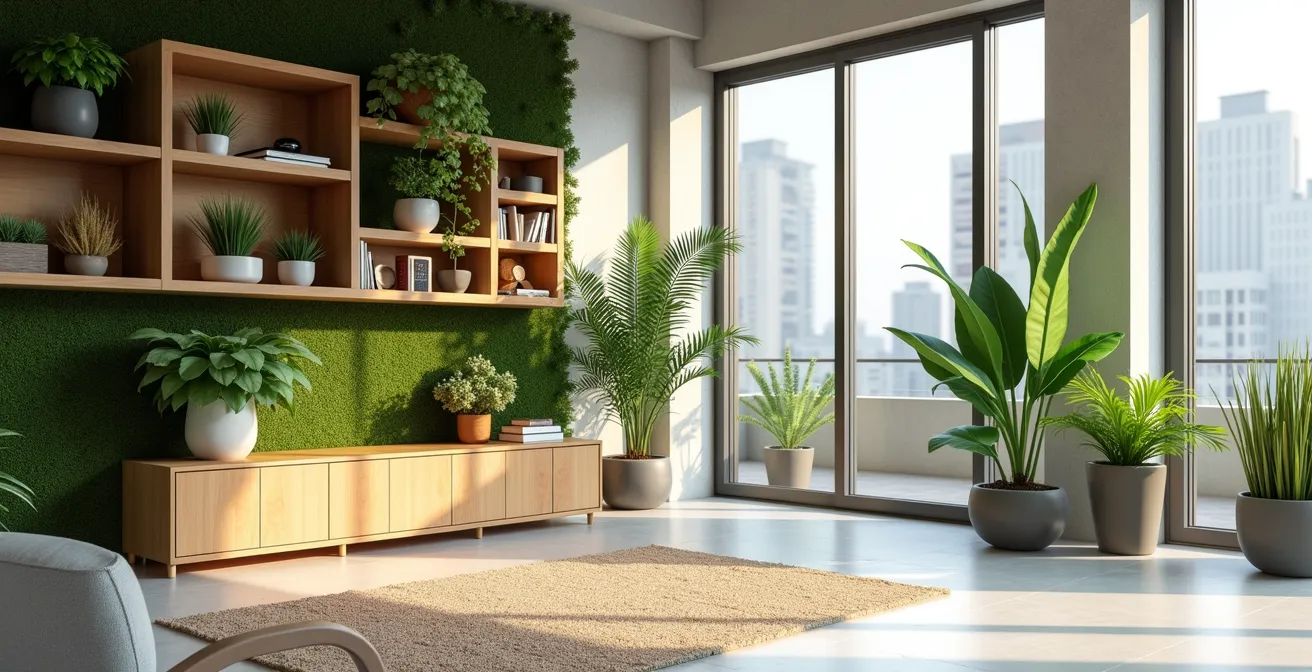
Contrary to popular belief, scattering a few houseplants is not true biophilic design; it’s about re-engineering your apartment into a functional wellness ecosystem to combat urban-induced stress.
- Effective biophilic design involves creating sensory-rich “micro-habitats” that actively regulate your home’s environment and your own physiology.
- The choice of materials—from living walls to textiles and surfaces—is as critical as plants in mitigating the effects of “sick building syndrome.”
Recommendation: Start by transforming one area, like your workspace or bedroom, into a dedicated restorative zone using the scientific principles outlined in this guide.
Living in a high-rise urban apartment can often feel like existing in a sealed box, suspended high above the natural world. The constant hum of the city, the recycled air, and the endless geometry of concrete and glass can leave us feeling profoundly disconnected, a condition contributing to what architects call ‘sick building syndrome’. For many, the default solution is to buy a few potted plants, a token gesture of green in a sterile environment. This is a well-intentioned but fundamentally limited approach.
While adding greenery is a start, it barely scratches the surface of what’s possible. True biophilic design is not a decorative style; it is a scientific discipline. It’s about a deep, systemic integration of natural elements, patterns, and processes into the built environment. But if the real key wasn’t just adding life, but engineering your home to function *like* a living system? What if your apartment could become a responsive, restorative indoor ecosystem that actively supports your mental and physical health?
This guide moves beyond the platitude of “just add plants.” As a wellness architect, I will show you how to apply the core principles of biophilic design to transform your garden-less apartment into a sanctuary. We will explore the science behind why these interventions work, from improving your focus while working from home to enhancing your sleep quality at night. We will cover practical, structural choices, weigh the pros and cons of elements like living walls, and address the critical, often-overlooked risks like water damage. Ultimately, you will learn to think of your home not as a container, but as a living, breathing partner in your well-being.
This article provides a structured path to understanding and implementing these powerful concepts. The following sections break down the essential components, from the psychological benefits of plants to the practicalities of creating a resilient indoor environment.
Summary: A Guide to Your Indoor Ecosystem
- Why Indoor Plants Improve Concentration for Home Workers
- How to Keep Ferns Alive in Central Heated UK Homes
- Living Walls vs Preserved Moss: Which Is Right for Low Maintenance?
- The Water Damage Risk of Indoor Planters on Wooden Floors
- How to Position Snake Plants to Maximize Oxygen at Night
- Why You Must Add Grit to Clay Soil for Mediterranean Plants
- Why Synthetic Blends Exacerbate Eczema in Winter
- How to Adapt Xeriscaping Principles for Wet British Winters?
Why Indoor Plants Improve Concentration for Home Workers
The shift to remote work has confined our professional lives to the same four walls, making sustained focus a significant challenge. The solution, however, may be rooted in our innate connection to nature. According to Attention Restoration Theory, natural environments engage our “soft fascination,” allowing our directed-attention abilities to rest and replenish. A plant’s subtle movements and complex fractal patterns provide just enough gentle stimulation to restore our cognitive resources without actively demanding our focus. This isn’t just theory; it’s a measurable phenomenon. In fact, recent workplace analytics research reveals that remote workers in biophilic environments can achieve 22.75 hours of focus time weekly, a substantial increase compared to the 18.6 hours managed by their office-bound counterparts.
Creating a focus-enhancing workspace is not about turning your desk into a dense jungle. It’s about strategic biophilic interventions. Placing a visually complex plant like a Calathea in your peripheral vision can subconsciously engage your restorative faculties during creative tasks. Conversely, a simple, static plant like a Sansevieria (Snake Plant) is better for analytical work, as it offers a calming presence without visual distraction. The goal is to build an indoor ecosystem that works with your cognitive rhythms. This involves more than passive placement; it requires active engagement through small rituals that create mindful breaks and transition points in your day.
Action Plan: Implementing Biophilic Micro-Breaks
- Position potted plants within your peripheral vision to benefit from ‘soft fascination’ while you work.
- Schedule short, 3-minute plant interaction breaks every 90 minutes to consciously rest your attention.
- Pair visually complex plants, like Calathea or Maranta, with creative tasks to stimulate indirect fascination.
- Use simple, static plants like Sansevieria or ZZ plants during deep, analytical work to minimize distraction.
- Establish plant care rituals, such as misting or pruning, as mindful transitions between different work tasks or at the end of the day.
How to Keep Ferns Alive in Central Heated UK Homes
Ferns, with their lush, ancient fronds, are the quintessential biophilic element, evoking a sense of shaded, damp woodland. Yet, they are notoriously difficult to keep alive in modern, centrally heated homes, especially during UK winters. The primary culprit is low humidity. Central heating systems create an arid environment, drastically different from the moist air ferns thrive in. For most indoor fern varieties, horticultural experts recommend maintaining a minimum of 40-50% humidity to ensure their survival, a level far above that of a typical heated living room.
The key to success is not just watering, but creating a dedicated restorative micro-habitat. This means engineering a small zone with consistently high humidity. Grouping several plants together is a great start, as they release moisture through transpiration, collectively raising the ambient humidity. Placing your fern in a naturally humid room, like a bathroom with a shower, is an even better solution. For other rooms, you can place the pot on a tray filled with pebbles and water. As the water evaporates, it creates a personal cloud of moisture around the fern. For serious fern enthusiasts, a small, quiet ultrasonic humidifier can be a game-changer, ensuring the immediate environment meets the plant’s needs without making the entire room feel damp.
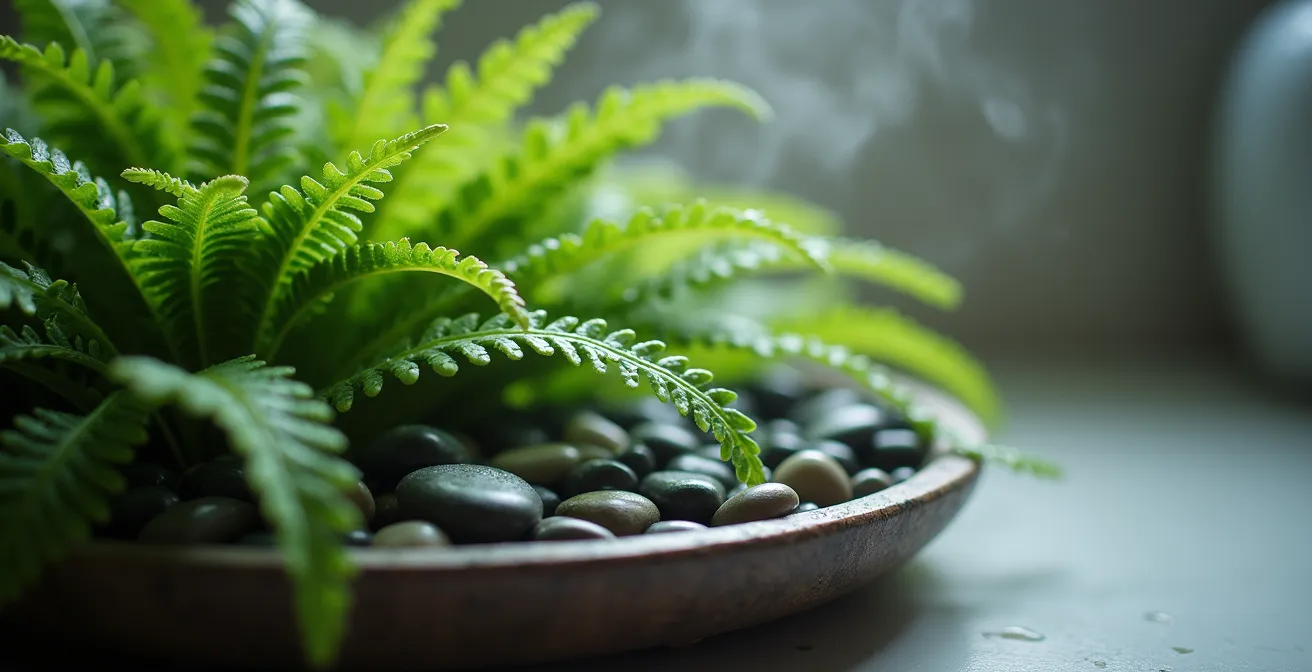
As this image beautifully illustrates, replicating these moist conditions is about focusing on the plant’s immediate surroundings. The visible water droplets on the fronds and the steamy atmosphere are precisely what you aim to create. This is a perfect example of moving beyond simple decoration and actively engineering a small part of your home to sustain a specific form of life, which in turn enhances your own connection to nature. Don’t fight your home’s environment; create a specialised niche within it.
Living Walls vs Preserved Moss: Which Is Right for Low Maintenance?
For those looking to make a significant biophilic statement, vertical gardens are a powerful option. The two main contenders are living walls and preserved moss walls, and while they may appear similar, they represent entirely different philosophies of maintenance and functionality. A living wall is a true indoor ecosystem: a vertical plane of living plants requiring complex irrigation, specific lighting, and regular horticultural maintenance. While visually stunning and excellent for air quality, their demands are high. They are a commitment, a living entity that depends on you.
Preserved moss walls, on the other hand, offer a compelling low-maintenance alternative. The moss is real but has been sustainably harvested and preserved through a non-toxic process, rendering it dormant. It requires no soil, no water, and no light, yet it retains its vibrant colour and soft texture for years. This makes it ideal for urban apartments where complex installations are impractical. Beyond aesthetics, moss walls offer a significant and often-overlooked benefit: sensory restoration through sound absorption. Research from the University of The Basque Country demonstrates a remarkable 15dB sound reduction with a 0.40 absorption coefficient, helping to dampen the ambient noise of city life and create a calmer indoor atmosphere.
When considering the total cost of ownership, the difference becomes even more stark. The initial outlay for a moss wall is often significantly lower, but the real savings are in the complete absence of ongoing maintenance costs, as detailed in the comparison below.
| Factor | Living Wall | Preserved Moss Wall |
|---|---|---|
| Initial Installation | £150-300 per sq ft | £90-180 per sq ft (40% less) |
| Annual Maintenance | £2000-4000 | £0 |
| Water/Irrigation System | Required | None needed |
| Lifespan | 3-5 years with care | 8-10 years |
| Weight per sq ft | 10-12 lbs | 2-3 lbs |
This data from a comparative analysis by industry specialists makes the choice clear for the time-poor urban dweller. A living wall is a pet; a preserved moss wall is a piece of maintenance-free art that quietly improves your acoustic environment. For most apartment settings, the preserved moss wall is the superior choice for achieving a high-impact biophilic look without the associated labour and risk.
The Water Damage Risk of Indoor Planters on Wooden Floors
While we focus on the life-giving properties of bringing plants indoors, it’s crucial to address the life-taking potential of water damage, especially in apartments with wooden floors or neighbors below. A slow, unnoticed leak from a planter can lead to catastrophic consequences: warped floorboards, black mould proliferation, and costly structural repairs to your ceiling or the one below you. The risk is not just from overwatering; it comes from condensation, hairline cracks in ceramic pots, or simply the porous nature of materials like terracotta. Ignoring this is not an option in a multi-story building where your floor is someone else’s ceiling.
Preventing this requires a multi-layered defence strategy. The first and most simple rule is to never place a pot directly on a wooden floor, carpet, or other sensitive surface. Even if the pot has a saucer, condensation can form underneath it. Always use a waterproof barrier. High-quality, non-porous cachepots (a decorative outer pot with no drainage hole) are an excellent solution; you simply place your nursery pot inside and remove it for watering. For larger pots, clear plastic drip trays are a must-have. They should be slightly larger than the pot’s base to catch any overflow and allow you to visually inspect for standing water.
Another effective technique is to elevate your planters. Using small feet or dedicated plant stands not only improves air circulation around the base of the pot, reducing the risk of rot, but it also allows you to see underneath, making it easy to spot moisture before it becomes a problem. Think of it as part of engineering your indoor ecosystem: you must manage the flow of water with the same care you’d give to an outdoor irrigation system. This practical diligence is the foundation upon which all the aesthetic and wellness benefits of indoor planting are built.
How to Position Snake Plants to Maximize Oxygen at Night
The Snake Plant (Sansevieria trifasciata) is often lauded as the perfect bedroom plant, and for a compelling scientific reason that goes far beyond its minimalist aesthetic. While most plants perform photosynthesis during the day—taking in carbon dioxide (CO2) and releasing oxygen (O2)—the Snake Plant operates on a different schedule. It utilizes a special process called Crassulacean Acid Metabolism (CAM). This adaptation, common in arid-climate plants, allows it to keep its stomata (leaf pores) closed during the hot day to conserve water. Then, in the cool of the night, it opens them to absorb CO2 and release the oxygen it stored from the day’s light cycle.
This nocturnal oxygen release makes the Snake Plant a powerful tool for improving bedroom air quality and supporting a healthy sleep environment. While a single plant won’t dramatically alter the oxygen percentage in a room, its process contributes to a more stable and cleaner air profile throughout the night, subtly enhancing your body’s rest and repair cycles. This is a prime example of physiological regulation through biophilic design, where a specific plant is chosen for its functional output, not just its form. It is an active component of your bedroom’s wellness machinery.
To maximize this benefit, placement is key. Position one or two Snake Plants relatively close to your bed, such as on a bedside table or a dresser nearby. This ensures the air you are breathing most directly is the air being enriched by the plant’s nocturnal activity. Given their tolerance for low light, they are perfectly suited to the typically dimmer conditions of a bedroom. By integrating a CAM plant into your sleeping quarters, you are creating a small, self-regulating biome that works in sync with your own circadian rhythms, a perfect synergy of nature and nurture for the urban dweller.
Why You Must Add Grit to Clay Soil for Mediterranean Plants
In outdoor gardening, a fundamental rule for growing Mediterranean plants like lavender or rosemary in heavy, wet soil is to amend it with grit. Clay soil holds too much water, and without the sharp drainage provided by grit, the roots of these sun-loving plants will rot. This principle serves as a powerful metaphor for creating a successful biophilic environment inside an urban apartment: you must first create the right “indoor terroir”. Simply placing a plant in a pot is like planting lavender in pure clay; failure is almost guaranteed if the foundational conditions are wrong.
Your apartment is an artificial environment. The light is often directional and limited, the air can be dry, and the temperature is unnaturally stable. Just as a gardener adds grit to soil, you must actively amend your indoor space. For a plant that needs bright, indirect light, this might mean positioning it near a north-facing window or supplementing with a grow light. For a tropical that craves humidity, it means creating the “micro-habitat” we discussed with ferns. For a succulent, it means using a gritty, fast-draining soil mix that mimics its native desert environment, not standard potting compost.
This concept of preparing the foundation is the most overlooked aspect of indoor gardening. We are often seduced by the look of a plant in the store, but we fail to assess if our home’s “soil”—its light, humidity, and temperature profile—is suitable. A successful indoor ecosystem isn’t about collecting plants; it’s about curating a collection of plants that are compatible with the specific terroir you can realistically create and maintain. Before bringing a new plant home, first assess your environment, and be prepared to amend it or choose a plant that is already adapted to it.
Why Synthetic Blends Exacerbate Eczema in Winter
This title, seemingly about dermatology and fashion, offers another critical metaphor for our indoor ecosystem. Synthetic fabrics like polyester and acrylic are known to trap heat and moisture against the skin, preventing it from breathing and often exacerbating conditions like eczema. Our skin, the body’s largest organ, reacts negatively to this synthetic, non-breathable environment. Now, scale this concept up to your entire home. Your apartment, when filled with synthetic materials, effectively becomes a giant, non-breathable container that can trigger or worsen the symptoms of “sick building syndrome.”
Many modern furnishings, paints, and flooring are loaded with volatile organic compounds (VOCs). Pressed-wood furniture, synthetic carpets, and standard paints can off-gas chemicals like formaldehyde into your enclosed air space. Just as a polyester sweater irritates your skin, these airborne chemicals “irritate” your respiratory and nervous systems, leading to headaches, fatigue, and dizziness. This is the architectural equivalent of eczema—an inflammatory response to an incompatible environment. A core tenet of wellness architecture is to specify materials that allow the building, and its inhabitants, to “breathe”.
The antidote is to choose natural, “breathable” materials for your home’s surfaces and textiles, extending the biophilic philosophy beyond just plants. Opt for solid wood furniture over particleboard. Choose paints labelled as low-VOC or zero-VOC. When selecting textiles for sofas, curtains, and bedding, prioritize natural fibres like cotton, linen, wool, and silk. These materials don’t just feel better to the touch; they contribute to a healthier indoor air profile, working in harmony with the air-purifying qualities of your plants to create a truly clean and restorative indoor ecosystem.
Key Takeaways
- True biophilic design is a scientific system for wellness, not just a decorative style.
- Create “micro-habitats” with specific conditions (e.g., humidity for ferns) rather than trying to change your entire apartment.
- Material choice is critical: preserved moss offers a high-impact, low-maintenance, and acoustically beneficial alternative to living walls.
How to Adapt Xeriscaping Principles for Wet British Winters?
Xeriscaping is a landscaping philosophy focused on water conservation, creating resilient gardens that thrive with minimal irrigation, even in dry climates. Applying this to a wet climate seems counter-intuitive, but the core principle is not just about using less water; it’s about creating a resilient, low-maintenance system that is perfectly adapted to its environment. This is the ultimate goal for our indoor ecosystem. We don’t want to create a fragile, high-maintenance jungle that becomes a source of stress; we want a self-regulating sanctuary that thrives with minimal, intelligent intervention.
Adapting xeriscaping indoors means choosing plants that are “drought-tolerant” of our attention. This is where species like the ZZ plant (Zamioculcas zamiifolia), the Snake Plant (Sansevieria), and various succulents excel. These plants are adapted to survive periods of neglect. They embody the xeriscape principle of “right plant, right place.” Secondly, it means efficient resource management. This includes grouping plants with similar water needs together, using well-draining soil to prevent root rot (the indoor equivalent of a flood), and maximizing natural light to reduce the need for artificial supplements. It’s about creating a system that works smarter, not harder.
This approach transforms the idea of plant care from a constant chore into a series of thoughtful, periodic interventions. It builds resilience into your indoor ecosystem, ensuring it can withstand a busy week or a holiday without collapsing. By applying these principles, you create a space that not only provides the restorative benefits of nature but does so in a sustainable, low-stress way that is perfectly suited to the demands of modern urban life. Your home becomes a true sanctuary, a place that nurtures you without demanding constant nurturing in return.
Start by choosing one room—your home office or bedroom—and commit to transforming it into a high-performance biophilic zone. Assess its “terroir,” select the right plants and materials, and begin engineering an environment that actively supports your well-being.