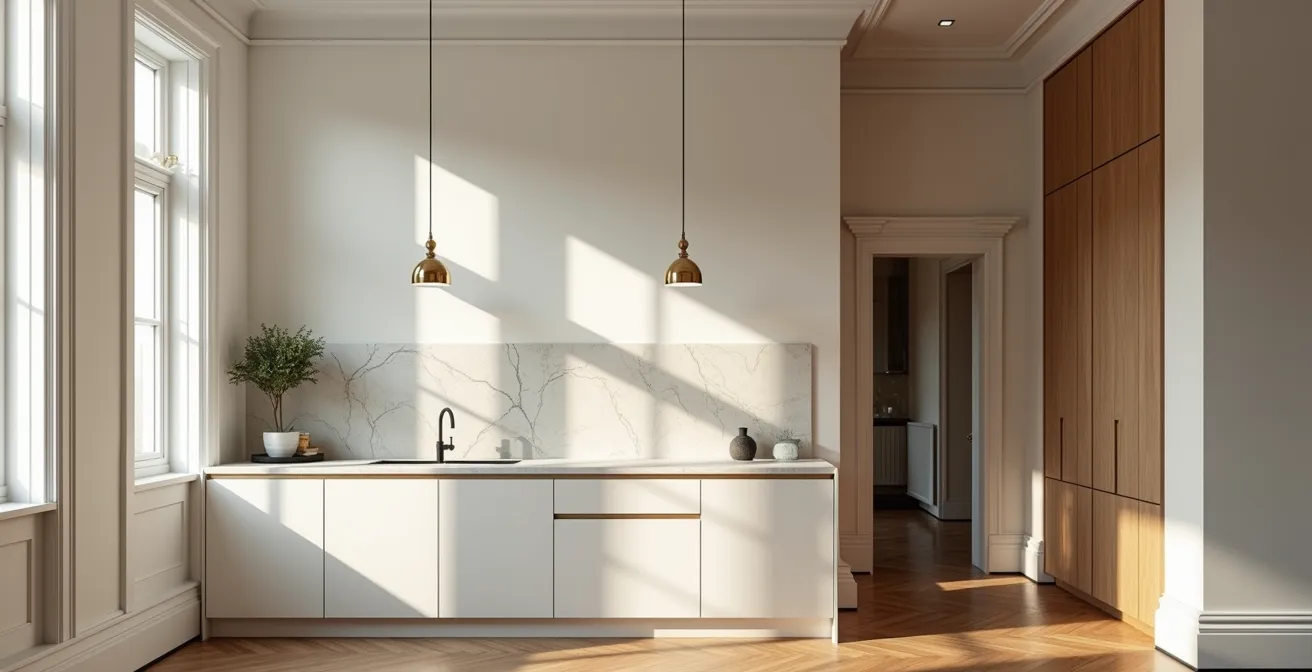
In the London market, the highest return on investment comes not from spending the most, but from spending the smartest on details that signal uncompromising quality.
- “Touchpoint” elements like taps and handles have a disproportionate impact on a buyer’s perception of value.
- For core surfaces, engineered durability (like Quartz) almost always provides a better ROI than high-maintenance aspirational materials (like Marble).
- Clever architectural details and smart storage hacks create the illusion of a bespoke build for a fraction of the cost, directly adding to the bottom line.
Recommendation: Focus your budget on the specific, high-impact finishes detailed in this guide to create a cohesive narrative of luxury that justifies a premium price tag.
In the cut-throat London property market, every renovation decision is an investment. Homeowners and investors alike face the same critical question: where should I spend my money to see a tangible return? The common advice to simply “update the kitchen and bathroom” is dangerously vague. It leads to misallocated capital on finishes that look good on Instagram but fail to impress discerning buyers who can spot a cheap compromise from a mile away. Many renovations chase trends, installing features that date quickly or require impractical levels of upkeep, ultimately detracting from the property’s value at resale.
The truth is, adding real, bankable value isn’t about gutting every room. It’s about a far more surgical approach. The key lies in understanding the psychology of the high-end buyer and focusing on the specific “touchpoints” and architectural details that create an overwhelming perception of quality and permanence. These are the elements that buyers interact with, see up close, and use to judge the overall standard of the property. They are the subtle signals that differentiate a standard refurbishment from a premium, thoughtfully designed home.
Forget generic advice. This guide is your commercial playbook. We will move beyond the obvious and dissect eight specific, high-leverage finishes that deliver a measurable Return on Detail (RoD). From the weight of a tap to the shadow line of a skirting board, you will learn which choices truly resonate with the London market and how to execute them for maximum financial impact, ensuring every pound spent is a strategic move towards a higher valuation.
This article provides a detailed breakdown of the finishes that matter. Explore the summary below to navigate directly to the insights most relevant to your project.
Summary: Which High-End Finishes Actually Add Value to a London Flat?
- Why Cheap Taps Can Sabotage the Perception of a Luxury Bathroom
- How to Install Shadow Gap Skirting for a Contemporary Finish
- Quartz vs Marble Worktops: Which Offers the Best ROI?
- The Maintenance Error That Ruins Unlacquered Brass Within Months
- How to Fake High-End Joinery with IKEA Hacks and Custom Fronts
- Why a Knoll Barcelona Chair Costs £6,000 More Than a Replica
- How to Hide the Walk-In Wardrobe Behind the Headboard
- Investing in Icons: Which Designer Chairs Hold Their Value Best?
Why Cheap Taps Can Sabotage the Perception of a Luxury Bathroom
In a city where prime property can command upwards of £1,441 per square foot, the concept of “touchpoint value” becomes paramount. Buyers are not just purchasing space; they are buying a feeling of quality. Taps, handles, and switches are the primary physical interactions a person has with a property. A lightweight, poorly finished tap provides immediate, negative tactile feedback. It screams “corner-cutting” and instantly undermines the thousands of pounds spent on expensive tiles and sanitaryware. It suggests that if the most visible details are cheap, hidden problems are likely lurking elsewhere.
This psychological impact is far greater than the few hundred pounds saved. A high-end bathroom renovation can significantly boost property value, but only if the execution is flawless. The choice of fixtures is a critical signal of that execution. Opting for a brand known for its engineering and solid brass construction—think Dornbracht, Vola, or Barber Wilsons & Co.—sends a powerful message. The substantial weight, the smooth mechanism, and the durable finish communicate longevity and a no-compromise approach. This is not about ostentatious design, but about the reassuring feeling of quality engineering.
While a full kitchen remodel can add up to 10% to a property’s value, the principle of using timeless, durable materials applies equally to bathrooms. Investing an extra £500-£1,000 on premium tapware in a £15,000 bathroom renovation is the most effective money you can spend. It protects the entire investment by ensuring the first and most frequent impression is one of unquestionable quality. In the mind of a buyer, a solid tap equals a solid investment.
How to Install Shadow Gap Skirting for a Contemporary Finish
Standard skirting boards are a visual interruption, a necessary but often clunky transition between wall and floor. A shadow gap skirting, however, is a sophisticated architectural detail that creates a clean, minimalist aesthetic. It makes the wall appear to “float” just above the floor, creating a crisp, dark line that speaks of precision and contemporary design. In a market saturated with generic refurbishments, this detail is a powerful differentiator that signals a designer-led approach and superior build quality. It’s a detail that architects and high-end developers use consistently, and savvy buyers recognise it instantly.
The visual effect is subtle but profound. It elongates walls, enhances the sense of space, and provides a sharp, clean finish that complements modern interiors, particularly those with hard flooring like timber or polished concrete. Unlike traditional skirting, which can look dated, the shadow gap is timelessly modern. Achieving this look requires precision during the construction phase, as any imperfection in the wall’s straightness or the floor’s level is immediately highlighted. Therefore, its successful execution is a direct testament to the quality of the craftsmanship throughout the property.
This detail is more than just an aesthetic choice; it’s a statement of intent. It tells a potential buyer that the renovation was not a superficial refresh but a considered, architectural upgrade.
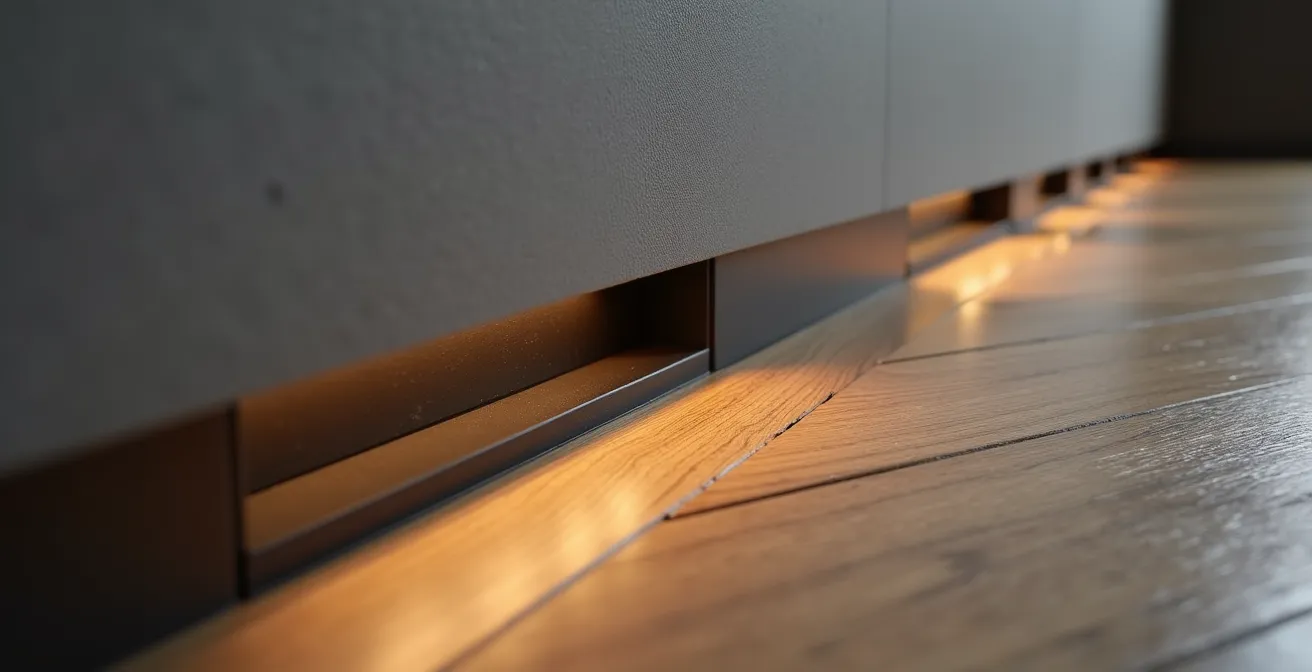
As the image demonstrates, the precision required is absolute. The crispness of the shadow line is what delivers the high-end feel. Integrating this feature is not a simple DIY task; it requires skilled tradespeople, which is precisely why it carries such a high perceived value. It’s a small detail that makes a huge statement about the overall quality of the build, justifying a higher asking price.
Action Plan: Checklist for a Flawless Shadow Gap Installation
- Ensure perfect wall and floor alignment: The first step is to guarantee the surfaces are perfectly level and straight, as the gap will expose any and all imperfections.
- Incorporate acoustic separation: Use appropriate materials between the floor and wall within the gap to reduce noise transmission, a critical feature in London flats.
- Consider integrated lighting: For a truly high-end ‘floating wall’ effect, plan for the integration of a discreet LED strip light within the recessed gap.
- Maintain consistent gap width: A consistent gap of 10-15mm is crucial for the optimal visual impact; use spacers during installation to guarantee uniformity.
- Use proper backing and joints: Install proper backing boards and allow for expansion joints to prevent the plaster from cracking due to natural building movement over time.
Quartz vs Marble Worktops: Which Offers the Best ROI?
The worktop is the centrepiece of any modern kitchen. The choice of material is one of the most significant decisions in a renovation, with a direct impact on both budget and buyer appeal. The classic debate pits the natural, aspirational beauty of marble against the engineered durability of quartz. For a property investor in London, the answer is almost always Quartz for superior ROI. While a stunning, bookmatched slab of Calacatta marble can be a showstopper in a super-prime property, its practical drawbacks make it a risky bet in most scenarios.
Marble is porous, prone to staining from coffee or red wine, and susceptible to etching from acidic liquids like lemon juice. More critically for London, the city’s hard water leaves chalky limescale deposits that are highly visible and difficult to clean on natural stone. This high-maintenance nature is a major red flag for many buyers and a nightmare for landlords. Quartz, on the other hand, is a non-porous, engineered stone that is highly resistant to stains, scratches, and the effects of hard water. It offers the aesthetic of natural stone without the associated upkeep, a combination that is commercially unbeatable. As leading experts advise, the smart money is on practical elegance.
Timeless Materials: Opt for durable materials like quartz countertops, hardwood flooring, and shaker-style cabinets
– Beau Property Staging, 15 High-ROI Home Improvements Report 2024
The financial case for quartz is compelling. While marble carries a higher initial cost and a lower typical ROI, quartz delivers a stronger return precisely because it meets the modern buyer’s desire for a premium look combined with everyday practicality. This is especially true for family flats or rental investments where durability is a primary concern. The following table breaks down the key decision-making factors for the London market.
| Feature | Quartz Worktops | Marble Worktops | Impact on London Property Value |
|---|---|---|---|
| Initial Cost | £300-500 per sq m | £400-800 per sq m | Both premium options signal quality |
| Maintenance Requirements | Low – non-porous, stain resistant | High – requires regular sealing | Critical for rental properties |
| Durability | Excellent – resistant to chips and scratches | Good – susceptible to etching from acids | Important for family flats |
| London Hard Water Impact | Minimal – easy to clean limescale | Significant – shows water marks | Major consideration for resale |
| ROI Potential | 65-75% return | 55-65% return (80%+ for bookmatched slabs) | Depends on target market segment |
| Best Application | Family homes, rental properties | Super-prime properties, statement pieces | Match to property positioning |
The Maintenance Error That Ruins Unlacquered Brass Within Months
Unlacquered brass is a “living finish” that has become a hallmark of high-end, bespoke interiors. Unlike standard lacquered or PVD-coated brass, it is designed to age and develop a unique patina over time, telling the story of the home. When executed correctly, it imparts a sense of warmth, character, and timeless authenticity that commodity finishes cannot replicate. However, its value is entirely dependent on its maintenance. Indeed, studies show that well-maintained fixtures and finishes can deliver up to a 63% ROI, but the inverse is also true: poorly maintained ones can actively devalue a property.
The single most common and destructive error is treating unlacquered brass like standard brass. Owners or, more often, their cleaners, reach for a common polish like Brasso. This is a catastrophic mistake. These harsh chemical cleaners are designed to strip away tarnish and restore a uniform, high shine. On a living finish, this action completely strips away the developing patina, leaving a raw, blotchy, and uneven surface. Repeated use ruins the intended effect, making an expensive, characterful feature look like a cheap, damaged fitting. Within months, an investment piece can be turned into a liability.
The correct approach is about controlled ageing, not aggressive cleaning. The patina should be allowed to develop naturally. For those who prefer a more controlled look, a quarterly application of a micro-crystalline wax (like Renaissance Wax) protects the surface and slows the patination process. For cleaning, only gentle, non-abrasive methods should be used. This material choice is a strategic one: it is perfect for an owner-occupied character property in Notting Hill, but potentially problematic for a high-turnover rental in Canary Wharf unless the tenants are properly educated. Framing it correctly in property descriptions as a “living finish that tells your home’s story” is key to realising its value.
Your Action Plan: Protecting Your Unlacquered Brass Investment
- Ban harsh chemicals: The number one rule is to never use Brasso or other abrasive polishes, as these will completely strip the developing patina and damage the surface.
- Apply wax for control: For a more controlled ageing process, apply a thin layer of Renaissance Wax every three to four months to protect the surface and even out the patina.
- Use gentle cleaning methods: For routine cleaning, use only a soft cloth with mild soap and water. For a deeper clean, a paste of lemon juice and bicarbonate of soda can be used gently.
- Educate all users: In rental properties, provide clear, written instructions to tenants and cleaners on the correct care to prevent accidental damage.
- Match finish to property type: Deploy this finish strategically. It’s ideal for homes where the owner appreciates character (e.g., Notting Hill townhouses) but can be a risk in high-turnover rentals (e.g., Canary Wharf).
How to Fake High-End Joinery with IKEA Hacks and Custom Fronts
Bespoke, floor-to-ceiling joinery is a cornerstone of luxury interiors, offering seamless storage that makes a space feel larger and more organised. However, its cost can be prohibitive, often running into tens of thousands of pounds. This is where the strategic “IKEA hack” comes in. By using affordable IKEA PAX wardrobe or METOD kitchen carcasses as a base and upgrading key visible elements, you can create the “built-in illusion” for a fraction of the price. This approach offers one of the highest returns on investment, as storage is a top priority for UK buyers, directly impacting perceived value. A smart renovation can see a UK home renovation’s average ROI reach 70%, and clever storage is a huge part of that.
The success of this strategy hinges on focusing the budget on the parts you see and touch. There are three key upgrades that transform a flat-pack shell into a high-end feature. First, custom fronts from companies like Semihandmade or Superfront offer a vast range of styles and finishes, from classic Shaker to minimalist flat panels. Second, premium handles and knobs from brands like Buster + Punch or Armac Martin provide the necessary weight and tactile quality. A £50 handle on a £100 door feels infinitely more expensive than a £2 handle. Third, using professional joinery techniques to add filler pieces, plinths, and cornices between the carcasses and the walls, floor, and ceiling is what creates the true, seamless built-in look.
The final touch is to top the units with a high-quality surface. For a run of low cabinets, a single, continuous piece of real stone or solid wood can tie the entire assembly together, making it indistinguishable from a bespoke piece costing five times as much. By investing in these specific, high-impact upgrades, you are essentially dressing a cost-effective structure in a luxury outfit. Buyers respond to the finished look and the practicality of abundant, well-organised storage, making it one of the most effective value-add strategies in a renovator’s toolkit.
Why a Knoll Barcelona Chair Costs £6,000 More Than a Replica
In the staging of a high-end London flat, furniture acts as a powerful signifier. An authentic, licensed piece of iconic design, such as a Knoll Barcelona Chair, is not merely a place to sit; it’s an “Authenticity Signal.” Its presence communicates a commitment to quality, design heritage, and investment that a cheap replica simply cannot. While a replica might mimic the shape, it lacks the soul, the correct proportions, the superior materials, and the flawless craftsmanship of the original. Discerning buyers, consciously or not, can spot the difference. A convincing fake is still a fake, and its presence can subtly undermine the perceived value of the entire property.
The £6,000 price difference between an authentic Knoll piece and a replica is not just for a brand name. It is for the meticulous craftsmanship: the single-piece chrome frame, hand-ground and hand-buffed to a mirror finish; the 17 individual straps of cowhide upholstery; the 40 individual panels of leather, hand-welted and hand-tufted. This level of detail is an investment in art as much as furniture. When a potential buyer sees an authentic Barcelona Chair, an Eames Lounge Chair, or an Arco Floor Lamp, it sets a precedent. It suggests that the same attention to detail and investment in quality has been applied to the less visible aspects of the property, from the plumbing to the wiring.
Properties featuring desirable, high-quality furnishings are inherently more marketable. They create an aspirational lifestyle that buyers want to step into. While you don’t need to furnish an entire flat with design icons, placing one or two statement pieces in key areas—a living room or a master bedroom—acts as a powerful anchor for the property’s luxury narrative.
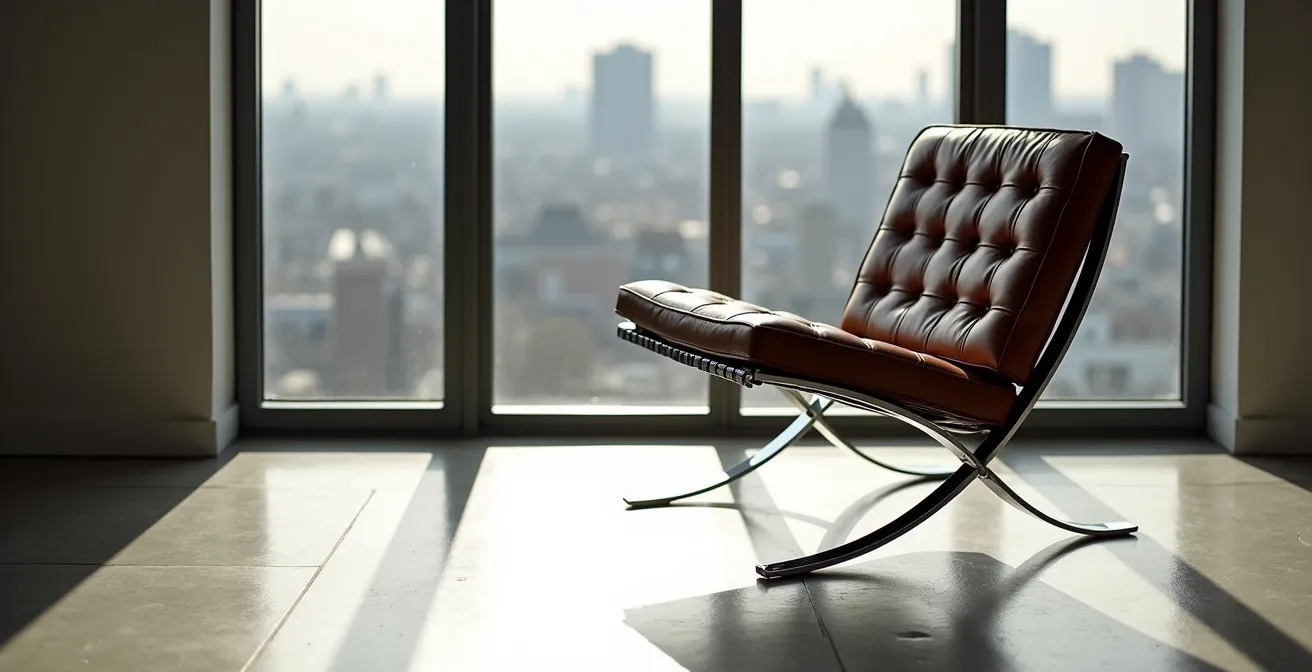
As this image conveys, the chair is more than furniture; it is a sculptural object that elevates the entire space. It holds its own as a piece of art. This is a value that replicas, with their often clumsy proportions and inferior materials, can never achieve. Investing in an authentic icon is an investment in the property’s story, a signal of quality that resonates deeply with the target market and helps secure a premium valuation.
How to Hide the Walk-In Wardrobe Behind the Headboard
In a city where residential space can cost an average of £7,700 per square meter, every inch must be maximised. One of the most innovative and value-adding layouts for a London bedroom, particularly in long, narrow Victorian conversions, is the “hidden” walk-in wardrobe. This design places a new stud wall a few feet from the end of the room, creating a discreet dressing area or wardrobe space behind the bed’s headboard. This isn’t just about adding storage; it’s about creating distinct functional zones without sacrificing the feeling of openness.
This layout, inspired by boutique hotel design, solves multiple problems at once. It provides a natural and elegant location for the bed, creating a focal point. More importantly, it transforms what is often an awkward, under-utilised area at the end of a long room into a highly desirable feature: a walk-in wardrobe. This is a feature with a very high perceived value among buyers. By creating a partition wall that also serves as the headboard wall, you achieve a sense of separation and luxury without the need for traditional doors, maintaining an open flow.
The benefits are both practical and psychological. This design offers excellent acoustic separation, meaning one partner can be in the wardrobe getting ready without disturbing another who is still sleeping. It also allows for different lighting zones; the main bedroom can have soft, ambient lighting, while the wardrobe area can have bright, functional task lighting. This intelligent use of space to create a more functional, luxurious, and organised living environment is exactly what commands a premium in the dense urban landscape of London. It demonstrates a sophisticated understanding of modern living that goes far beyond a simple cosmetic update.
Key Takeaways
- Focus on Touchpoint Value: The perceived quality of a property is disproportionately influenced by items buyers physically interact with, like taps, handles, and light switches.
- Prioritise Durability for ROI: In most London properties, hard-wearing, low-maintenance materials like quartz offer a more reliable return on investment than aspirational but fragile materials like marble.
- Authenticity is a Signal: An authentic piece of designer furniture acts as a powerful statement of quality that elevates the entire property, an effect a replica cannot achieve.
Investing in Icons: Which Designer Chairs Hold Their Value Best?
We’ve established that an authentic piece of designer furniture can act as a powerful “Authenticity Signal,” elevating the perceived value of a property. But from a purely commercial standpoint, not all icons are created equal. For a property investor or a homeowner focused on resale, the ideal piece is not just a status symbol but also a tangible asset that holds, or even increases, its value over time. Certain chairs and lighting from specific designers and manufacturers have a proven track record as blue-chip investments, much like a piece of fine art.
Manufacturers like Herman Miller, Knoll, Vitra, and Carl Hansen & Søn are custodians of these classic designs. Their commitment to using the original specifications and highest quality materials ensures their products are built to last for generations. This longevity, combined with timeless design and brand prestige, creates a robust secondary market. An Eames Lounge Chair, for example, is famous for retaining 85-95% of its value over five years, and vintage models often sell for more than new ones. This makes it more than just staging; it’s a liquid asset that can be sold with the property or separately.
Choosing the right piece depends on the property’s style and target demographic. An Eames Lounge Chair speaks to a professional, established buyer and fits perfectly in a home office or a City flat. The lighter, Scandinavian aesthetic of a Wegner Wishbone chair is ideal for dining areas targeting younger, design-conscious professionals. The key is to select a piece that is instantly recognisable, has a strong value retention history, and complements the architectural style of the property. This strategic investment underpins the entire narrative of luxury and quality you are building.
The following table provides a clear investment guide to some of the most reliable designer pieces for the London market, analysing their value retention and best application.
| Designer/Model | New Price Range | 5-Year Value Retention | Best for London Property Type |
|---|---|---|---|
| Eames Lounge (Herman Miller) | £5,000-7,000 | 85-95% | Professional flats, home offices |
| Wegner Wishbone (Carl Hansen) | £600-900 | 70-80% | Dining areas, Scandinavian aesthetic |
| Prouvé Standard (Vitra) | £500-700 | 75-85% | Modern developments, young professionals |
| Barcelona Chair (Knoll) | £6,000-8,000 | 80-90% | Reception areas, master bedrooms |
| Artichoke Lamp (Louis Poulsen) | £6,000-9,000 | 90-100% | Statement lighting, dining rooms |
Ultimately, maximising your property’s value is a game of calculated decisions. By moving beyond generic advice and focusing on these specific, high-leverage finishes, you create a compelling narrative of quality that discerning buyers are willing to pay a premium for. Apply this detail-oriented mindset to your next project to ensure every pound spent is a strategic investment in your property’s final valuation.