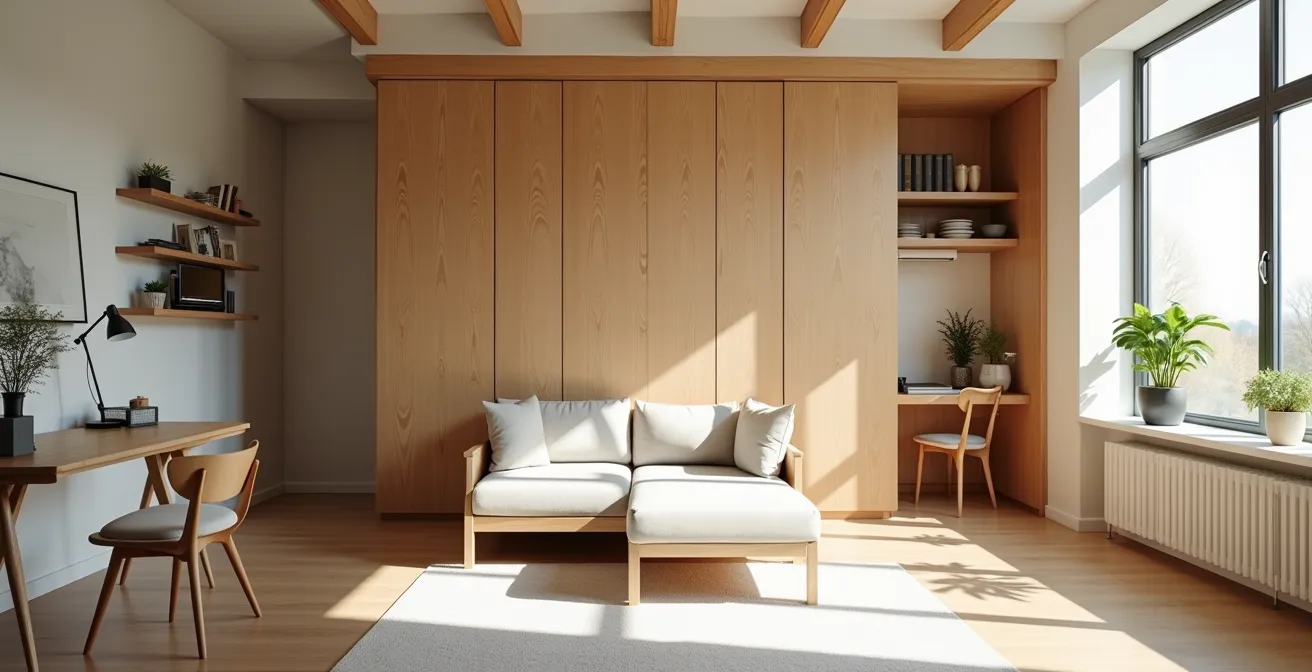
The right smart furniture isn’t just about saving space; it’s a financial and engineering investment that unlocks tangible value in your home.
- A high-quality wall bed can add thousands to your property’s functional value by creating a dual-purpose room.
- The long-term cost of renting furniture often surpasses the purchase price after just 18-24 months, offering zero equity.
Recommendation: Prioritise items with proven mechanical integrity and a clear financial break-even point for your specific living situation.
Living in a studio flat under 40 square metres, especially in cities like London or Manchester, is an exercise in ruthless optimisation. Every square inch counts, and the conventional advice often falls short. You’ve heard it all before: buy a folding table, use mirrors, choose light colours. While not incorrect, this advice barely scratches the surface of true spatial efficiency. It treats the problem as one of perception, not of mechanics and utility. The real challenge isn’t making your space *feel* bigger; it’s making it *work* harder.
This is where the conversation must shift. We need to move beyond simple space-saving tips and into the realm of high-performance design and spatial economics. The key isn’t just finding furniture that folds away, but investing in engineered solutions that fundamentally transform a room’s function. It’s about understanding the financial return on investment of a wall bed, the load-bearing physics of installing shelving on plasterboard, and the critical difference between a piston and a spring mechanism. It’s about thinking like an engineer, not just a decorator.
This guide abandons the platitudes and dives into the mechanics, safety, and financial analytics of smart furniture. We will dissect the engineering that makes these pieces possible, evaluate their long-term value, and equip you with the knowledge to make informed decisions. By treating your limited square footage as a valuable asset to be maximised, you can create a home that is not just livable, but exceptionally functional.
To navigate these crucial decisions, this article breaks down the essential considerations, from the financial implications of specific furniture pieces to the practicalities of installation and long-term ownership. Explore the topics below to master the art of compact living.
Summary: The Expert’s Guide to High-Utility Furniture
- Why a Wall Bed Can Save You £10,000 in Property Value
- How to Secure Heavy Modular Shelving to Plasterboard Walls
- Piston vs Spring Mechanisms: Which Wall Bed Lasts Longer?
- The Safety Hazard of Cheap Murphy Beds You Must Check
- How to Hide a Dining Table for 6 in a Coffee Table
- Why Renting a Sofa Costs More After 18 Months
- Why Modular Sofas Are the Only Option for Narrow Hallway Access
- Renting vs Buying Furniture: Is the Circular Economy Cheaper?
Why a Wall Bed Can Save You £10,000 in Property Value
The single most transformative piece of furniture in a studio flat is the wall bed, or Murphy bed. Its value proposition is not merely “saving space”; it is about fundamentally changing a room’s classification. By allowing a room to function as a living room or office by day and a bedroom by night, you are effectively creating a “one-bedroom” experience within a studio footprint. This dual-utility directly translates into tangible financial value. While it doesn’t add a room on a deed, it dramatically increases the functional, and therefore perceived, value of the property for both renters and future buyers.
The numbers support this concept of unlocking value. Consider the raw floor space a standard bed occupies. A queen bed can consume 35 square feet, which, in a high-value urban market, represents a significant frozen asset. A well-designed wall bed reduces this footprint to as little as 8.5 square feet when closed. This reclaimed space is now available for other income-generating or lifestyle-enhancing activities, a fact that has contributed to a growing market. In fact, research projects the global Murphy bed market to reach $1953.7 million by 2030, driven by this demand for efficiency in urban areas.
For landlords, the return on investment can be swift and substantial. An analysis shows that a one-time investment in a quality Murphy bed can be recouped in as few as 20-40 nights by marketing the property with additional sleeping capacity. For a property with a decent occupancy rate, this can generate tens of thousands in additional revenue within the first year. For homeowners, the calculation is simpler but no less powerful: you gain the functionality of an extra room without the six-figure cost of moving.
| Configuration | Floor Space Used | Value at £150/sq ft | Net Gain |
|---|---|---|---|
| Standard Queen Bed | 35 sq ft | £5,250 value locked | – |
| Murphy Bed (closed) | 8.5 sq ft | £1,275 value locked | £3,975 space value gained |
How to Secure Heavy Modular Shelving to Plasterboard Walls
Going vertical is a cornerstone of small-space living, but the reality of modern construction, particularly in UK flats, is the prevalence of plasterboard (drywall). Attaching heavy modular shelving systems to these walls without proper technique is not just ill-advised; it’s a significant safety hazard. The key is to understand that plasterboard itself has very little load-bearing capacity. The strength comes from the wooden studs behind it, and your entire mounting strategy must be based on transferring the load to these structural elements.
The first step is always to map your wall. A high-quality magnetic or electronic stud finder is a non-negotiable tool. You must locate the centre of each vertical stud, which are typically spaced at 16 or 24-inch intervals. Simply using a standard plasterboard plug is wholly inadequate for a shelving system that will hold books, electronics, or dinnerware. A single metre of books can weigh approximately 20kg, and your fixing solution must be rated to handle the total combined weight of the shelves and their maximum potential contents.
For truly heavy loads, a French cleat system is the gold standard for distributing weight. This involves mounting a continuous rail horizontally across multiple studs. The shelving units then hang from this rail, ensuring the load is spread evenly across the wall’s strongest points rather than being concentrated on a few weak fixings. This approach provides superior stability and allows for some horizontal adjustment of the shelves after installation, adding a layer of flexibility.
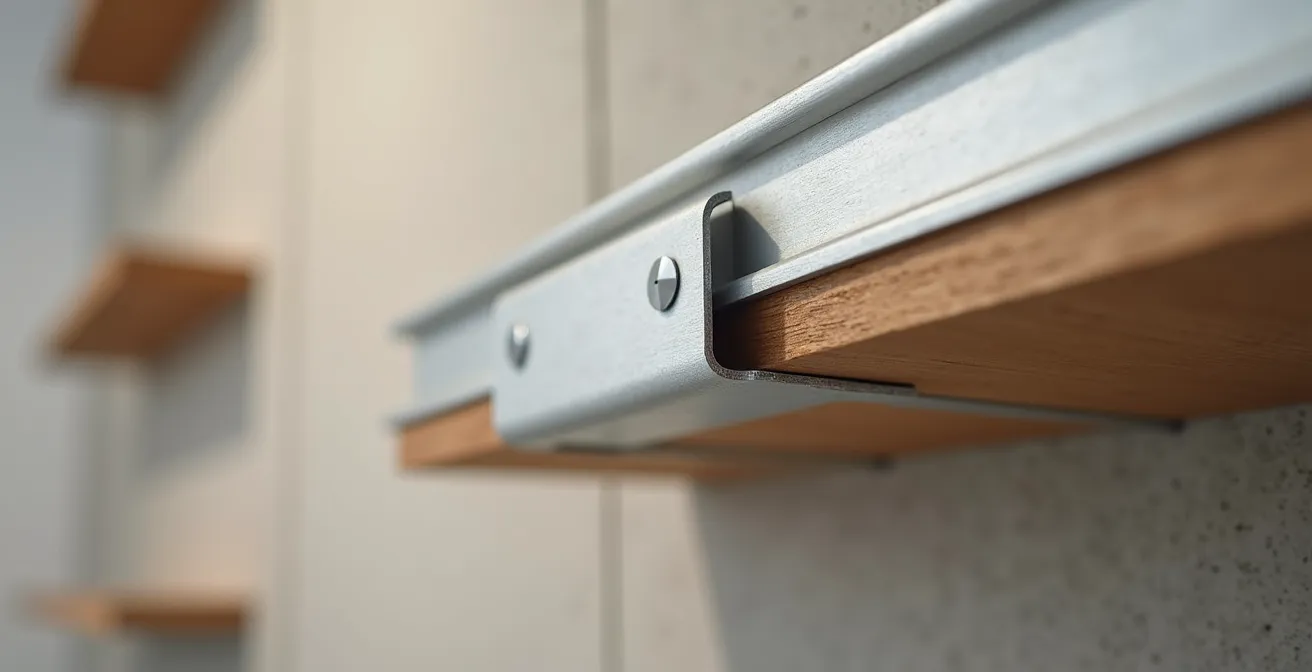
As this image demonstrates, the interlocking design of a French cleat provides a secure and robust foundation. When combined with heavy-duty toggle bolts or direct-to-stud fixings, it creates a system you can trust. Never compromise on this stage; the integrity of your vertical storage depends entirely on a secure connection to the wall’s internal structure.
Piston vs Spring Mechanisms: Which Wall Bed Lasts Longer?
The heart of any wall bed is its lifting mechanism. This is the component that does the heavy lifting, making the transformation from living room to bedroom effortless and safe. The two dominant technologies on the market are gas pistons and spring mechanisms, and the choice between them is a critical decision that impacts the bed’s longevity, performance, and safety profile. While both can perform the basic function, their long-term behaviour and mechanical integrity are vastly different.
Gas piston systems are the modern standard in high-quality wall beds. They operate like the struts that hold open the boot of a car, providing a smooth, silent, and controlled movement. Their primary advantage is consistency; a well-made piston will provide the same level of assistance from its first use to its five-thousandth. They are self-contained units that require no adjustment over their lifespan. Spring mechanisms, by contrast, are a collection of individual steel springs that are stretched and calibrated to counterbalance the weight of the mattress and bed frame. While effective initially, they are prone to metal fatigue.
Over time and with repeated cycles, springs can lose tension, leading to a bed that becomes progressively heavier to lift or that won’t stay fully closed. They can also develop squeaks and require periodic re-tensioning. The failure mode is also a key differentiator. A spring system will degrade gradually, whereas a gas piston tends to fail completely and suddenly, though this is a rare event in a high-quality product. For long-term, maintenance-free reliability, the piston is the superior engineering choice. As a testament to the longevity of quality mechanisms, Wilding Wallbeds notes:
The very first Wilding Wallbed ever built is still in use today. It has been in place for about 30 years with no issues.
– Wilding Wallbeds, Company durability report
This long-term performance is why premium brands overwhelmingly favour piston systems. While the initial cost may be higher, the investment pays dividends in reliability and user experience over the 15-20 year expected lifespan.
| Feature | Gas Pistons | Spring Mechanisms |
|---|---|---|
| Performance after 5,000 cycles | Maintains consistent force | 15-20% tension loss |
| Operational noise | Silent glide | Develops squeaks over time |
| Replacement cost | £150-£300 specialist required | £40-£120 DIY possible |
| Failure mode | Sudden complete failure | Gradual degradation |
| Expected lifespan | 15-20 years | 7-10 years |
The Safety Hazard of Cheap Murphy Beds You Must Check
The growing demand for wall beds, with the US market alone valued at over $3 billion, has unfortunately led to a flood of low-cost, poorly engineered products. While a tempting way to save money upfront, a cheap Murphy bed is a significant safety hazard. The forces involved in counterbalancing a heavy mattress and frame are immense, and a failure in the mechanism or structure can have catastrophic consequences. User-centric safety must be your absolute priority, and there are several non-negotiable checks you must perform before purchasing or using any wall bed.
The most critical safety feature is the counterbalance precision. A properly balanced bed should feel almost weightless throughout its range of motion. It should hold its position at any angle without assistance. If a bed drifts down when partially open or requires significant force to pull down or lift, the mechanism is either incorrectly calibrated, failing, or simply low-quality. Another key area is material specification. Many cheap beds use thin particle board (less than 18mm) which cannot withstand the long-term stresses. The screws holding the mechanism can pull out of the material over time, leading to a sudden and complete failure.
Finally, inspect the safety latch systems. A quality bed will have a dual-latch system: a primary latch to hold it securely in the closed position, and a secondary safety latch that acts as a fail-safe. Mattress retention is also vital; straps should be made of reinforced nylon with robust metal buckles, not cheap elastic that can stretch and fail. Before putting any wall bed into service, a thorough inspection using a clear checklist is not just recommended, it’s essential for peace of mind.
Your Essential Safety Inspection Checklist: Murphy Beds
- Counterbalance Drift Test: Open the bed to 45°, 90°, and fully open positions. The bed must hold each position without drifting up or down.
- Material Inspection: Check for particle board thickness (minimum 18mm is crucial). Verify that all mechanism screws bite securely into solid material, not just the board’s surface.
- Mechanism Check: Ensure a dual-latch system is present and functional—a primary latch for closure and a secondary safety lock.
- Mattress Retention: Verify straps are made of reinforced nylon with metal buckles. They must be rated to hold the full weight of the mattress securely.
- Frame Stability Test: With the bed closed, apply significant lateral force (around 50kg) to the side of the cabinet. The frame should not flex or wobble.
How to Hide a Dining Table for 6 in a Coffee Table
Beyond the bedroom, the living area presents the next great challenge for optimisation in a studio flat. The dream is a space that can host friends for dinner but doesn’t feel like a cluttered dining room the rest of the time. The solution lies in transformative furniture—pieces that undergo a significant mechanical change to serve entirely different functions. The pinnacle of this concept is the convertible coffee table that expands into a full-height dining table.
These are not simply coffee tables with a lift-top. True convertible tables house complex internal mechanisms, often involving gas pistons and butterfly-leaf extensions, that allow them to rise from a low coffee table height (around 40cm) to a standard dining height (around 75cm). Simultaneously, their surface area expands, often doubling or tripling, to comfortably accommodate six or even eight people. This is a feat of engineering that completely redefines the utility of the living space, a concept explored by major innovators like IKEA in their quest for “a Swiss army knife for life on limited square metres.”
The magic is in the seamless transition. A well-designed table can be transformed by a single person in under a minute. It allows you to maintain a clean, open-plan living room for everyday life, then instantly reconfigure the space for entertaining. This avoids the compromises of a permanent dining table (which consumes valuable floor space) or a low coffee table for meals (which is uncomfortable and impractical for groups). It is the ultimate expression of having your cake and eating it too, offering maximum functionality without a permanent spatial penalty.

The transformation from a compact, unassuming coffee table into a full-sized dining setup, as shown here, is the key to unlocking true flexibility in a studio. This ability to switch configurations on demand means your 30-square-metre flat can have the social functionality of one twice its size, but only when you need it.
Why Renting a Sofa Costs More After 18 Months
For many setting up a new flat, especially renters on a temporary basis, furniture rental seems like a flexible, low-commitment option. It avoids a large upfront cost and the hassle of moving or selling items later. However, a pragmatic, efficiency-obsessed analysis reveals a clear financial break-even point where renting ceases to be economical and becomes a significant financial drain. For most mid-range furniture, particularly big-ticket items like sofas, this point is often reached much sooner than people expect.
The rental model is built on monthly fees. While a single monthly payment of £100-£200 might seem manageable, the cumulative cost quickly adds up. A sofa that would cost £2,400 to purchase could easily cost £1,200 to rent for just six months. At the 12-month mark, you’ve spent the full purchase price but have zero equity. As the timeline extends, the financial folly becomes stark. After 18 months, you will have paid significantly more than the item’s retail value.
This is the fundamental flaw in long-term rental: you are perpetually paying for an asset without ever owning it. As one analysis bluntly puts it, at the end of your rental term, “You’ll have nothing to show for all the money you paid towards the furniture you were renting.” While rental can make sense for very short-term needs (under a year), for anyone planning to stay in one place for 18 months or more, purchasing becomes the far more logical financial decision. The numbers simply do not lie.
The table below, based on a typical cost structure, illustrates this crossover point with stark clarity. The initial cash-flow advantage of renting is quickly eroded and then completely reversed over time.
| Timeframe | Cumulative Rental Cost | Upfront Purchase Cost | Savings by Buying |
|---|---|---|---|
| 6 months | £1,200 | £2,400 | -£1,200 |
| 12 months | £2,400 | £2,400 | £0 (break-even) |
| 18 months | £3,600 | £2,400 | £1,200 |
| 24 months | £4,800 | £2,400 | £2,400 |
Why Modular Sofas Are the Only Option for Narrow Hallway Access
The dream of the perfect, plush sofa often meets a harsh reality in urban flats: the narrow hallway, the tight stairwell turn, or the small lift. A traditional one-piece sofa is frequently impossible to deliver into these spaces, leaving owners with a logistical nightmare. This is where modular sofas transition from a stylistic choice to an absolute necessity. Their design, which breaks a large sofa down into smaller, individual sections, is the only practical solution for navigating the architectural constraints of many modern and period properties.
Each module—be it a corner piece, a single seat, or an ottoman—is designed to be moved independently. This means that instead of trying to manoeuvre a 2.5-metre-long object around a 90-degree corner, you are simply moving a series of manageable, box-sized pieces. The maximum dimension of your narrowest pivot point (e.g., a 75cm doorway) becomes the constraint that dictates your module choice, not a barrier that prevents you from having a sofa at all. This approach removes the single biggest point of failure in furniture delivery.
Beyond the initial access, the modularity offers unparalleled long-term flexibility, a key tenet of smart living in a small space. As your needs change, the sofa can be reconfigured. You can split a three-seater into a two-seater and an armchair, or add a chaise-longue module later on. This adaptability means the sofa can evolve with your life and even move with you to a new, differently shaped space. It’s a system, not a static object. To ensure a successful delivery and installation, a methodical approach is key:
- Measure everything: Document the dimensions of all doorways, hallways, stairwell turns, and lift interiors.
- Identify the choke point: The single narrowest measurement is your absolute maximum module width and depth.
- Choose your modules: Select a modular sofa system where each individual piece is comfortably smaller than your choke point dimension.
- Plan the assembly: Have a clear plan for where you will assemble the sofa inside your flat before the pieces arrive.
- Keep instructions: Retain the manufacturer’s reconfiguration guide for future moves or layout changes.
Key Takeaways
- Prioritise Engineering over Aesthetics: A smart furniture piece is a machine. Its value lies in the quality of its mechanism, materials, and safety features, not just its looks.
- Analyse for Financial Return: Treat every major furniture purchase as an investment. Calculate its impact on your property’s functional value or its cost break-even point against alternatives like renting.
- Design for Transformation, Not Just Storage: The most powerful solutions are those that allow a room to change its fundamental purpose, such as a wall bed or a convertible dining table.
Renting vs Buying Furniture: Is the Circular Economy Cheaper?
The debate between renting and buying furniture is often framed as flexibility versus ownership. However, with the rise of the “circular economy” narrative, renting is sometimes positioned as a more sustainable, and therefore superior, choice. This argument requires careful scrutiny from an efficiency-obsessed perspective. While the idea of reusing furniture is sound, the industrial rental model is not always the most cost-effective or environmentally friendly path for the end-user, especially when compared to the alternative of buying quality second-hand pieces.
The core of the rental business model involves logistics—multiple deliveries, collections, and industrial-scale refurbishment between users. While this keeps furniture out of landfills, it comes at a cost, both financial and environmental. Experts note that furniture rental packages can cost between $189 to $499 per month, a significant ongoing expense. As a leading industry voice states, “If you plan to stay in one location for more than 3-5 years, buying furniture often becomes more economical in the long run.” The true circular economy champion for an individual may actually be the second-hand market.
Buying a high-quality, pre-owned piece of furniture involves a single transport event and extends the life of an item within a single home, minimising packaging and transport-related carbon emissions. The cost comparison is particularly revealing. Over a three-year period, renting can accumulate costs that are orders of magnitude higher than purchasing a similar item second-hand. The rental model serves a valid purpose for transient, very short-term situations, but for anyone establishing a home for more than a year, the most efficient, economical, and arguably sustainable choice is to buy—either new for the long-term or quality second-hand to truly participate in a personal circular economy.
| Factor | Renting | Buying Second-Hand |
|---|---|---|
| Carbon footprint | Multiple deliveries/collections | Single transport event |
| Product lifespan | Industrial refurbishment cycles | Extended single-owner use |
| Packaging waste | Repeated plastic wrapping | One-time minimal packaging |
| 3-year total cost | £5,000-£15,000 | £400-£1,500 |
By applying this rigorous, analytical mindset to every furniture decision, you transform the challenge of a small space into an opportunity for intelligent design. Your home becomes a testament to efficiency, where every component is chosen for its performance, safety, and financial contribution to your life. Begin today to evaluate your own space not by its limitations, but by its potential for optimisation.