
The true cost of removing a load-bearing wall isn’t the steel beam; it’s the procedural mistakes made before the first sledgehammer swings.
- Misidentifying a wall based on joist direction is a classic, dangerous amateur error.
- Failing to serve a Party Wall Notice correctly can lead to thousands in unexpected surveyor fees and months of delays.
Recommendation: Your first investment must be in professional structural calculations and a thorough understanding of your statutory obligations under the Party Wall Act.
The allure of open-plan living is powerful. Merging a cramped kitchen and dining room into one light-filled, sociable space is a dream for many UK homeowners. The primary obstacle is often a single internal wall, and the immediate question becomes, “How much to knock it down?” While many guides offer simple cost calculators, this approach misses the fundamental truth of such a project. From a chartered surveyor’s perspective, removing a load-bearing wall is not demolition; it is structural surgery on the very spine of your home.
The process is governed by a strict set of regulations and carries significant risks if mishandled. The common advice to “check which way the joists run” is dangerously oversimplified, and simply budgeting for a steel beam and a builder overlooks the critical—and often costly—procedural steps. These include engaging a structural engineer, navigating the Party Wall etc. Act 1996, and securing the correct Building Regulations approval. Getting any of these stages wrong can halt your project, invalidate your insurance, and create serious disputes with neighbours.
But what if the key to a successful project wasn’t just finding the cheapest builder, but mastering the procedural sequence? This guide moves beyond generic price lists to focus on the professional due diligence required. We will dissect the process through the lens of risk mitigation and statutory compliance, revealing why the initial steps you take—long before any dust is created—are the most crucial for controlling costs and ensuring a safe, legally sound renovation.
To navigate this complex but rewarding journey, this article breaks down the critical stages and considerations. The following summary outlines the key areas we will explore, from initial structural identification to the final regulatory sign-off.
Summary: A Step-by-Step Guide to Wall Removal
- Why You Cannot Just Check the Joist Direction to Identify a Wall
- How to Serve a Party Wall Notice to Your Neighbours Correctly
- Hidden Beam vs Box Frame: Which Maximizes Ceiling Height?
- The ‘Contingency Fund’ Error That Halts Renovations Mid-Way
- When to Apply for Building Control: Before or During Works?
- Why Open Plan Kitchens Increase Heating Bills by Up to 20%
- Why Basements Cost £1,000 More Per Square Metre Than Lofts
- Loft vs Basement: Which Conversion Adds More Value in London?
Why You Cannot Just Check the Joist Direction to Identify a Wall
The most persistent and perilous myth in home renovation is that a wall is not load-bearing if the floor joists above run parallel to it. While sometimes true in simple structures, relying on this rule of thumb is a high-stakes gamble. The structural integrity of a house is a complex, three-dimensional system where loads are transferred down to the foundations through a variety of interconnected elements. A wall may be supporting loads from walls on the floor above, sections of the roof, or other beams, all of which are invisible to a casual inspection.
This is especially true in the UK’s diverse housing stock. Victorian and Edwardian properties, for instance, often feature internal spine walls that form part of the primary structure, creating complex load paths that defy the simple joist rule. Furthermore, modern homes with trussed roofs can distribute roof loads onto internal walls in non-obvious ways. Assuming a wall is a simple partition without professional assessment can lead to catastrophic failure, including sagging floors, cracked plasterwork throughout the house, or worse.
The only correct first step is to engage a qualified structural engineer. Their diagnostic process is far more thorough and is the bedrock of a safe project. Initial site visits and the production of structural calculations are a non-negotiable investment, and according to industry analysis, structural engineer fees typically range from £300 to £700 for this vital preliminary work. This is a minor cost to prevent a multi-thousand-pound structural disaster.
Action Plan: The Professional Structural Assessment
- Floor Load Paths: The engineer will check how weight transfers through the entire structure, not just the immediate floor.
- Roof Geometry Assessment: They will assess if roof trusses or beams create unexpected load points on the wall in question.
- Vertical Alignment Check: The investigation includes examining the walls directly above and below to understand the full vertical load path.
- Joist Span & Point Loads: They will calculate joist spans and identify any concentrated “point loads” from other structural members.
- Foundation Adequacy: The engineer verifies that the foundations beneath the supporting piers are sufficient for the new, concentrated loads from the steel beam.
How to Serve a Party Wall Notice to Your Neighbours Correctly
Once you have your structural engineer’s drawings, the next critical step involves your neighbours. The Party Wall etc. Act 1996 is a piece of legislation designed to prevent and resolve disputes in relation to party walls, boundary walls, and excavations near neighbouring buildings. If your project involves cutting into a shared wall to insert a steel beam (an RSJ), you are legally required to serve a formal notice on your adjoining neighbours. This is not an informal chat over the fence; it is a statutory duty.
You must give your neighbours at least two months’ written notice before work begins. The notice must be correctly formatted and describe the proposed work in detail, accompanied by your structural engineer’s plans. Your neighbour then has 14 days to respond. Their response dictates the cost and timeline of your project. If they consent in writing, you can proceed. If they dissent, or do not reply, you are deemed to be ‘in dispute’ under the Act, and you must appoint a Party Wall Surveyor. This is where significant, unbudgeted costs can arise. A single surveyor acting for both parties is the most economical outcome, but if your neighbour insists on their own surveyor, you are legally responsible for paying the fees for both. This can be substantial, as data suggests the average party wall agreement costs range from £1,000 to £2,000 or more if two surveyors are involved.
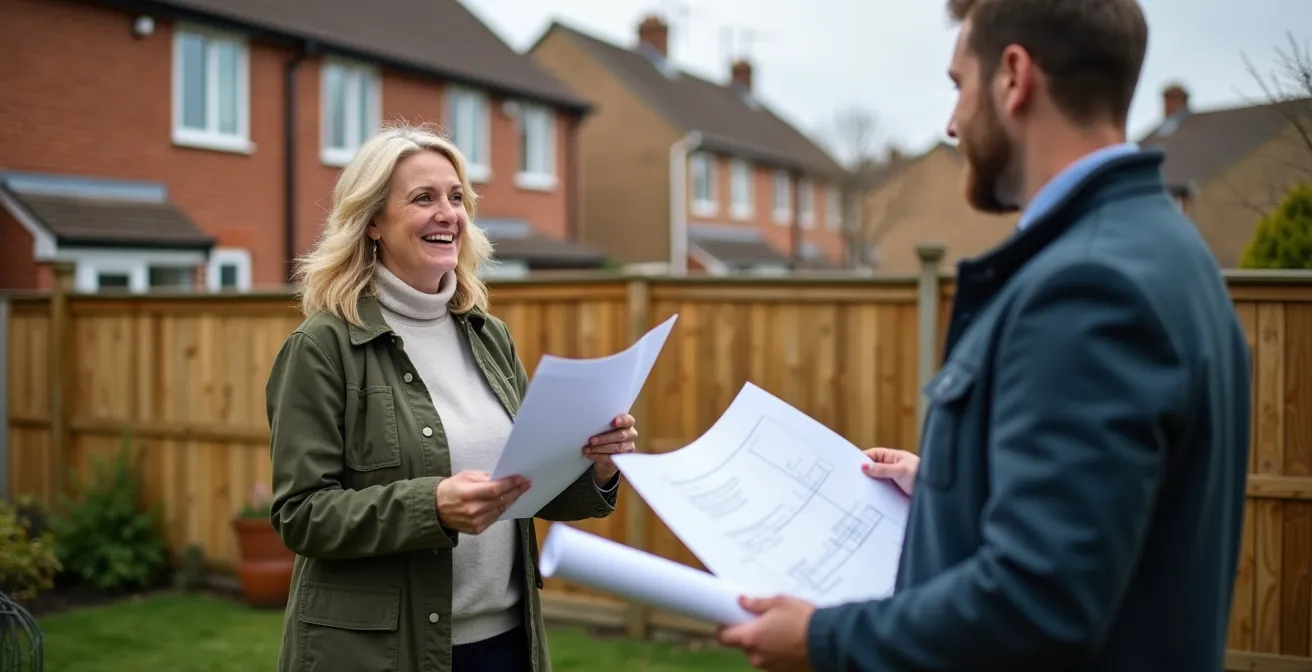
The goal is to manage this process smoothly to achieve consent. Being transparent, providing full details of the work, and discussing the plans in a friendly manner before serving the formal notice can significantly increase your chances of a positive outcome. The image below represents the ideal scenario: a collaborative discussion about the planned works.
Understanding the potential responses is key to planning your budget and timeline. Each path has a different implication, and preparing for the worst-case scenario is a prudent part of project management.
The following table, based on guidance from organisations like the HomeOwners Alliance, outlines the three potential outcomes after you serve notice.
| Response Type | Timeline | Cost Impact | Next Steps |
|---|---|---|---|
| Consent | Within 14 days | No additional cost | Record agreement in writing, proceed with works |
| Dissent with Joint Surveyor | 14-28 days typically | £1,000-£2,000 shared cost | Appoint agreed surveyor, await Party Wall Award |
| Dissent with Two Surveyors | 4-8 weeks typically | £2,000-£3,000+ you pay both | Each party appoints surveyor, they prepare joint Award |
Hidden Beam vs Box Frame: Which Maximizes Ceiling Height?
Once the structural and legal preliminaries are handled, attention turns to the engineering solution. The goal is nearly always to make the new steel beam as invisible as possible to achieve a seamless, open-plan look. This typically involves two primary methods: a “hidden beam” recessed into the ceiling void, or a “box frame” for larger openings. The choice has significant implications for both aesthetics and cost.
A hidden beam is the preferred option for maintaining a flat, uninterrupted ceiling. This involves positioning the new steel beam (or beams) within the depth of the floor joists above. The joists are then hung from the new steelwork using specialist metal hangers. This creates a flush finish but is often more complex. It requires careful coordination to ensure there is enough space, and it can become complicated if pipes or electrical wiring are running through the ceiling void in the path of the new beam.
A box frame is a more substantial solution required when removing a large section of a wall, especially an external one, or when there are complex loads from above. It consists of a horizontal beam supported by two vertical steel posts at either end. While incredibly strong, this method inevitably creates a “downstand” or bulkhead where the beam is visible below the ceiling line, and the vertical posts must also be concealed within the remaining walls. This approach is more expensive due to the extra steel and labour involved. For particularly wide openings, analysis shows that large rear wall openings with box frames can cost from £6,000 to £8,500, excluding finishing.
Case Study: The Hidden Costs of a Hidden Beam
A project to remove a wall between a kitchen and dining room aimed for a completely flush ceiling using a hidden beam. The initial quote covered the structural work only. However, during installation, it was discovered that the main soil stack and several central heating pipes ran directly through the proposed beam path. The project had to be paused while a plumber was called in to re-route these services at a significant additional cost, a common issue often omitted from initial quotes for kitchen-diner knock-throughs due to the high density of services in that area.
The ‘Contingency Fund’ Error That Halts Renovations Mid-Way
One of the most frequent and devastating mistakes a homeowner can make is failing to establish an adequate contingency fund. A survey-based cost is an estimate, not a fixed price. The nature of working with existing buildings means that unforeseen issues are not a possibility; they are a probability. A contingency fund of 15-20% of the total project cost is not a luxury, it is an essential risk management tool.
Relying solely on the builder’s quote is a recipe for disaster. That quote typically covers the structural work and basic “making good.” It rarely accounts for the host of “known unknowns” that can surface once work begins. This is particularly true in older UK properties, where decades of previous alterations can hide structural surprises. Without a contingency, the discovery of a single major issue can halt the project indefinitely while you scramble to find extra funds, leaving you with a chaotic and potentially unsafe building site.
The key is to proactively identify potential risks with your surveyor and builder before work starts. In the UK, common high-cost surprises include asbestos in textured ceilings, inadequate foundations requiring underpinning, or complex plumbing rerouting. Each of these can add thousands to the final bill. Even a straightforward project requires a formal Building Control application, and while some sources indicate that Building Control application fees typically cost from £240 to £420, this is just the administrative fee and does not cover the cost of any remedial work an inspector might demand.

Thinking like a surveyor means anticipating these financial risks. The following list highlights some of the most common, high-cost issues encountered during wall removal projects specifically within the UK context.
- Asbestos in Artex: If your home was built or refurbished before 2000, textured ceilings may contain asbestos, requiring specialist and costly removal.
- Inadequate Foundations: The new steel beam concentrates the load onto two points. If the foundations at these points are found to be insufficient, underpinning will be required.
- Complex Pipe Rerouting: Moving soil stacks or central heating systems that run through the wall or ceiling void is a complex plumbing job.
- Listed Building Consent: If your property is listed or in a conservation area, you will need additional permissions beyond standard Building Regulations, adding time and cost.
- Retrospective Approval Fines: Starting work before securing the necessary approvals can lead to significant penalties and difficulties when you come to sell the property.
When to Apply for Building Control: Before or During Works?
All structural alterations, including the removal of a load-bearing wall, require approval under the Building Regulations. This is a legal requirement to ensure the work is safe, structurally sound, and energy efficient. Homeowners have two main routes to achieve compliance: a ‘Full Plans’ application or a ‘Building Notice’. Choosing the wrong route for your project’s complexity is a significant risk.
A Building Notice is a simpler, faster process. You give your local authority’s Building Control department 48 hours’ notice before you start work. There are no plans to approve upfront; instead, an inspector will visit the site at various stages to check the work as it progresses. While this seems convenient, it is a high-risk strategy for structural work. If the inspector finds an issue with the engineer’s calculations, the beam size, or the installation method, they can order you to stop work and rectify it, or even demand you undo the work entirely. This route is only suitable for very simple, non-structural projects.
A Full Plans application is the correct and only prudent route for removing a load-bearing wall. You submit your structural engineer’s detailed drawings and calculations to Building Control for approval *before* any work begins. The plans are checked by a council surveyor, who will either approve them or request amendments. This process takes 5-8 weeks but gives you certainty. Once your plans are approved, you know that as long as your builder follows them precisely, the work will be compliant. This de-risks the entire project and prevents costly surprises during the build. Upon satisfactory completion, you will be issued a vital completion certificate, which is essential for home insurance and future property sales.
The temptation to start work prematurely without approval can lead to a nightmare scenario. As highlighted in many industry case studies, retrospective approval is invasive, expensive, and stressful. It can invalidate your insurance and will be flagged by any solicitor during a future sale, potentially scuppering the transaction.
This table summarises the critical differences, drawing on data from construction guidance portals, to help you make an informed, risk-based decision.
| Application Type | Cost | Timeline | Risk Level | Best For |
|---|---|---|---|---|
| Full Plans | £650 average | 5-8 weeks approval | Low – pre-approved | Major structural work |
| Building Notice | £250-£400 | 48 hours notice | High – issues found during work | Simple non-structural work only |
Why Open Plan Kitchens Increase Heating Bills by Up to 20%
While the focus of removing a load-bearing wall is often on structure and cost, a crucial long-term consequence is the impact on your home’s thermal performance. Creating a large, open-plan space fundamentally changes how your home retains and distributes heat. Smaller, separate rooms are easier to heat quickly and efficiently. When you combine a kitchen, dining room, and living area into one voluminous space, the existing heating system may struggle to cope.
The increased volume of air requires more energy to bring to a comfortable temperature. Heat from radiators rises and can become trapped at the ceiling in a large, double-height or open-plan room, leaving the living area feeling cool. Furthermore, kitchen activities generate significant moisture, and without proper ventilation, this can lead to condensation issues in a larger, cooler space. Industry studies and trade cost guides consistently warn that open plan layouts can increase heating bills by up to 20% if no mitigating measures are taken. This is a significant, ongoing cost that must be factored into the “true cost” of your renovation.
A prudent homeowner and their design team should consider this thermal impact from the outset. Rather than dealing with a cold, expensive-to-heat room after the fact, you can integrate solutions into the renovation project itself. This might involve upgrading or repositioning radiators, or considering more modern, efficient heating solutions that are better suited to large spaces. Proactive planning turns a potential long-term problem into a feature of a well-designed home.
Here are some of the most effective solutions to consider incorporating into your project to mitigate the thermal impact:
- Underfloor Heating: Provides gentle, radiant heat distributed evenly across the entire floor area, making it highly effective for large spaces.
- Zoned Heating Systems: Installing smart thermostats allows you to create different temperature zones within the open-plan area, so you only heat the part you are using.
- Upsized Radiators: Your heating engineer can calculate the new BTU (British Thermal Unit) requirement for the larger space and recommend larger or additional radiators.
- Mechanical Ventilation with Heat Recovery (MVHR): An advanced solution that extracts moist, stale air while recovering the heat to warm incoming fresh air, improving air quality and efficiency.
- High-Performance Thermal Curtains/Blinds: A simple but effective way to reduce heat loss through large windows or bifold doors, which are common features of open-plan extensions.
Why Basements Cost £1,000 More Per Square Metre Than Lofts
When evaluating the significant investment of removing a load-bearing wall, it’s useful to contextualise it against other major structural projects, such as loft or basement conversions. While a “knock-through” project improves existing space, conversions create new space, but at vastly different costs. In the UK, basement conversions are notoriously more expensive than loft conversions, often by a significant margin.
The primary driver of this cost difference is the nature of the work. A loft conversion largely works within the existing building shell, using lighter materials and facing fewer ground-related challenges. A basement conversion, by contrast, is a heavy civil engineering project conducted within a residential setting. It involves major excavation and soil removal, which is labour-intensive and logistically complex, especially in dense urban areas with limited access.
Furthermore, basements require extensive and robust waterproofing, a process known as ‘tanking’. This is a critical, specialist trade, as failure can lead to catastrophic damp issues. The structural work is also more substantial, often requiring the underpinning of the existing house foundations to dig deeper. Creating light and ventilation with light-wells and ensuring safe fire escape routes adds further complexity and cost. As a result of these factors, basement work is subject to stricter Planning Permission and Building Regulations scrutiny. The Party Wall process for basement work is also inherently more complex and high-risk for neighbours, often leading to more expensive Party Wall Awards. These combined factors explain why creating space below ground is a far costlier endeavour than creating it above.
Key Takeaways
- Procedural rigour is paramount: correctly serving a Party Wall Notice and getting a Full Plans Building Control approval before starting are non-negotiable.
- The “joist direction” rule is an unreliable myth; only a structural engineer can safely identify a load-bearing wall.
- Budget for more than just the build: a contingency fund of 15-20% and costs for professional fees (engineer, surveyors) are essential parts of the true total cost.
Loft vs Basement: Which Conversion Adds More Value in London?
While removing an internal wall enhances the quality and flow of your existing space, loft and basement conversions add valuable square meterage, which directly impacts a property’s market price, particularly in a high-value market like London. The return on investment (ROI) for these projects, however, is not equal and depends heavily on the property type and its specific location within the capital.
In prime London zones, where space is at an absolute premium, the potential value added by a basement can be immense. For many properties, particularly flats or terraced houses with no room to extend outwards or upwards, digging down is the only way to add substantial living space. This can create an entire new floor for a cinema room, gym, or bedrooms, and in these high-value areas, analysis suggests that in prime London zones, basement conversions can add a 15-25% value increase, sometimes more, justifying their high initial cost.
A loft conversion, while typically cheaper to build, often adds less percentage value in prime central locations but can be the most profitable option in outer London suburbs. In a Zone 4 semi-detached house, for example, adding a master suite in the loft might provide the best ROI, as the cost-to-value ratio is more favourable and may be enough to push the property to the top of the local price ceiling. The decision is strategic and depends entirely on local market dynamics and the physical constraints of the property.
The following table provides a simplified comparison of the potential value impact in different London scenarios, illustrating how location and property type dictate the most financially advantageous project.
| Property Type | Location | Loft Value Add | Basement Value Add | Key Factor |
|---|---|---|---|---|
| Victorian Terrace | Zone 2 Prime | 10-15% | 20-25% | Creates new ‘floor’ of living |
| Semi-detached | Zone 4 Suburban | 15-20% | 10-15% | Loft reaches ceiling price |
| Flat Conversion | Central London | N/A often | 25-30% | Only way to add space |
Ultimately, a successful renovation project—whether it’s removing a wall or converting a loft—is one that is built on a foundation of professional advice and procedural diligence. The key to transforming your home safely and on budget is to invest in expertise at the very beginning. By engaging a structural engineer and understanding your legal obligations from day one, you are not adding costs; you are managing risk and safeguarding the value and integrity of your most important asset. For a detailed assessment of your specific project, the next logical step is to seek a professional consultation.