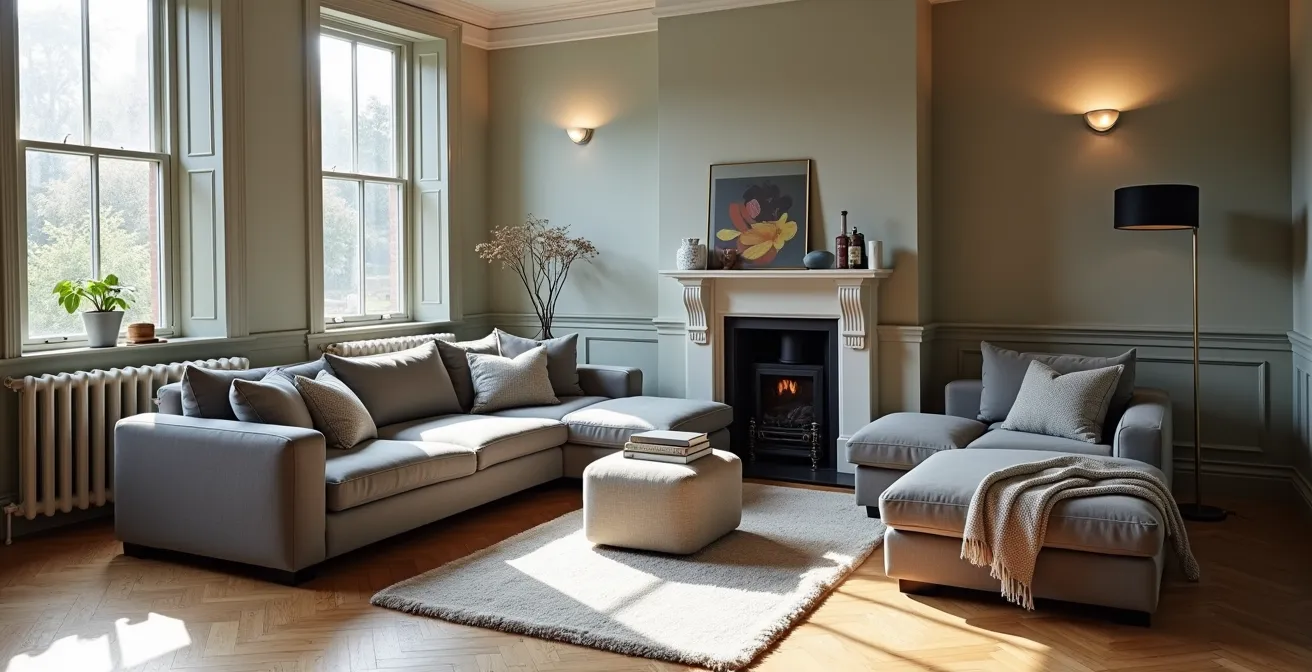
The geometry of older UK homes makes standard sofas impractical; a modular sofa is the only true architectural solution.
- It breaks down into manageable sections to navigate the narrow hallways and tight pivot points common in period properties.
- It allows for precise, custom configurations around fixed obstacles like chimney breasts and alcoves, eliminating wasted space.
Recommendation: Use masking tape on your floor to map your traffic flow and test the module footprint before committing to a purchase.
The story is a classic for anyone living in a characterful UK home: the perfect sofa, spotted in a spacious showroom, arrives only to become wedged in a narrow Victorian hallway. This moment of geometric defeat is where the conversation about furniture must change. The common advice to “measure your space” is a platitude that drastically underestimates the unique challenges of British properties—from tight 90-degree turns and low ceilings to the ubiquitous chimney breast that dictates the entire room. The problem isn’t just about size; it’s about access, flow, and the inflexible nature of traditional three-seater sofas in architecturally awkward spaces.
But what if the sofa wasn’t a single, monolithic object, but a set of strategic, geometric building blocks? This is the fundamental shift in thinking that modular sofas enable. This guide moves beyond simple decoration to treat your living room layout as an act of spatial engineering. We will not just discuss flexibility; we will delve into the principles of traffic flow geometry, pivot point calculus, and micro-zoning. A modular system isn’t just “versatile”; it’s a bespoke solution that empowers you to architecturally re-engineer an awkward space, turning architectural constraints into design opportunities. It’s the key to conquering difficult floor plans and creating a room that is both functional and beautiful.
This article will provide a strategic framework for selecting, delivering, and configuring a modular sofa to solve the specific geometric problems of your home. We will cover the critical first step of getting it through the door, securing it for stability, choosing the right materials for longevity, and planning the layout to perfection. We will then explore how these principles can be extended to optimise the entire home environment, from hallways to studio flats.
Summary: Modular Sofas for Awkward Layouts
- Why Modular Sofas Are the Only Option for Narrow Hallway Access
- How to Secure Modules Together to Prevent Sliding
- Feather vs Foam: Which Seat Cushion Retains Shape Longer?
- The Depth Error That Blocks Traffic Flow in Small Rooms
- How to Reconfigure Your Sofa for Movie Night vs Cocktail Hour
- How to Brighten a North-Facing Hallway with Mirrors and Paint
- How to Hide a Dining Table for 6 in a Coffee Table
- Smart Furniture Solutions for Studio Flats Under 40 Square Metres
Why Modular Sofas Are the Only Option for Narrow Hallway Access
The single greatest obstacle to furnishing a period UK home is not the living room itself, but the journey to it. Many terraced houses feature narrow hallways, tight turns, and doorways that were never designed for modern furniture. For a standard sofa, this journey requires a complex ‘pivot point calculus’—a stressful combination of tilting, turning, and hoping. A modular sofa bypasses this problem entirely. By breaking a large seating arrangement into smaller, manageable geometric blocks, each piece can be navigated individually through spaces that would be impossible for a fixed-frame sofa.
Consider the typical challenge in a city like Bristol, where a customer’s new 215cm sofa couldn’t pass a 72cm wide hallway and a sharp 90-degree turn. The delivery became a two-hour ordeal of tilting and sliding. A modular alternative would have transformed this into a simple, stress-free process of carrying individual boxes. Given that the average UK terraced house living room measures just 3.8m x 3.5m, maximising seating is crucial, and a modular design is often the only way to get a generously sized sofa into such a space without removing windows or doors.
This isn’t just about convenience; it’s about possibility. A modular system allows you to introduce a large, comfortable L-shape or corner configuration into a room that could otherwise only accommodate a much smaller, less functional two-seater. It fundamentally changes the equation of what is achievable in a home with architectural constraints, making it an essential, rather than optional, choice for many UK residents.
How to Secure Modules Together to Prevent Sliding
Once your modular sofa has successfully navigated the hallway, the next engineering challenge is ensuring its stability. A common concern is ‘module creep’—the gradual sliding apart of sections, creating unsightly and uncomfortable gaps. This is especially prevalent on the slightly uneven original floorboards found in many older UK homes. Thankfully, reputable manufacturers have developed robust connection systems to create a unified, solid-feeling piece of furniture. A recent survey highlighted that as the format’s popularity grows, so does the sophistication of its engineering, with a report from the British Furniture Manufacturers Association revealing that over 73% of UK manufacturers now offer modular formats, driving innovation in connection hardware.
The most common solutions involve heavy-duty hardware concealed on the underside of each module. These typically fall into two categories:
- Crocodile or Alligator Clips: These are interlocking metal teeth. One module has a male component (the ‘post’) and the adjacent one has a female component (the ‘teeth’). Lifting one module slightly allows you to drop it onto the other, locking them securely in place.
- U-Shaped Brackets: A simple but effective system where a U-shaped piece of metal on one module slots into a receiver on the next, preventing lateral movement.
For homes with characterfully uneven floors, a critical feature to look for is adjustable feet. These small but essential components allow you to level each module individually, ensuring a perfectly flat and stable seating surface while preventing any rocking or stress on the connection points.
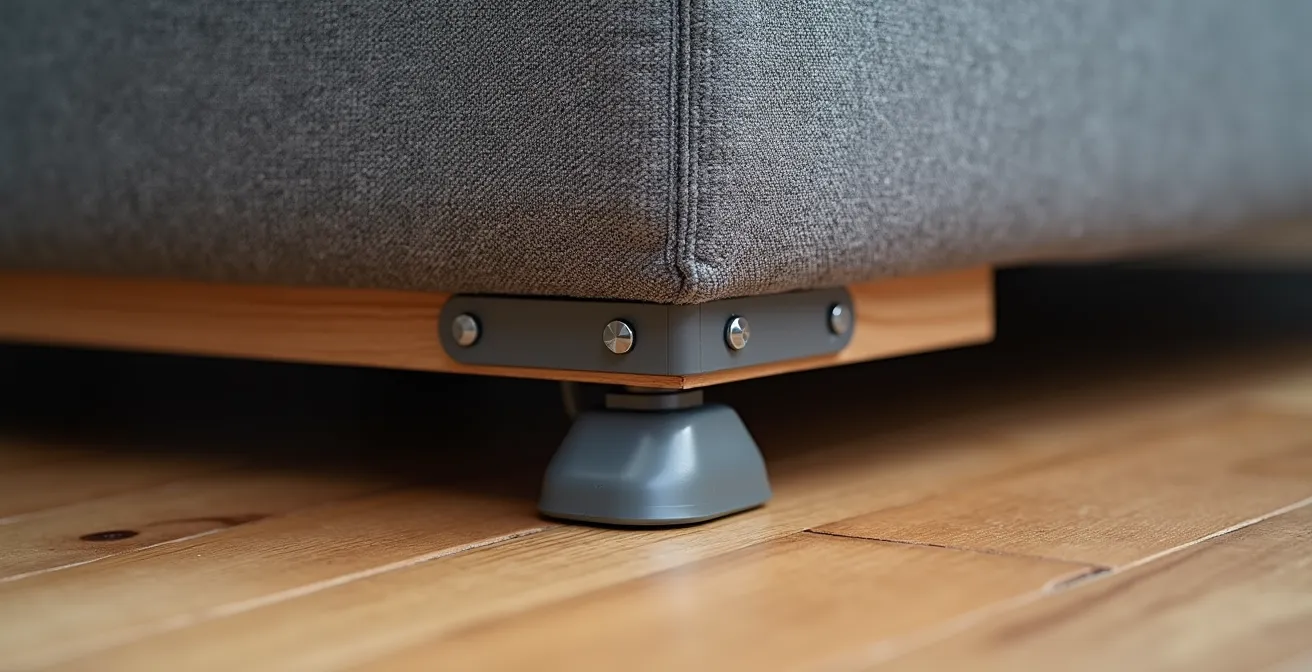
As the image above illustrates, the combination of robust metal connectors and adjustable feet provides a complete engineering solution. It ensures that once assembled, your sofa feels as solid and dependable as a single-piece frame, eliminating any sense of fragility and allowing the focus to return to comfort and style.
Feather vs Foam: Which Seat Cushion Retains Shape Longer?
The long-term performance of your modular sofa hinges on the material science of its cushions. The choice between feather and foam is not just about initial comfort; it’s a strategic decision about maintenance, shape retention, and longevity, especially within the context of the UK’s often damp climate. While feather-filled cushions offer an initial sense of plush, luxurious comfort, they require constant maintenance to look their best. High-density foam, on the other hand, provides a firmer, more supportive feel and superior shape retention over time.
The critical factor is resilience—the cushion’s ability to bounce back after compression. High-density foam has a cellular structure that inherently pushes back to its original shape. Feather and down fillings are composed of individual, loose elements that compress and shift with use, requiring daily ‘plumping’ to redistribute the filling and restore volume. In humid British conditions, this problem is exacerbated, as moisture can cause feathers to clump together, accelerating the loss of loft and support.
To make an informed decision, a direct comparison of their properties is essential. The following table breaks down the key performance metrics based on long-term use, as highlighted in a detailed analysis of cushion fillings.
| Cushion Type | Average Lifespan | UK Climate Impact | Maintenance Required |
|---|---|---|---|
| High-Density Foam | 5-10 years | 15% support loss in humid conditions | Minimal – rotate quarterly |
| Feather/Down | 3-7 years | Clumping risk in damp conditions | Daily plumping required |
For those who want the best of both worlds, a hybrid cushion—a supportive foam core wrapped in a soft layer of feather and down—offers a practical compromise. It maintains the structural integrity and shape of foam while providing the gentle surface comfort of feathers, requiring only weekly plumping. For a low-maintenance, long-lasting investment in an awkward room where the sofa is the main event, high-density foam or a foam-core hybrid is the superior engineering choice.
The Depth Error That Blocks Traffic Flow in Small Rooms
In spatial engineering, the most critical dimension is often not the width of a sofa, but its depth. A common mistake in smaller or awkwardly shaped UK living rooms is choosing a sofa so deep that it chokes off essential traffic flow geometry. A beautiful sofa is useless if it creates a permanent obstacle course. The goal is to leave a minimum of 3 feet (approximately 90cm) of clearance for primary walkways—the paths from a doorway to the sofa, or from the sofa to a window. This ensures the room feels open and usable, not cramped and congested.
This problem is particularly acute in rooms with fixed architectural features like a chimney breast. A deep sofa placed against the main wall can create a narrow “pinch point” as you try to walk past it into the alcoves. This is where the reduced depth of a modular design, or the ability to use a shallower chaise or ottoman piece, becomes a strategic advantage. You can configure the layout with varying depths to accommodate traffic flow where it’s most needed.
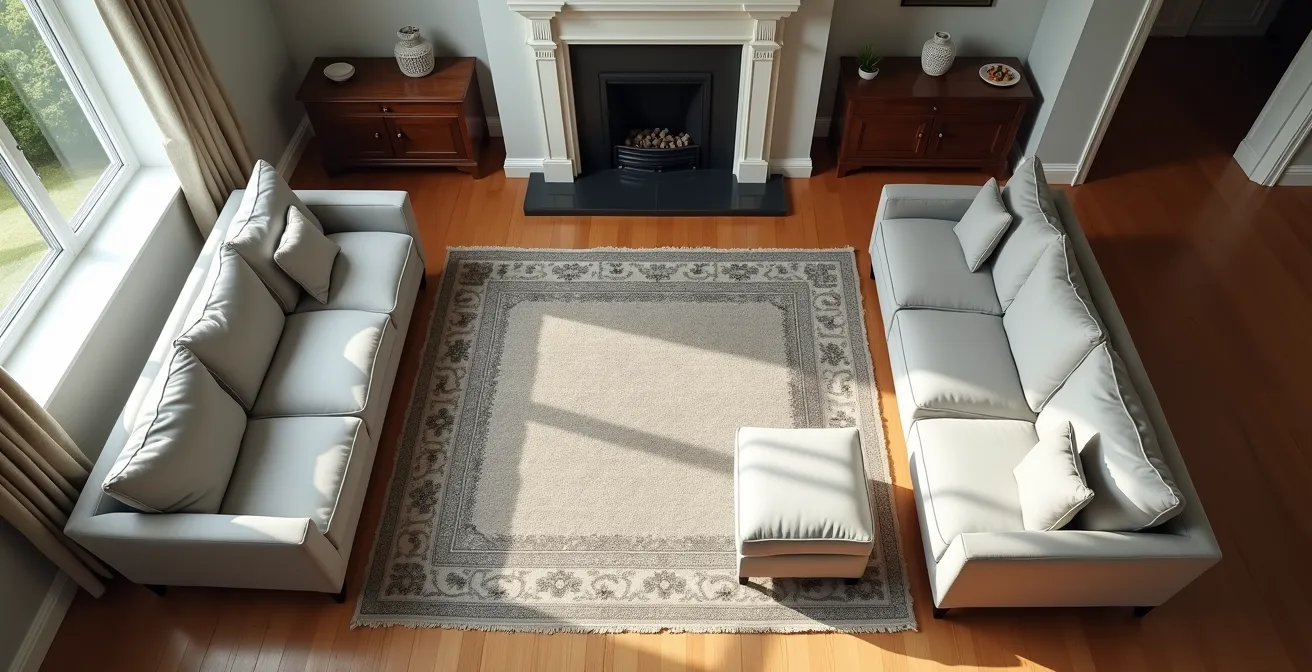
As the aerial view shows, a smart modular configuration can wrap around an obstacle like a fireplace, using slimmer modules in the alcoves and maintaining clear, wide pathways. Before purchasing, the single most effective technique is to physically map the sofa’s footprint in your room. This moves the plan from abstract numbers to a tangible reality you can interact with.
Your Action Plan: The Masking Tape Manoeuvre
- Outline the Footprint: Use masking tape to mark the exact outer dimensions of the proposed modular sofa configuration on your floor.
- Test the Seating Zone: Place a chair inside the taped area and sit in it. Does it feel too close to the TV or fireplace? Is the sense of space comfortable?
- Walk the Paths: Walk all the natural routes around the taped outline: from the door, to the window, to the bookshelf. Do you have to turn sideways or squeeze past?
- Check Critical Clearance: Use a tape measure to confirm you have at least 90cm for main walkways. For minor paths, 60-75cm may suffice.
- Position Other Furniture: Place your existing coffee table or side tables within or next to the outline. Can you still move around comfortably without collision?
How to Reconfigure Your Sofa for Movie Night vs Cocktail Hour
The true genius of a modular sofa is its dynamic nature. Beyond solving the static problem of an awkward layout, it offers the ability to transform your living room’s function on demand. A space that serves as a cosy family retreat during the week can be instantly reconfigured into an open, social hub for a weekend gathering. This adaptability is the key to maximising the utility of a single, precious living area. It’s not just about having a flexible sofa; it’s about having a flexible room.
The process of reconfiguration should be straightforward. With lightweight modules and simple connection hardware, changing the layout can be a five-minute task. The key is to think in terms of “modes”—pre-planned configurations that serve specific activities. By detaching and rearranging the individual geometric blocks, you can fundamentally alter the room’s social dynamics and functionality.
Here are some of the most effective configurations for different occasions:
- Movie Night Mode: Arrange all modules into a long, straight line or a gentle curve facing the television. Combine ottomans with seat modules to create a vast, comfortable daybed for the ultimate cinematic experience.
- Cocktail Hour Mode: Break the sofa apart into two or three smaller, distinct groupings. For example, create two separate two-seaters facing each other to encourage conversation, with an ottoman serving as a central coffee table. This creates ‘conversation zones’ and improves flow for mingling guests.
- Guest Accommodation Mode: Combine two single seat modules with an ottoman to form a comfortable, temporary bed for an overnight guest. This eliminates the need for a separate, space-consuming sofa bed.
- Daily Use Mode: A classic L-shape is often the most efficient for daily life, maximising seating along two walls while keeping the centre of the room open for traffic flow and play.
- Work/Reading Mode: Detach a single corner or armchair module and position it in a quiet corner with a side table and lamp to create a dedicated, comfortable workspace or reading nook.
This ability to adapt means you are no longer constrained by a single furniture layout. Your living room can become a multi-purpose environment, fluidly shifting its form to match its function. This is the ultimate expression of smart, space-efficient design.
How to Brighten a North-Facing Hallway with Mirrors and Paint
While the living room is the main stage, its perceived size and comfort are heavily influenced by the journey to it. A dark, narrow, north-facing hallway—a common feature in UK homes—can make the entire ground floor feel gloomy and cramped. Before you even begin arranging your modular sofa, optimising this transitional space is a crucial act of spatial engineering. Brightening the approach creates an illusion of greater space that carries through into the living area.
The strategy relies on two key elements: light-reflective paint and the clever placement of mirrors. North-facing light is cool and grey, so a standard brilliant white can look flat and stark. The solution is to use warm whites with yellow or pink undertones. Heritage paint brands like Farrow & Ball or Little Greene offer complex pigments specifically designed to perform in the challenging UK light. Colours with high Light Reflectance Values (LRV) will bounce more light around the space, amplifying what little natural illumination is available.
Mirrors are your second tool. They don’t just reflect light; they create an illusion of depth. A large mirror placed on a landing opposite a staircase or at the end of a long corridor can visually double the length and brightness of the space. For maximum impact, consider mirroring an entire alcove. This not only bounces light but also creates a ‘false window’, tricking the eye into seeing a larger, more open area.
To combat the notorious 4 PM gloom of a UK winter, a layered lighting strategy is essential. This involves placing light sources at different heights to eliminate shadows and create warmth. A typical three-tier approach includes low-level plug-in wall lights to wash the floor with light, a main ceiling fixture for ambient brightness, and a console table lamp to provide a welcoming, mid-level glow. This combination ensures the hallway remains a bright and inviting prelude to the main living space.
How to Hide a Dining Table for 6 in a Coffee Table
Once you’ve perfected your living room’s seating and flow with a modular sofa, the next challenge in a compact home is integrating other essential functions without sacrificing space. The dining table is the largest culprit, a huge footprint that often sits unused. The solution lies in multi-functional, transforming furniture—specifically, a coffee table that expands to become a full-size dining table.
This is not a gimmick; it’s a serious piece of mechanical engineering. Several specialist brands offer tables that use sophisticated lifting and extending mechanisms to transition from a low-level coffee table to a dining-height table for six or more people in under a minute. These pieces are the perfect complement to a modular sofa in a single living/dining area, allowing you to reclaim valuable floor space when not eating. The room can remain an open, comfortable lounge for 95% of the time, and instantly transform for a dinner party when needed.
When selecting a transforming table in the UK, several factors come into play, from mechanism type to price. The following comparison, based on an overview of available transforming furniture, highlights some popular options.
| Brand | Model Type | Capacity | UK Price Range | Transformation Time |
|---|---|---|---|---|
| Resource Furniture | Wall-mounted console | 4-8 people | £2,500-4,000 | 30 seconds |
| Calligaris | Extending coffee table | 6 people | £1,200-2,000 | 45 seconds |
| BoConcept | Lifting mechanism | 4-6 people | £1,800-2,800 | 1 minute |
One critical consideration, especially in older properties with original floorboards, is the point load. A solid wood or metal-framed table, combined with the weight of six adults (approximately 600kg total), places significant stress on a small area of the floor. Before purchasing, it’s wise to test the floor’s stability by walking heavily near the intended location and checking for any noticeable flex or bounce. For period properties, a structural inspection of the joists from below may be advisable to ensure the floor can safely handle the concentrated weight.
Key Takeaways
- Embrace Geometry: Treat your modular sofa as a set of building blocks to solve the specific geometric challenges of your room, from narrow access to fixed obstacles.
- Prioritise Flow: The depth of your sofa is as important as its width. Use masking tape to map out your layout and ensure at least 90cm of clearance for main traffic paths.
- Invest in Structure: Choose high-density foam cushions for better shape retention and longevity in the UK climate, and ensure your chosen model has robust connectors and adjustable feet for stability.
Smart Furniture Solutions for Studio Flats Under 40 Square Metres
The principles of spatial engineering find their ultimate test in the most challenging of all living spaces: the studio flat. In an area under 40 square metres, every piece of furniture must perform multiple duties, and the modular sofa becomes the undisputed command centre of the home. As living spaces shrink, market data shows a clear trend, with increased demand for modular sofas and folding tables becoming a defining feature of the UK furniture market. The modular sofa is no longer just a seating choice; it’s the primary tool for micro-zoning a single room into distinct living, sleeping, and working areas.
For renters, who cannot make structural changes, a modular sofa is particularly powerful. As one clever case study on renter-friendly design demonstrates, an open-back modular shelving unit (like an IKEA KALLAX) can be used to divide a space without drilling into walls. The modular sofa is then positioned to anchor the “living room” zone, often demarcated by a large rug. This creates clear visual separation between the living and sleeping areas while maintaining an open, bright feel. The sofa itself can act as a low-slung wall, delineating the lounge space from the kitchenette or dining nook.
Beyond zoning, other smart solutions are essential. A fold-down Murphy-style desk that doubles as a piece of art or a shallow shelf when closed provides a dedicated workspace without a permanent footprint. When choosing such a piece, ensure it aligns with UK ergonomic guidelines (72-75cm desk height) and has a weight capacity sufficient for monitors and equipment (minimum 30kg). The goal is to create a home that is a collection of highly efficient, overlapping functional zones, with the adaptable, reconfigurable modular sofa at its heart.
This approach transforms a small studio from a single, compromised room into a highly functional, multi-faceted home. The modular sofa provides the core anchor, around which all other functions of daily life can be elegantly arranged and rearranged as needed. It proves that with smart furniture and strategic thinking, even the smallest of spaces can offer a high quality of life.
By applying these geometric principles to your floor plan, you can begin to architect a living space that works for you, not against you, transforming an awkward room into a perfectly configured home.