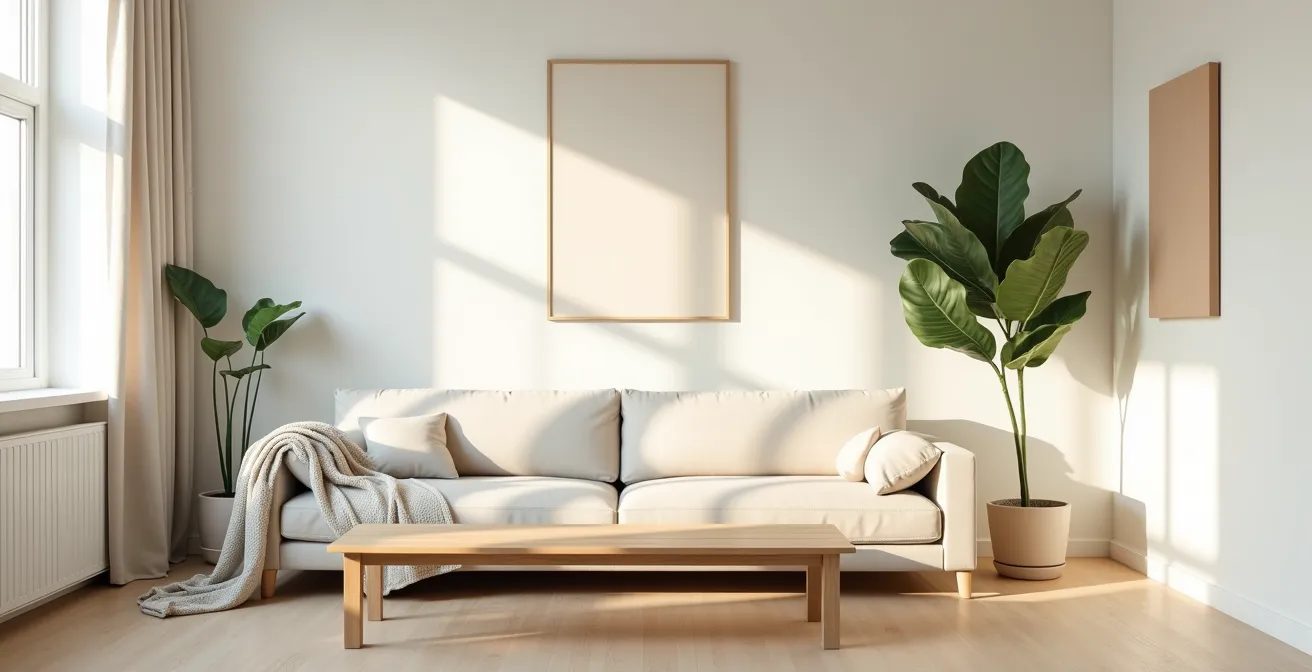
True minimalism in a family home is not about owning less, but about creating smart, low-friction systems that reduce your daily mental load.
- Scientific research shows a direct link between a cluttered home environment and elevated levels of the stress hormone cortisol, especially in women.
- The most effective strategies focus on managing the *flow* of items (the ‘One In, One Out’ rule) and using storage that provides ‘cognitive closure’ (closed cabinetry).
Recommendation: Shift your focus from simply hiding mess to designing systems that manage clutter automatically. Prioritize solutions that reduce decision-making and restore a sense of calm.
The dream of a minimalist home is serene, spacious, and calm. The reality for parents is often a landscape of scattered toys, overflowing school bags, and a never-ending tide of “stuff.” You love the clean aesthetic, but the daily chaos makes it feel like an impossible goal. The common advice is to buy more bins, baskets, and clever storage furniture. But this often just becomes a frustrating game of hide-and-seek with your clutter, moving the mess from the floor into a box without solving the underlying problem: the constant mental energy it takes to manage it all.
This feeling of being overwhelmed isn’t a personal failing; it’s a systems failure. The constant visual noise of a cluttered space doesn’t just look messy—it places a significant and measurable burden on your brain. The real challenge isn’t just about finding a place for everything, but about designing a home environment that actively works to reduce decision fatigue and restore your mental clarity. What if the key wasn’t about achieving a perfect, sterile space, but about implementing strategic, non-judgmental systems that manage the natural flow of family life?
This guide moves beyond generic organizing tips to explore the psychology of clutter and provide realistic, system-based solutions. We will examine the science behind clutter-induced stress, establish practical rules for managing items, compare storage philosophies, and explore smart furniture that creates space both physically and mentally. It’s time to create a home that feels as calm as it looks, even with a family in tow.
Summary: A Systematic Approach to a Clutter-Free Family Home
- Why Visual Clutter Increases Cortisol Levels in Women
- How to Execute the ‘One In, One Out’ Rule Successfully
- Open Shelving vs Closed Cabinetry: Which Maintains Minimalism?
- The Echo Problem: Dealing with Acoustics in Empty Rooms
- How to Create a Tech-Free Zone in a Open Plan House
- How to Zone an Open Space Using Slatted Wood Screens
- Why a Wall Bed Can Save You £10,000 in Property Value
- Smart Furniture Solutions for Studio Flats Under 40 Square Metres
Why Visual Clutter Increases Cortisol Levels in Women
The feeling of stress that arises when you walk into a messy room is not just in your head—it’s a physiological response. Research increasingly shows a powerful link between our physical environment and our hormonal health. For parents, especially mothers who often manage the household’s mental load, visual clutter acts as a chronic, low-grade stressor. It’s a constant to-do list made visible, subtly reminding you of tasks undone and decisions unmade. This isn’t about a preference for tidiness; it’s about your brain’s capacity for focused, calm thought being hijacked by environmental chaos.
The science backs this up. Studies have found that women living in cluttered homes show a stress hormone profile that is strikingly different from those in organized spaces. A landmark UCLA study on dual-income families revealed that wives who perceived their homes as “stressful” or cluttered had flatter diurnal slopes of cortisol. This pattern, where cortisol levels don’t decline normally throughout the day, is associated with a higher risk of adverse long-term health outcomes. In contrast, those who described their homes as “restorative” showed healthier, steeper cortisol slopes, indicating their environment helped them recover from stress.
Women don’t only notice the mess but begin to actively process what they need to do next and how they will do it. Thinking through the act of navigating clutter can create cognitive overload, which results in a stressed state that can cause agitation, overwhelm, and shutdown.
– Elizabeth Earnshaw, MA, LMFT, Psychology Today
This “cognitive overload” is the core of the problem. Every object in your field of vision competes for your attention, draining mental energy. For women, this effect is often amplified, as they tend to carry a heavier mental load related to home management. The visible mess serves as a constant, tangible reminder of this load, preventing the mind from ever truly being at rest. Understanding this connection is the first step toward creating a home that supports your well-being, not one that undermines it.
How to Execute the ‘One In, One Out’ Rule Successfully
The “One In, One Out” rule is a cornerstone of maintaining a minimalist home, yet it often fails in practice because it lacks a clear system. Simply vowing to discard an old item for every new one is too abstract. For the rule to work in a busy family home, it needs to be a built-in, low-friction process. The goal is to make letting go of items as easy and automatic as acquiring them. This requires creating physical stations and family habits that manage the flow of objects without requiring constant willpower or major decluttering sessions.
The key is to intercept items at the door and have a clear, non-negotiable exit strategy. This isn’t about deprivation; it’s about conscious curation. By gamifying the process for children and making donation a visible, positive family habit, you transform decluttering from a chore into a shared value. An attractive donation basket in a high-traffic area is far more effective than a hidden box in the garage because it keeps the process top-of-mind and reduces the friction of taking the next step.
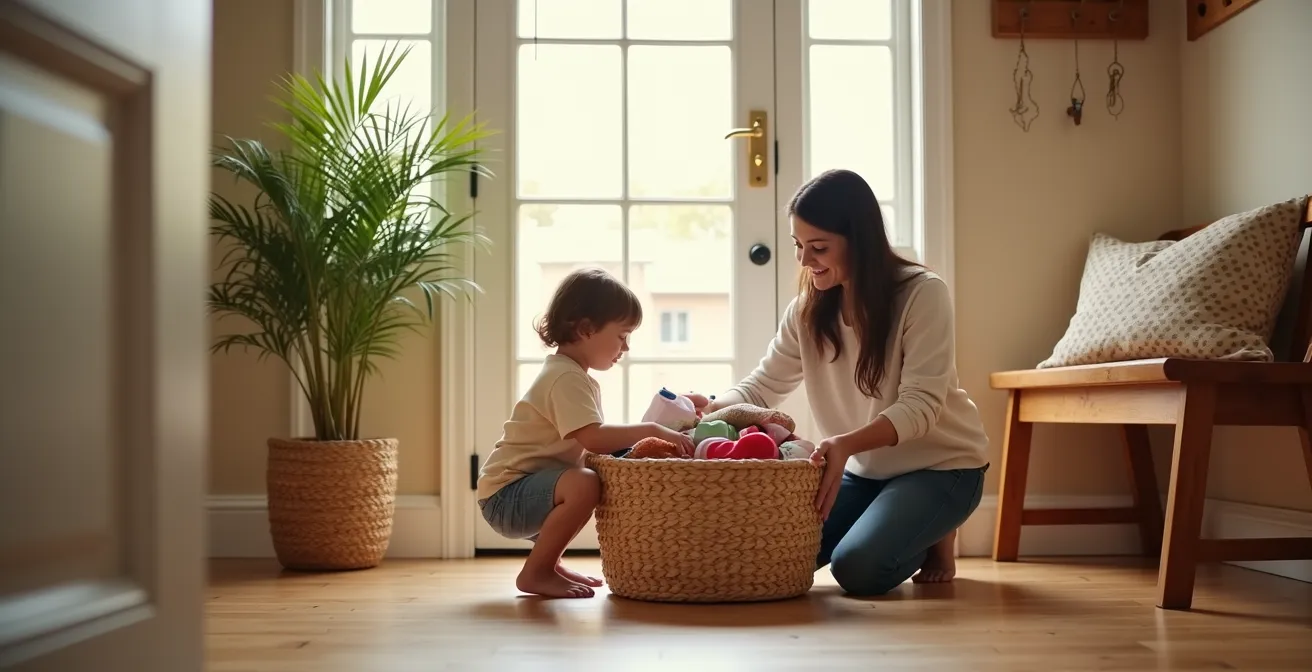
The visual of a designated, beautiful donation station, as shown above, reinforces the idea that letting go is a positive and organized action, not a sign of waste. It becomes part of the home’s aesthetic and rhythm. To systematize this, you need a clear plan of action that the whole family can understand and participate in.
Your Action Plan: Implementing a ‘One In, One Out’ System
- Create a Quarantine Box: Designate a ’24-hour quarantine box’ at your home’s main entrance. All new non-essential items (toys, clothes, decor) go here first, preventing them from immediately scattering and giving you a moment to decide what they will replace.
- Set Up a Permanent Outbox: Place a permanent ‘outbox’ or donation station in a high-traffic area, like the mudroom or near the front door. Use an attractive, open basket to make it an inviting part of the home.
- Use the ‘Upgrade Exception’: When replacing a functional item (like a new coffee maker or pair of shoes), the old one must be discarded or placed in the outbox at the exact moment the new one is put into use. No exceptions.
- Gamify the ‘Clutter Tax’: Frame the process for children as a ‘clutter tax’ or a ‘toy trade’. For every new toy that enters their space, one or two older, less-used toys must be placed in the donation basket. This teaches conscious consumption from a young age.
Open Shelving vs Closed Cabinetry: Which Maintains Minimalism?
The debate between open shelving and closed cabinetry is central to minimalist design, especially in a family context. While open shelves are aesthetically popular, they are often a source of significant visual vibration. Every single item—from a stack of plates to a child’s mug—creates a small demand on your attention. For a parent already managing a high mental load, this constant, low-level visual input can be exhausting. Open shelves require relentless curation and daily maintenance to look serene; otherwise, they quickly become a visible display of your clutter.
Closed cabinetry, on the other hand, provides what designers call cognitive closure. When a door is shut, the items behind it are mentally ‘dealt with’. Your brain registers the task of organizing them as complete, freeing up mental resources. This doesn’t mean you can hide chaos behind the doors—the interior still needs to be organized—but it removes the items from your immediate peripheral awareness. For a family, where objects are constantly in use and in flux, closed storage offers a quick ‘reset button’. In under five minutes, a visually chaotic space can be restored to a state of calm by simply closing the doors.
The following table breaks down the critical differences, helping you make a strategic choice for your home’s functionality and your mental well-being.
| Aspect | Open Shelving | Closed Cabinetry |
|---|---|---|
| Visual Noise Level | High – every item creates ‘visual vibration’ | Low – provides ‘cognitive closure’ |
| Reset Time | 10-15 minutes daily maintenance | Under 5 minutes to restore calm |
| Best Use Ratio | 10% for curated identity items | 90% for functional everyday items |
| Mental Energy Impact | Items remain in peripheral awareness | Brain registers items as ‘dealt with’ |
| Ideal For | Displaying 3-5 meaningful objects | Hiding daily-use items and clutter |
The most effective strategy is a hybrid model. Experts recommend a 90/10 split: allocate 90% of your storage to closed cabinetry for the functional, everyday items (like stacks of plastic kids’ plates, mismatched cups, and small appliances). Reserve just 10% for carefully curated open shelving to display a few meaningful objects that define your family’s identity—a special vase, a framed piece of your child’s art, or a treasured travel souvenir. This balance prevents the sterile, museum-like feel of an all-closed space while aggressively defending your home against visual noise.
The Echo Problem: Dealing with Acoustics in Empty Rooms
As you successfully declutter and embrace minimalist design, you might encounter an unexpected problem: echo. Hard surfaces, sparse furnishings, and open spaces can turn a visually calm room into an acoustically harsh one. Sound bounces off walls, floors, and ceilings, creating a cold, cavernous feeling that is the opposite of the cozy sanctuary you’re trying to create. This auditory clutter can be just as unsettling as visual clutter, making conversations feel loud and strained, and undermining the sense of peace.
A room with soft acoustics feels safer, more intimate, and more like a sanctuary, directly contributing to mental clarity.
– Interior Design Expert, Balance Through Simplicity Guide
The solution isn’t to re-clutter the space with bulky furniture. Instead, the focus should be on “textural minimalism”—layering soft, sound-absorbing materials that add warmth and function without adding visual noise. The goal is to absorb sound waves strategically, using elements that blend seamlessly into your minimalist aesthetic. Think of it as adding a “soft filter” to your room’s soundscape. This not only makes the space more pleasant to be in but also enhances feelings of intimacy and safety, reinforcing the home as a true refuge from the outside world.
Here are several effective, clutter-free ways to dampen sound and solve the echo problem:
- Install Thin Felt Wall Panels: Products like Akupanels or other slatted wood-and-felt panels add texture and absorb sound while maintaining a clean, modern look.
- Choose Natural Textiles: Opt for thick wool rugs and heavy linen or velvet curtains. These materials are excellent natural sound absorbers.
- Rethink Your Artwork: Replace standard glass-fronted art prints with large-scale canvas prints. The fabric surface is much better at dampening sound than reflective glass.
- Add Large Plants: Incorporate plants with large, dense foliage, such as a Fiddle Leaf Fig or a Snake Plant. Their leaves help to break up and scatter sound waves.
- Use Acoustic Paint: For a completely invisible solution, consider applying acoustic paint to walls or ceilings. It’s formulated with sound-absorbing fillers to reduce reverberation.
- Layer Soft Textures: Introduce bouclé fabrics on chairs or pillows, and use soft, woven baskets for storage. These textures work together to create a softer, more absorbent environment.
How to Create a Tech-Free Zone in a Open Plan House
In an open-plan family home, technology is one of the most pervasive forms of clutter. Cords, charging stations, tablets, and screens create constant visual noise and mental distraction. Creating a “tech-free zone” without walls can feel challenging, but it’s essential for mental clarity and family connection. The key is not to build physical barriers, but to establish powerful sensory boundaries. These are non-physical cues that signal to your brain and your family that you are transitioning into a different kind of space—one for rest, conversation, and analog activities.
This technique relies on creating a distinct shift in the atmosphere. It’s about making the tech-free zone so appealing and calming on a sensory level that the absence of screens feels like a relief, not a restriction. This can be more effective than rules alone, as it works on a subconscious level to change behavior.
Case Study: The Sensory Boundary Technique
The organization expert behind The Minimal Mom recommends using a combination of sensory cues to define a no-tech area. By pairing a shift to warm, low lighting (from a dedicated floor lamp), a calming scent from an essential oil diffuser, and a distinctively plush, textured rug underfoot, the brain learns to associate that specific corner with relaxation and disconnection. This method has proven highly effective for families in open-plan homes, creating a powerful psychological boundary where a physical one doesn’t exist.
To support this, you also need a “tech landing strip” — a single, organized spot where all devices “live” when not in use. This contains the visual clutter of cords and chargers to one designated area, preventing it from creeping into your living spaces. Here’s how to create an effective system:
- Install a Docking Station: Create a beautiful “docking station” right by the front door, ideally with built-in charging, where phones and tablets are placed upon entering the home.
- Hide the Hardware: Use attractive woven baskets or closed cabinets to hide routers, smart speakers, and nests of cords from view.
- Choose Smart Furniture: Select media units or side tables with integrated cable management systems to keep wires tidy.
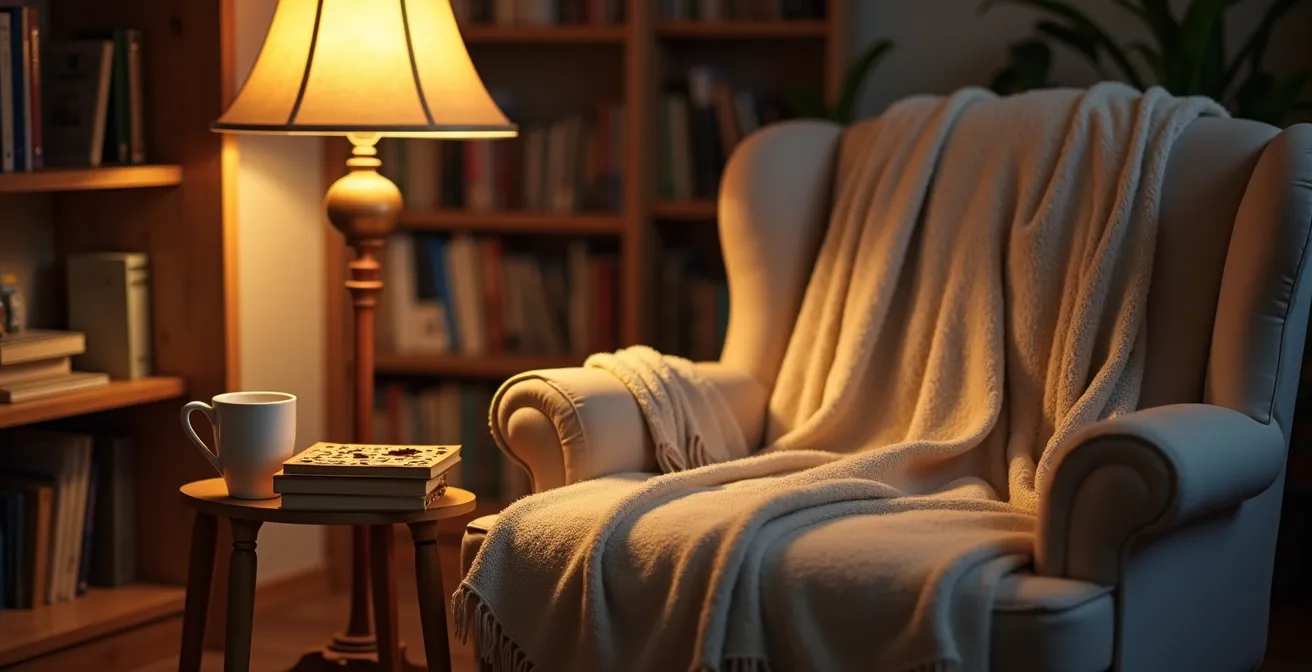
- Place an ‘Analog Anchor’: In the designated tech-free zone, place an “analog anchor”—an inviting puzzle, a few curated magazines, a beautiful board game, or simply a comfortable armchair and a soft throw blanket.
- Establish a Ritual: Make it a family habit to leave devices at the landing strip. Rituals are more powerful than rules.
How to Zone an Open Space Using Slatted Wood Screens
Open-plan living is a hallmark of modern design, but for families, a single, large space can lead to chaos and decision fatigue. Without clear boundaries, the living area can feel like a jumble of competing activities—work, play, and relaxation all bleeding into one another. The solution is not to build walls, but to use permeable barriers like slatted wood screens. These dividers create distinct psychological zones without sacrificing light or the sense of spaciousness, which is crucial for a minimalist aesthetic.
A slatted screen works by providing just enough visual separation to signal a change in function. It tells your brain, “This is the work area,” and “That is the relaxation area.” This simple act of delineation reduces the mental effort required to switch tasks and helps contain the activities—and the clutter associated with them—to their designated zones. It’s a way of having the best of both worlds: the airy feel of an open plan and the organizational clarity of separate rooms.
Case Study: Creating ‘Psychological Walls’
In one documented example, a family of six in a 1,500-square-foot home successfully used slatted wood screens to create distinct zones for a home office, a children’s play area, and a quiet reading nook within their main living space. The screens act as ‘psychological walls,’ clearly delineating the purpose of each area. This has been credited with significantly reducing decision fatigue and containing clutter, all while maintaining the bright, open feel essential to their minimalist lifestyle.
To maximize their utility, these screens can be more than just dividers. By integrating subtle, minimalist functions, they become an active part of your home’s organizational system. The key is to add functionality without adding visual clutter.
- Add a Discreet Hook: Choose a screen design that allows for a small, integrated hook for hanging headphones or a single set of keys.
- Incorporate a Slim Ledge: A slim ledge at waist height can hold a single coffee cup, a small plant, or a phone while it charges, serving a purpose without becoming a clutter magnet.
- Use Dynamic Light: Position screens to catch sunlight, creating dynamic patterns of light and shadow that shift throughout the day, adding visual interest without adding objects.
- Integrate Minimal Shoe Storage: Use the solid base of a screen near an entrance for minimal shoe storage, with a strict limit of one or two pairs per person.
- Consider a Track System: For ultimate flexibility, install screens on a ceiling track. This allows you to reconfigure the space in seconds, opening it up for entertaining or closing it off for focused work.
Why a Wall Bed Can Save You £10,000 in Property Value
In the quest for minimalist living, the biggest culprit of lost space is often the bed. A standard bed occupies a huge amount of floor space 24/7, even though it’s only used for about eight hours a day. This is where a modern wall bed (or Murphy bed) becomes a powerful financial and spatial tool. It’s not just about hiding a bed; it’s about reclaiming an entire room’s worth of functionality. This transformation can have a direct and significant impact on your property’s perceived value, especially in markets where space is at a premium.
The math is simple. A standard queen bed can take up 35 square feet of floor space. In many urban areas, with property values averaging $200-300 per square foot, that single piece of furniture is effectively occupying $7,000-$10,500 of “dead” space. As a case study from GoDownsize.com shows, a wall bed reduces this footprint to just 8.5 square feet when closed, effectively “creating” $6,000-$9,500 worth of usable space for an investment of around $3,000. This isn’t just a theoretical gain; it translates into tangible value when you sell or rent your property.
By transforming a room from single-purpose (a bedroom) to multi-purpose (a home office, gym, or playroom that also serves as a guest room), you fundamentally change how it is marketed and perceived by potential buyers or renters. This added functionality is a major selling point that can increase perceived value far beyond the cost of the bed itself.
| Property Type | Without Wall Bed | With Wall Bed | Value Impact |
|---|---|---|---|
| Studio Apartment | Listed as studio | Marketed as ‘1-bedroom functionality’ | +15-20% perceived value |
| Home Office | Single-purpose room | Office/Guest Room hybrid | Appeals to remote workers |
| Small Bedroom | Limited floor space | Multi-functional space | Stages larger for buyers |
| Rental Property | Sleeps 2-4 | Sleeps 4-6 | Potential for higher nightly rates |
A wall bed is one of the single most impactful investments you can make in a small or minimalist home. It’s a strategic decision that pays dividends in daily functionality, mental clarity (by creating more “negative space”), and long-term property value.
Key Takeaways
- Visual clutter is not just messy; it’s a measurable source of stress, particularly for women, due to its impact on cortisol levels.
- The most effective storage is closed cabinetry, which provides ‘cognitive closure’ and reduces the constant mental processing of visible items.
- Smart space-saving is about ‘frictionless transformation’ (e.g., wall beds) and creating psychological zones, not just adding multi-functional pieces that create more work.
Smart Furniture Solutions for Studio Flats Under 40 Square Metres
Living in a small space, such as a studio flat under 40 square metres, requires a radical approach to furniture. Every piece must earn its keep, but the common wisdom of “multi-functional” furniture can be a trap. An ottoman with storage or a sofa bed with a complex mechanism often creates more problems than it solves. These high-friction solutions add to your daily mental load, and the effort required to transform them means they are rarely used to their full potential. The true key to small-space living is zero-friction transformation.
The smartest furniture isn’t just multi-functional, it’s ‘zero-friction’. High-friction transformations like complex sofa beds create daily mental clutter and are rarely used.
– Michelle Marine, Simplify, Live, Love
Zero-friction furniture is designed to convert in a single, effortless motion. A modern wall bed that pulls down smoothly is superior to a sofa bed that requires removing cushions, unfolding a heavy frame, and making the bed from scratch. This principle extends to all furniture choices. The goal is to create a flexible, adaptable space that can change its function in seconds, not minutes. This approach, combined with a focus on preserving “negative space,” is what creates a feeling of spaciousness and calm, even in the most compact homes.
Here is a guide to selecting zero-friction, high-impact furniture for a small studio:
- Prioritize Single-Motion Transformations: Always choose furniture that transforms in one easy step. A high-quality wall bed is a better investment than a complicated sofa bed. A dining table that folds down from the wall is better than one that requires complex assembly.
- Embrace Floating Furniture: Use wall-mounted desks, nightstands, and media units whenever possible. By keeping the floor clear, you create an unbroken sightline that makes the room feel significantly larger.
- Choose Visually Lightweight Pieces: Select furniture with slim legs or transparent materials like acrylic or glass. These pieces have less visual weight and allow light to pass through, reducing their footprint in the space.
- Invest in Nesting and Stacking: Nesting side tables and stackable chairs provide expandable functionality without taking up permanent space. You can accommodate guests easily and then reclaim your space afterward.
- Maintain Negative Space: Adhere to the 60% rule: aim to keep at least 60% of your floor and wall space empty. This “negative space” is not wasted; it’s essential for psychological comfort and a feeling of calm.
To begin reclaiming your space and your peace of mind, start by implementing just one of these systems today. Choose the one that addresses your biggest point of friction, and build from there. A truly minimalist family home is a journey, not a destination.