
The most profitable conversion isn’t about gaining the most space, but the most valuable space; basements often fail this test despite their higher initial appeal.
- Basements cost up to double per square metre due to extensive structural work and critical waterproofing risks.
- Lofts, especially hip-to-gable designs, offer a superior Return on Investment (ROI) by maximizing ‘walkable’ high-value floor area with fewer regulatory hurdles.
Recommendation: Prioritize a loft conversion for a faster, more predictable ROI. Only consider a basement if you have exhausted all above-ground options and hold a significant contingency budget for unforeseen structural and legal costs.
For any London property owner, the desire for more space is a constant battle against the city’s prohibitive property prices. With lateral expansion often impossible, the only ways to go are up, into the loft, or down, into the ground. The common wisdom suggests a loft conversion is the standard choice for an extra bedroom, while a basement dig offers the potential for a luxurious, multi-room extension. This often frames the decision as a lifestyle choice between a simple extra room and a premium underground space.
However, from a property developer’s or quantity surveyor’s perspective, this is the wrong question. The decision should not be driven by vague notions of luxury but by a cold, hard analysis of Return on Investment (ROI). The crucial metric is not just the total value added, but the net value added per pound spent, per square foot gained. This requires a deep dive into the factors the brochures don’t mention: the true cost of creating ‘walkable floor area’, the impact of regulatory choke points like fire safety and party wall negotiations, and the long-term financial risk of structural liability. A loft conversion and a basement extension are not equal investments, and understanding their profound differences in cost, risk, and value is the key to a profitable project.
This guide will dissect the loft versus basement dilemma through the uncompromising lens of a quantity surveyor. We will break down the real costs per square metre, navigate the critical regulations that can derail a project, analyse which designs truly maximize usable space, and even explore value engineering alternatives that can deliver a surprising ROI without a full-scale conversion. By the end, you will be equipped to make a decision based not on aspiration, but on a sound financial strategy.
Summary: A Developer’s Analysis of Loft vs. Basement ROI
- Why Basements Cost £1,000 More Per Square Metre Than Lofts
- How to Design Fire Escape Routes for 3-Storey Homes
- Hip-to-Gable vs Dormer: Which Maximizes Walkable Floor Area?
- The Tanking Failure That Floods Basements Years Later
- When to Serve Notices to Neighbours for a Basement Dig
- Why a Wall Bed Can Save You £10,000 in Property Value
- How to Serve a Party Wall Notice to Your Neighbours Correctly
- Removing Load-Bearing Walls: Costs and Regulations in the UK
Why Basements Cost £1,000 More Per Square Metre Than Lofts
The fundamental difference in ROI between a loft and a basement conversion begins with the raw construction cost. While a finished basement may feel premium, the process to create it is fraught with heavy engineering and significant risk, which is directly reflected in the price. From a quantity surveyor’s standpoint, the numbers are stark. A basic loft conversion offers a relatively predictable and contained project scope, often working within the existing building envelope. In contrast, excavating a new basement is akin to a major civil engineering project conducted underneath a delicate, existing structure.
The cost escalates due to several non-negotiable factors: the need for extensive excavation and soil removal, the complex underpinning required to support the entire house and its neighbours, and the critical, multi-layered waterproofing systems needed to prevent future damp. These elements are not optional extras; they are fundamental to the project’s structural integrity and longevity. As a result, even refurbishing an existing cellar is more expensive than a simple loft conversion, and creating a new basement from scratch is in another league entirely. According to London conversion specialists, a standard loft conversion might cost between £50,000 and £70,000, while a new basement starts at £140,000 and can easily exceed £250,000.
This detailed cost breakdown illustrates precisely where the money goes. The cost per square metre for a new basement excavation is often more than double that of a simple loft, a differential that must be justified by a significant uplift in final property value to be a sound investment.
| Conversion Type | Cost per Square Metre | Total Project Cost |
|---|---|---|
| Simple loft conversion | £1,150-£1,450/m² | £50,000-£70,000 |
| Refurbishing existing cellar | £1,200-£1,900/m² | £60,000-£90,000 |
| Lowering floor & underpinning | £1,500-£2,500/m² | £75,000-£125,000 |
| New basement excavation | £2,000-£4,000/m² | £140,000-£250,000+ |
Ultimately, this initial cost disparity means a basement project starts with a significant financial handicap. It must generate substantially more value than a loft just to break even on a £/m² basis, a challenge that is often underestimated.
How to Design Fire Escape Routes for 3-Storey Homes
Adding a new habitable floor to a property, whether in the loft or the basement, fundamentally changes its fire safety dynamics. Building Regulations (Approved Document B) are stringent and non-negotiable, particularly for three-storey homes. Designing compliant escape routes is not a finishing touch; it is a critical ‘regulatory choke point’ that must be factored into the initial plans, as failure to do so can lead to costly redesigns or render the new space legally uninhabitable as a bedroom.
The core principle is creating a ‘protected escape route’. For a loft conversion, this means the stairway leading from the new floor down to the final exit door must be enclosed by materials offering at least 30 minutes of fire resistance. This typically requires installing new fire-rated doors (FD30s) at every level of the stairwell, including the entrance to the loft itself. For basements, the challenge is different. Any new bedroom must have an independent escape route to the outside, which usually means a certified egress window or door. This window must have a minimum clear opening size and be positioned no more than 1.1 metres from the finished floor level, a detail that heavily influences the basement’s layout and external landscaping.
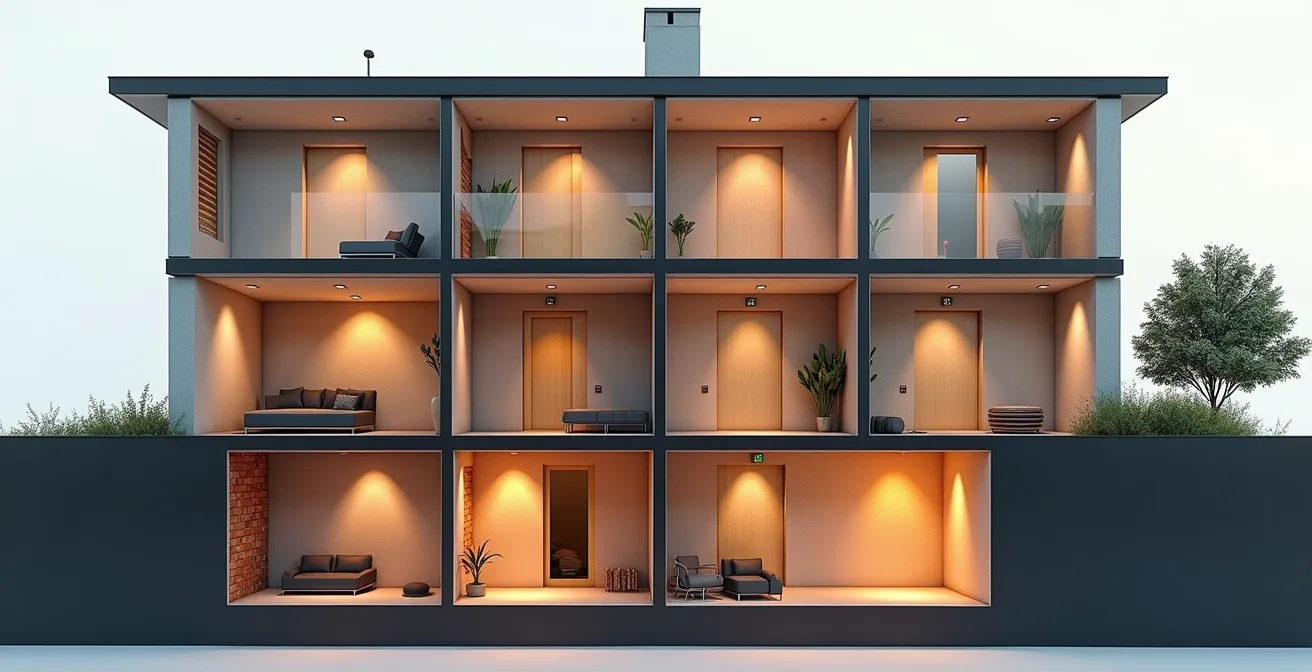
Furthermore, the entire property’s alarm system must be upgraded. This involves installing an interconnected system of mains-powered smoke alarms on every floor, along with a heat detector in the kitchen. In some cases, especially with modern open-plan ground floors that compromise the protected route, compensatory features like a residential sprinkler or mist system may be required by building control, adding another layer of cost and complexity. These are not minor details; they are fundamental to project viability.
Action Plan: Key Fire Safety Requirements for 3-Storey Conversions
- Protected Stairway: Ensure the entire stairway from the new floor to the final exit is enclosed with 30-minute fire-resistant construction, including FD30 fire doors at every habitable room opening onto it.
- Basement Egress: For any basement bedroom, design and install a certified escape window or door leading directly outside, ensuring it meets size and height-from-floor requirements.
- Interlinked Alarms: Upgrade the entire property to a Grade D, LD2 system of interlinked, mains-powered smoke alarms on every level, plus a heat alarm in the kitchen.
- Party Wall Protection: Verify and, if necessary, upgrade the party wall in a loft conversion to provide full fire resistance from the eaves to the roof ridge, preventing fire spread to neighbours.
- Compensatory Features: If an open-plan layout compromises the escape route, consult with building control early to agree on compensatory measures, such as installing a sprinkler or mist system.
Failing to account for these requirements from day one is a common and expensive mistake. A surveyor will always budget for these items as a core project cost, not an afterthought.
Hip-to-Gable vs Dormer: Which Maximizes Walkable Floor Area?
When assessing the ROI of a loft conversion, not all designs are created equal. The primary goal is to maximize the creation of high-value, usable space, which a surveyor refers to as ‘walkable floor area’—typically defined as the area with a ceiling height of 1.9m or more. This is where the choice between a simple Dormer conversion and a more structural Hip-to-Gable conversion becomes a critical financial decision. While a dormer adds a box-like structure to the rear slope of the roof, a hip-to-gable conversion replaces the entire sloping side of the roof (the ‘hip’) with a vertical wall (the ‘gable’), dramatically increasing the internal volume.
For properties with hipped roofs, common in semi-detached and detached London homes, a hip-to-gable is almost always the superior choice for maximizing ROI. The extra cost is relatively marginal in the context of the overall project—as the latest pricing data shows a hip-to-gable might cost £66,000-£112,000 versus a dormer at £64,000-£110,000—but the gain in full-height, usable space can be transformative. This additional space is what allows for a comfortable master bedroom with an ensuite, rather than a compromised room with sloping ceilings. Many hip-to-gable conversions also fall under permitted development rights, avoiding the time and cost of a full planning application, a significant advantage over most basement projects.
This focus on usable space directly translates to property value. Research has shown that a well-executed loft conversion creating a large master bedroom and ensuite can add a significant percentage to a home’s value. According to Nationwide’s chief economist, a full loft conversion can add 20% to the property’s value, with the bedroom accounting for 15% and the ensuite another 5%. By investing slightly more in a hip-to-gable design, a property owner is not just buying space; they are buying high-value, functional square footage that delivers a quantifiable return.
Therefore, when evaluating a loft project, the key question is not “what is the cheapest option?” but “which design generates the most valuable and functional space for the capital invested?”
The Tanking Failure That Floods Basements Years Later
The single greatest structural liability in a basement conversion is water. A failure in the waterproofing system, or ‘tanking’, can lead to catastrophic and ruinously expensive problems years after the project is completed. Unlike a leaky roof, a failed basement membrane is buried behind finished walls and floors, making diagnosis and repair an incredibly disruptive and costly exercise. For a quantity surveyor, the risk of tanking failure is a major financial variable that must be mitigated with robust design and expert installation, as cutting corners here is a false economy of the highest order.
The British Standard for waterproofing (BS 8102:2009) outlines three types of protection, and understanding them is key to assessing risk. This is not just a contractor’s concern; it’s a core aspect of the investment’s long-term security. The choice of system has profound implications for cost and reliability.

The most robust solutions often involve a ‘belt and braces’ approach, combining two different types of systems—for example, a Type A membrane with a Type C cavity drain system. The Type C system is particularly important as it is designed to manage any water that may find its way past the primary barrier, channelling it to a sump pump for removal. As experts in building control point out, a properly managed system is the key to compliance and long-term success.
Three methods of basement waterproofing are defined in the standard: ‘Type A’ (barrier protection) which requires a tanking membrane, ‘Type B’ (structurally integral protection) relies on the quality of the concrete structure only and is not suitable for all applications, ‘Type C’ (drained protection) allows water into the structure, but collects it and drains it away from the occupied areas
– LABC Building Control, Building Regulations Compliance Guide
An investor must demand a system designed by a Certified Surveyor in Structural Waterproofing (CSSW) and installed by specialists with an insurance-backed guarantee. Anything less is a significant and unjustifiable gamble with the property’s value.
When to Serve Notices to Neighbours for a Basement Dig
Excavating a basement is one of the most invasive forms of construction you can undertake, and its impact on neighbouring properties is a primary legal and financial concern. The Party Wall etc. Act 1996 is not optional; it is a legal framework designed to manage this process. For a basement project, navigating the Act correctly is a critical path item that can significantly affect timelines and budgets. Serving the correct notices at the right time is paramount, as errors can lead to expensive delays or even court injunctions, stopping work entirely.
The Act grants you the right to perform the work but simultaneously protects your neighbours from potential damage. As basement specialists OLBC Construction clarify, this legal right comes with strict procedural obligations.
The Act grants you the legal right to undertake certain works, such as a loft or basement conversion, that might otherwise constitute trespass or nuisance… However, the Act also protects your neighbours’ interests from any adverse effects that a basement conversion might have by imposing a requirement that all adjoining owners are aware of the works and have signed a party wall agreement
– OLBC Construction, Party Wall Agreements for Basement Conversions Guide
For a basement dig, the most relevant part is typically Section 6, which covers adjacent excavation. You must serve notice to any neighbour whose property is within 3 metres of your planned excavation if your new foundations will go deeper than theirs. This notice must be served at least one month before work begins. The process, however, should start much earlier with informal diplomacy to maintain good relations. A successful party wall process is a blend of legal compliance and neighbourly communication.
Action Plan: Timeline for Party Wall Notices in Basement Projects
- Pre-Notice Diplomacy (3-6 Months Prior): Initiate informal conversations with your neighbours. Share preliminary plans and explain the nature of the work to build goodwill before the formal process begins.
- Serve Formal Notice (1-2 Months Prior): Serve a Section 6 ‘Adjacent Excavation’ notice a minimum of one month before your planned start date. Ensure it is served to the legal freeholder, not tenants.
- Allow for Response (14-Day Period): The adjoining owner has 14 days to consent in writing. If they dissent or do not respond, a ‘dispute’ is automatically triggered.
- Conduct Schedule of Condition (Before Work Begins): Before any work starts, a surveyor must conduct a detailed ‘schedule of condition’ survey of the neighbour’s property to document its existing state. This protects both parties.
- Appoint Surveyors & Award (If in Dispute): If a dispute arises, both you and your neighbour will appoint a surveyor (or agree on one) who will draw up a Party Wall Award—a legal document outlining how the work will be carried out.
Budgeting for party wall surveyors should be a standard line item in any basement cost plan. Expect to pay between £1,000 to £2,000 per neighbour, a cost that can quickly multiply in a terraced London street.
Why a Wall Bed Can Save You £10,000 in Property Value
In the relentless pursuit of square footage, property owners often overlook the power of ‘value engineering’—achieving the desired function at a fraction of the cost. Not every need for an “extra bedroom” requires a £50,000+ construction project. In space-constrained London properties, the challenge is often not a lack of rooms, but a lack of flexibility. A room that must serve as a home office by day and a guest room by night is a common scenario. Here, a high-quality, bespoke wall bed (or Murphy bed) system can be a surprisingly powerful investment.
Instead of adding a new room, a wall bed system transforms an existing one, making it dual-purpose without sacrificing daily functionality. When folded away, it can be integrated into a seamless wall of storage or a dedicated desk unit. This preserves the valuable floor space of the room for its primary use, whether as an office, a gym, or a playroom. When needed, it converts the space into a comfortable guest bedroom in seconds. This flexibility is highly attractive to potential buyers who face the same spatial dilemmas.
From an ROI perspective, the numbers are compelling. A full conversion is a high-cost, high-value proposition, but a wall bed is a low-cost, high-impact solution. It unlocks value that is already present in the property but is being inefficiently used. The table below demonstrates the stark difference in investment efficiency.
| Solution | Cost | Space Created | Value Added | ROI |
|---|---|---|---|---|
| Bespoke Wall Bed System | £4,000 | Multi-function room | £10,000 | 150% |
| Basic Loft Conversion | £50,000 | Extra bedroom | £70,000 | 40% |
| Full Basement Conversion | £140,000 | Multiple rooms | £180,000 | 28% |
While it doesn’t create new square footage, a wall bed multiplies the value of existing footage. It solves the “guest room problem” for a fraction of the cost of a conversion, freeing up capital and avoiding months of disruptive construction work—a smart developer’s move.
How to Serve a Party Wall Notice to Your Neighbours Correctly
The Party Wall Act is a frequent source of confusion for homeowners, but its principles are straightforward. It applies whenever you are doing work directly to a shared ‘party structure’ (like a wall or floor between two properties) or excavating near a neighbour’s foundations. For a loft conversion, the Act is typically triggered when inserting new steel beams into the party wall to support the new floor. For any conversion, understanding the notice periods and the correct legal procedure is essential for maintaining a positive relationship with neighbours and avoiding costly disputes.
The first step is identifying which part of the Act applies. For work on the party wall itself (e.g., inserting beams for a loft), you must serve a Section 2 Party Structure Notice, which requires a minimum of two months’ notice before work begins. For excavations near a neighbour’s property (critical for basements), a Section 6 Adjacent Excavation Notice is required with one month’s notice. Serving the wrong notice or serving it to the wrong person (e.g., a tenant instead of the legal freeholder) will invalidate it, causing significant delays.
Once served, the adjoining owner has 14 days to respond. They can consent in writing, allowing work to proceed. If they dissent, or simply don’t reply, they are deemed to be ‘in dispute’. At this point, surveyors must be appointed. The most cost-effective route is for both parties to agree on a single ‘Agreed Surveyor’. If they cannot agree, each side appoints their own surveyor, and the two surveyors then select a third to arbitrate any disagreements—a process that significantly increases professional fees. The surveyors’ role is to produce a Party Wall Award, a legal document that sets out the what, how, and when of the work, and includes a schedule of condition of the neighbour’s property to protect all parties.
While the process can seem daunting, approaching it with clear communication and a willingness to follow the legal steps is the best way to prevent a minor building project from escalating into a major neighbourly dispute.
Key Takeaways
- Cost is King: Basements are fundamentally more expensive, costing up to double per square metre (£2,000-£4,000/m²) compared to lofts (£1,150-£1,450/m²) due to heavy engineering and structural risks.
- Focus on ROI, Not Just Space: A well-designed loft conversion that maximizes ‘walkable floor area’ can add up to 20% to a property’s value, often delivering a better return on investment than a more expensive basement.
- Mitigate Inherent Risks: The biggest financial risks are basement waterproofing (tanking) failures and navigating the Party Wall Act for excavations, both of which require specialist expertise and significant budget contingency.
Removing Load-Bearing Walls: Costs and Regulations in the UK
Whether as part of a larger conversion or a standalone project, creating modern, open-plan living spaces often involves removing internal walls. However, not all walls are simple partitions. Removing a load-bearing wall is a major structural intervention that requires careful planning, engineering calculations, and Building Regulations approval. A load-bearing wall supports the weight of the structure above it—be it a floor, a roof, or another wall. Removing one without providing adequate alternative support can lead to catastrophic structural failure.
The process always begins with a structural engineer. They will assess the wall and calculate the loads it is carrying. Based on these calculations, they will design a new support system, typically one or more steel beams (RSJs) or a goalpost frame, to transfer the load safely to the foundations. This engineer’s report and drawings are not optional; they are essential for both the contractor to work from and for the Building Control department to approve. Attempting this work without professional engineering input is illegal and exceptionally dangerous.
The cost of removing a load-bearing wall varies significantly based on the length of the span, the size of the steel beam required, and the complexity of the installation. In London, where labour costs are higher, this type of structural work is a significant investment. According to data from London-based architectural firms, the cost for removing a structural wall, including the engineer’s fees, the steel beam, installation, and making good, can range from £5,000 to £15,000 for a typical project. This cost must be factored into any conversion budget where an open-plan layout is desired, as it is a common and often underestimated expense.
To put this in perspective, this single element of a project can cost as much as a new kitchen. Before committing to a conversion project, the next logical step is to commission a detailed feasibility study and cost plan from a qualified surveyor. This initial investment will identify all structural and regulatory costs upfront, preventing budget overruns and ensuring your project delivers maximum value per square foot.
Frequently Asked Questions on Conversion Regulations
What’s the difference between Section 2 and Section 6 notices?
A Section 2 Party Structure Notice requires 2 months’ notice for work directly affecting a party wall, such as inserting steel beams for a loft. A Section 6 Adjacent Excavation Notice requires 1 month’s notice for any excavation within 3 to 6 metres of a neighbouring property’s foundations, which is standard for most basement conversions.
What happens if my neighbour doesn’t respond within 14 days?
If no written consent is received within 14 days of serving a Party Wall Notice, a ‘dispute’ is automatically triggered under the Act. You cannot proceed with the works. You must then appoint a surveyor, and if your neighbour does not appoint one, you must appoint one on their behalf to prepare a legally binding Party Wall Award.
Can I serve notice to a tenant instead of the freeholder?
No. The notice must be served to the legal owner of the property, which is typically the freeholder or a leaseholder with a lease of more than one year. You can find the legal owner’s details through the Land Registry. Serving a notice to a tenant is not valid and will be dismissed, causing significant delays to your project.