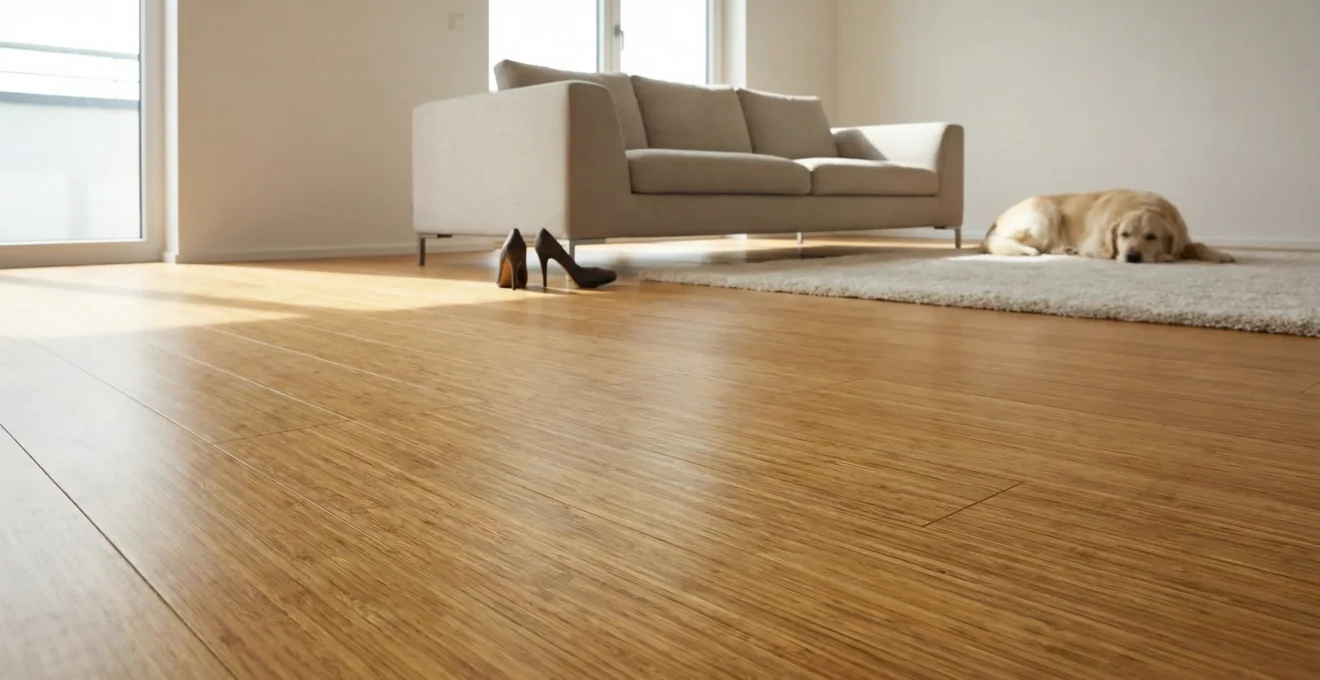
Strand woven bamboo is technically harder than oak, but its finish is the real line of defense against claws and heels.
- Strand woven varieties score up to 3x higher on the Janka scale than traditional hardwoods.
- Moisture control during installation is critical to prevent gaps where dirt accumulates.
- Not all bamboo is safe; cheap options often carry formaldehyde risks.
Recommendation: Opt for strand woven bamboo with a high-quality aluminum oxide finish and verify CARB Phase 2 compliance for a floor that survives active households.
If you are reading this, you are likely standing in a showroom or browsing samples online, torn between the eco-friendly promise of bamboo and the terrifying reality of your Labrador’s claws. It is the classic homeowner’s dilemma: you want the warm aesthetic of wood, but you live a life that demands the resilience of concrete. The market is flooded with generic advice telling you bamboo is “strong” and “green,” often failing to mention that there are different types of bamboo, some of which dent if you look at them the wrong way.
Most buying guides will simply toss Janka hardness numbers at you without context. They ignore the chemistry of the finish or the physics of acclimatization. But if we look closer, we find that durability isn’t just about hardness; it’s about engineering. From the specific weave of the fiber to the glues that bind it, the difference between a floor that lasts 20 years and one that fails in two lies in the manufacturing details. We are going to stress-test these claims, looking at everything from impact resistance to air quality.
But durability doesn’t stop at the floorboards. To understand how materials hold up in a busy home, we need to look at the bigger picture of your renovation materials. By examining the structural integrity of bamboo alongside other engineered materials in your home, we can separate marketing fluff from material science.
The following sections break down the mechanical realities of living with bamboo flooring.
Table of Contents: Durability Analysis
- Why Strand Woven Bamboo Is 2x Harder Than Oak
- How to Acclimatize Bamboo to Prevent Shrinkage Gaps
- Bamboo vs Cork: Which Is the Lower Carbon Flooring?
- The Formaldehyde Glue Risk in Cheap Bamboo Flooring
- How to Refinish Bamboo When You Can’t Sand It
- Wood-Effect Porcelain vs Real Wood: Can You Tell the Difference?
- MDF vs Birch Ply: Which Is Best for Painted Wardrobes?
- Fitted Wardrobes: Are They Worth the £3,000 Investment?
Why Strand Woven Bamboo Is 2x Harder Than Oak
Let’s get straight to the physics. If you buy “horizontal” or “vertical” bamboo, you are buying a floor that will dent when you drop your keys. However, strand woven bamboo is an entirely different beast. It is not made by layering strips, but by shredding the bamboo into fibers, dipping them in resin, and compressing them under immense pressure. This process creates a material with a density that rivals tropical hardwoods.
To visualize why this matters for dog owners, look at the material structure. Standard wood has a grain that can split; strand woven bamboo is essentially a composite block. The image below reveals this density.
This macro view illustrates the interlocking fibers that give strand woven bamboo its structural integrity. Unlike the open grain of oak, these compressed strands leave no room for compression dents.
As you can see, the resin bonding creates a nearly solid surface. In terms of raw impact resistance, industry testing data shows a 3,800–5,000 Janka rating for strand woven bamboo, compared to Red Oak which sits comfortably around 1,290. This means it requires more than twice the force to embed a steel ball into the bamboo than it does for oak. For a high-heel impact, which concentrates weight into a tiny surface area, this hardness is non-negotiable.
The following table compares these hardness ratings to give you a clear hierarchy of durability.
Data indicates that strand woven options outperform traditional hardwoods, as detailed in this Janka hardness comparison.
| Flooring Material | Janka Rating (kN) | Relative Hardness |
|---|---|---|
| Strand Woven Bamboo | 15.8 kN | Extremely Hard |
| Jatoba (Brazilian Cherry) | 10.5 kN | Very Hard |
| Maple | 6.4 kN | Hard |
| Solid Bamboo | 6.2 kN | Hard |
| Oak | 6.0 kN | Medium-Hard |
| Walnut | 4.5 kN | Medium |
| Cherry | 4.2 kN | Soft |
However, hardness is useless if the floor pulls itself apart.
How to Acclimatize Bamboo to Prevent Shrinkage Gaps
Bamboo is hygroscopic; it breathes. The most common failure in bamboo flooring isn’t scratches—it’s gaps opening up between the boards because the installer treated it like plywood. Strand woven bamboo is dense, which means it takes significantly longer to adjust to the moisture content of your home than standard timber.
If you rush this process, your floor will shrink in the winter, leaving gaps where dirt and pet hair will pack in, eventually ruining the subfloor connection. In extreme climates, strand-woven bamboo requires up to 30 days to fully acclimatize. Ignoring this timeline is the primary cause of installation failure.
Protocol for Acclimatization Audit : 5 Steps
- Points of contact: Ensure job site humidity is maintained within a 40%-60% relative humidity range, with temperatures between 60-80°F.
- Collecte: Remove flooring from packaging and sticker-stack the planks in a lattice formation to facilitate airflow between boards.
- Cohérence: Wait until bamboo flooring adjusts to room temperature and humidity (minimum 72 hours, up to 30 days for strand-woven in extreme climates).
- Mémorabilité/émotion: Use a pinless moisture meter to verify bamboo and subfloor moisture content are within 3% of each other.
- Plan d’intégration: Only proceed with installation when moisture equilibrium has been achieved—not based on time alone.
Do not rely on the calendar; rely on the moisture meter. If the differential between your subfloor and the bamboo is greater than 3%, you are installing a ticking time bomb.
Stability is vital, but many owners choose bamboo for its carbon profile.
Bamboo vs Cork: Which Is the Lower Carbon Flooring?
Marketing materials love to paint all rapidly renewable materials with the same green brush, but the carbon cycle of bamboo is distinct from cork. Bamboo is a grass that is clear-cut and regrows from the root system, whereas cork is bark harvested from living trees. In terms of raw sequestration during the growth phase, bamboo is a powerhouse.
The speed of growth allows for rapid carbon intake. Comparative analysis indicates that bamboo forests sequester 6.88 metric tons of CO₂ per acre annually, which is roughly 70% more than a typical hardwood forest. This makes the raw material incredibly efficient at scrubbing the atmosphere.
Life Cycle Assessment: The Processing Penalty
A peer-reviewed study found that producing 1 m³ of bamboo scrimber flooring generates 252.65 kg CO₂eq in emissions, but the product stores 267.54 kg CO₂eq, resulting in a net negative carbon footprint of -14.89 kg CO₂eq—making it technically carbon-negative when lifecycle factors are considered.
However, the transport footprint and the resin usage in strand woven bamboo add a “processing penalty” that cork, which requires less industrial compression, often avoids. Cork is the winner for minimal processing, but bamboo wins on raw regeneration speed and durability-to-carbon ratio.
Environmental safety leads us directly to the chemicals used in that processing.
The Formaldehyde Glue Risk in Cheap Bamboo Flooring
Here is the dirty secret of the bamboo industry: to make grass as hard as steel, you have to glue it together. The resin used in this process can be a source of Volatile Organic Compounds (VOCs), specifically formaldehyde. Bargain-basement bamboo flooring is often cheap because manufacturers use urea-formaldehyde adhesives that off-gas for years, compromising your indoor air quality.
For pet owners, whose animals spend their lives with their noses inches from the floor, this is a critical safety factor. You must demand transparency. The global benchmark for safety is the CARB Phase 2 standard which limits emissions to ≤0.05 ppm. If a retailer cannot show you this certification, walk away.
Action Plan for Toxic Glue Detection : Safety Audit
- Points of contact: Look for CARB Phase 2 certification on packaging (limits formaldehyde to 0.05 ppm).
- Collecte: Check for NAUF (No Added Urea Formaldehyde) or ULEF (Ultra-Low Emitting Formaldehyde) labels.
- Cohérence: Verify FloorScore or GREENGUARD certification for comprehensive VOC testing.
- Mémorabilité/émotion: Request the Material Safety Data Sheet (MSDS) to confirm adhesive and coating composition.
- Plan d’intégration: Perform the ‘smell test’: fresh bamboo with a sour or pickle-like odor indicates uncured resins.
Do not compromise on this. A “sour” smell is not the smell of nature; it is the smell of bad chemistry.
Eventually, even the hardest floor will show wear.
How to Refinish Bamboo When You Can’t Sand It
There is a persistent myth that you cannot refinish strand woven bamboo. This is half-true. You cannot sand it in the traditional sense. The material is so dense that it shreds sandpaper, and the resin content creates a dust that can be hazardous if inhaled without industrial extraction. Furthermore, sanding destroys the unique fiber pattern that makes the floor attractive.
However, you can screen it. Screening involves abrading the top layer of polyurethane finish without cutting into the bamboo fiber itself. This removes surface scratches and prepares the floor for a fresh coat of sealer. Sustainable flooring specialists confirm that strand woven bamboo can be refinished at least once, significantly extending its service life.
Checklist for Screen and Recoat : Maintenance Plan
- Points of contact: Never use a drum sander on strand woven bamboo—it shreds sandpaper and creates hazardous dust.
- Collecte: Instead, use a floor buffer with 120-150 grit screen pads to lightly abrade the existing finish.
- Cohérence: Clean thoroughly with a tack cloth to remove all dust particles.
- Mémorabilité/émotion: Apply a compatible water-based polyurethane topcoat (verify manufacturer recommendations).
- Plan d’intégration: For deep gouges, use a manual cabinet scraper to smooth specific spots locally before recoating.
This process rejuvenates the sacrificial wear layer, which is what actually takes the abuse from dog claws, not the wood itself.
Sometimes, the best wood flooring for a dog owner isn’t wood at all.
Wood-Effect Porcelain vs Real Wood: Can You Tell the Difference?
If you have a 150lb Great Dane, even strand woven bamboo might eventually succumb. The nuclear option is wood-effect porcelain tile. Modern inkjet technology has made these tiles visually indistinguishable from timber, complete with grain texture. They are impervious to scratches and water.
However, the trade-off is tactile and acoustic. Tile is cold and hard. For an aging dog, it offers zero traction and no shock absorption.
As one pet owner vividly described their experience:
“Very hard, slippery for old dogs, awful clicking sound… It’s like an ice skating rink for old dogs with bad joints. Horrible.”
– Pet owner, Dengarden Forum
You have to weigh the indestructibility of the floor against the comfort of the animal. Porcelain wins on durability, but bamboo wins on livability.
A comparison of the functional differences for pet households shows distinct trade-offs, as seen in this pet-friendly flooring analysis.
| Characteristic | Wood-Effect Porcelain | Real Wood/Bamboo |
|---|---|---|
| Sound (Pet Claws) | High-pitch click (potentially stressful) | Soft thud (sound-absorbing) |
| Thermal Feel | Cold underfoot (may affect older dogs’ joints) | Warm, insulating |
| Visual Authenticity | Grout lines break continuity | Seamless natural grain flow |
| Scratch Resistance | Virtually impervious | Varies by species/finish |
| Water Resistance | Completely waterproof | Requires prompt cleanup |
| Comfort for Pets | Hard, unforgiving surface | Softer, more forgiving |
Since we are analyzing engineered materials, we must address the cabinetry that sits on your new floor.
MDF vs Birch Ply: Which Is Best for Painted Wardrobes?
Just as strand woven bamboo is engineered for performance, the choice between MDF and Birch Plywood for your fitted furniture comes down to material science. In a home with pets and high traffic, furniture takes impacts just like flooring. MDF (Medium Density Fiberboard) is often demonized, but for painted finishes, it is superior because it has no grain to telegraph through the paint.
However, MDF hates moisture. If your dog shakes off water next to a cheap MDF wardrobe, the plinth will swell and blow. Birch plywood is structurally more stable and holds screws better, which is vital for hinges that get opened daily. Just like flooring, emissions matter here too. California regulations now require CARB Phase 2 compliance for MDF platforms, ensuring your storage doesn’t pollute your air.
For a durable home, use Birch Plywood for the carcass (the structural box) and moisture-resistant MDF for the painted doors. This hybrid approach gives you strength where it counts and a flawless finish where it shows.
Key Takeaways
- Strand woven bamboo is 2-3x harder than oak, making it the only viable bamboo option for dogs.
- Acclimatization is the most critical installation step; ignore moisture meters at your peril.
- Always verify CARB Phase 2 compliance to avoid toxic formaldehyde off-gassing.
Fitted Wardrobes: Are They Worth the £3,000 Investment?
Investing in high-durability flooring like bamboo is about long-term value, and fitted storage follows the same logic. While freestanding furniture is cheaper, it wastes space and collects dust—a nightmare for allergy sufferers and pet owners. Fitted wardrobes maximize volume, utilizing the awkward alcoves that otherwise become dead space.
From a valuation perspective, these are considered fixtures, not chattel. They add equity. Strategic home improvements can drive up to a 20% increase in property value, provided the materials (like the Birch Ply mentioned above) are high quality. Just as you shouldn’t skimp on the flooring finish, do not cut corners on the storage hardware.
Assess your home’s humidity levels today and order a strand woven sample to test the finish yourself before committing.
Frequently Asked Questions about Bamboo Flooring
How hard is strand woven bamboo compared to oak?
Strand woven bamboo is significantly harder, with a Janka rating often between 3,800 and 5,000, whereas Red Oak typically rates around 1,290. This makes it much more resistant to compression dents.
Can you sand and refinish bamboo flooring?
You generally cannot sand strand woven bamboo with a drum sander due to its density and resin content. However, you can use a screen and recoat method to refresh the polyurethane finish and extend the floor’s life.
Is bamboo flooring safe for indoor air quality?
It depends on the manufacturing. High-quality bamboo flooring adheres to CARB Phase 2 standards (≤0.05 ppm formaldehyde). Cheaper options may use urea-formaldehyde glues that off-gas toxic VOCs, so always check certifications.
Does bamboo flooring expand and contract?
Yes, bamboo is a natural grass and is hygroscopic. Strand woven bamboo is particularly dense and can take up to 30 days to fully acclimatize to a home’s humidity levels before installation to prevent gaps.