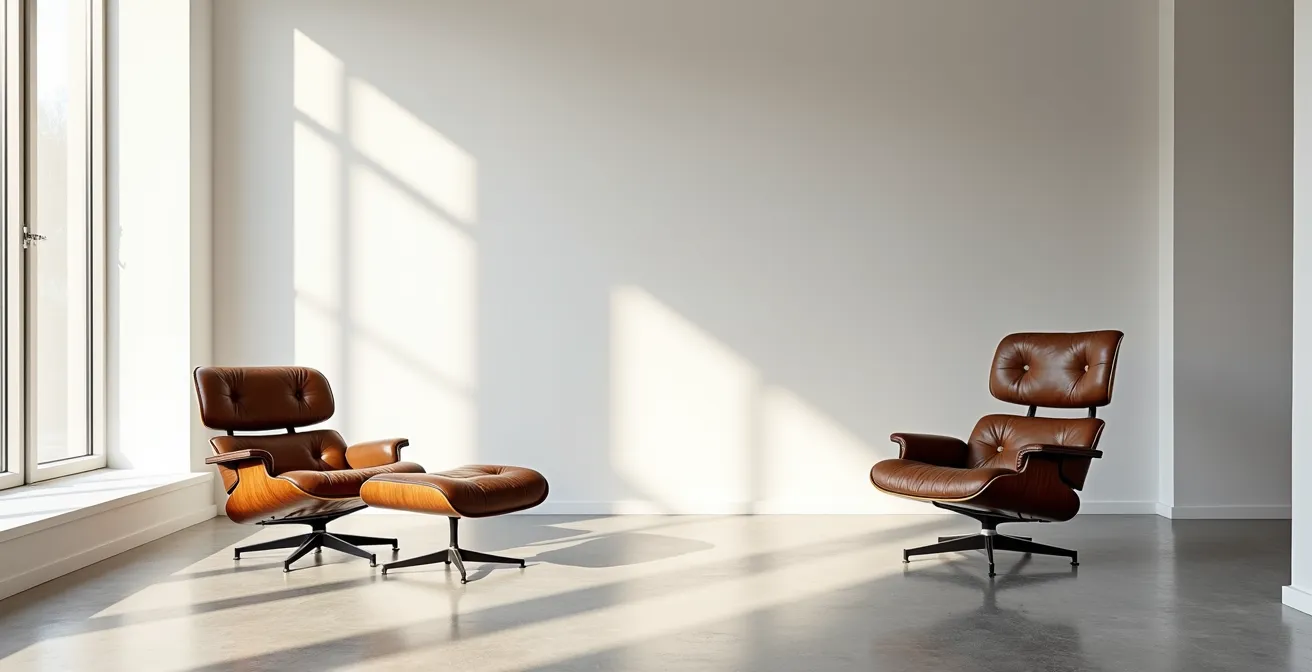
Investing in iconic chairs is profitable, but only if you can distinguish an appreciating asset from a depreciating lookalike.
- Authentication is about structural DNA and material integrity, not just labels which can be faked.
- Vintage pieces often trump new production in value due to historical material changes and proven collectibility.
Recommendation: Treat your next purchase like a financial asset: verify its provenance, protect its material integrity from common mistakes, and understand its market cycle before you buy or sell.
When you’re looking to acquire a piece of design history—an Eames Lounge Chair, a Knoll Barcelona—you’re standing at a crossroads. On one path is a piece of furniture; on the other, a financial asset. Most people think the difference is just the price tag and a logo. As a dealer, I can tell you that’s a costly mistake. The market is flooded with convincing replicas, and the common advice to “check the label” is dangerously superficial. Anyone can fake a sticker. Faking the soul of a piece, its material history and structural DNA, is another matter entirely.
The enthusiast buys a chair for its beauty. The investor buys it for its story, its future value, and the subtle markers of authenticity that a novice eye would miss. This isn’t about simply avoiding fakes. It’s about understanding why a 1960s original might be a better investment than a brand-new official production, how a simple cleaning error can erode thousands in value, and when the market signals it’s time to sell. The real key to a sound furniture investment isn’t just knowing what to look for, but adopting a dealer’s mindset. Forget decorating; we’re talking about asset management.
This guide will walk you through that mindset. We’ll dissect the real difference in value, learn to spot fakes through forensic details, compare vintage against new, protect your asset from value erosion, and identify market peaks. It’s time to learn to see these icons not just as objects, but as the investments they truly are.
This article provides a structured approach to viewing iconic furniture as a tangible asset. Below is a summary of the key areas we will explore to help you develop a connoisseur’s eye for value.
Summary: A Dealer’s Framework for Furniture Investment
- Why a Knoll Barcelona Chair Costs £6,000 More Than a Replica
- How to Spot a Fake Eames Lounge Chair in 3 Steps
- Vintage 1960s vs New Production: Which Is Better Quality?
- The Cleaning Mistake That Devalues Vintage Leather
- When to Sell: Identifying Peaks in the Vintage Furniture Market
- Why Cheap Taps Can Sabotage the Perception of a Luxury Bathroom
- How to Resell IKEA Furniture for 50% of Retail Price
- Renting vs Buying Furniture: Is the Circular Economy Cheaper?
Why a Knoll Barcelona Chair Costs £6,000 More Than a Replica
The first lesson in furniture investment is understanding the chasm in value. It’s not a gap; it’s a canyon. A convincing replica of a Barcelona Chair might cost a few hundred pounds, while an authentic, licensed Knoll piece commands a price anywhere from £6,000 to over £8,000. Why? You are not paying for a design; you are paying for provenance, material integrity, and legally protected intellectual property. The price difference is your entry fee into the world of assets that appreciate, rather than disposable goods that depreciate the moment they enter your home.
A replica manufacturer’s goal is to mimic a shape at the lowest possible cost. An official manufacturer like Knoll is legally bound to honour the designer’s original intent and quality standards. This means using specific grades of steel, precise welding techniques invisible to the naked eye, and high-quality leather upholstery cut from a single hide. These are not aesthetic choices; they are the core components of the asset’s value. Real-world market data confirms this; on the high-end secondary market, the average selling price for an original Barcelona chair is around $7,500, with prized examples fetching much more. The premium isn’t for the name; it’s for the verifiable quality that ensures it will last and, more importantly, hold or increase its value over time.
How to Spot a Fake Eames Lounge Chair in 3 Steps
Authentication goes far beyond a simple label check. As a dealer, I rely on what I call the chair’s “structural DNA”—the immutable characteristics that are too expensive or complex for counterfeiters to replicate perfectly. The Eames Lounge Chair is a masterclass in this. Forget the sticker on the bottom for a moment and learn to read the chair itself. An authentic model made by Herman Miller or Vitra has a story to tell through its construction.
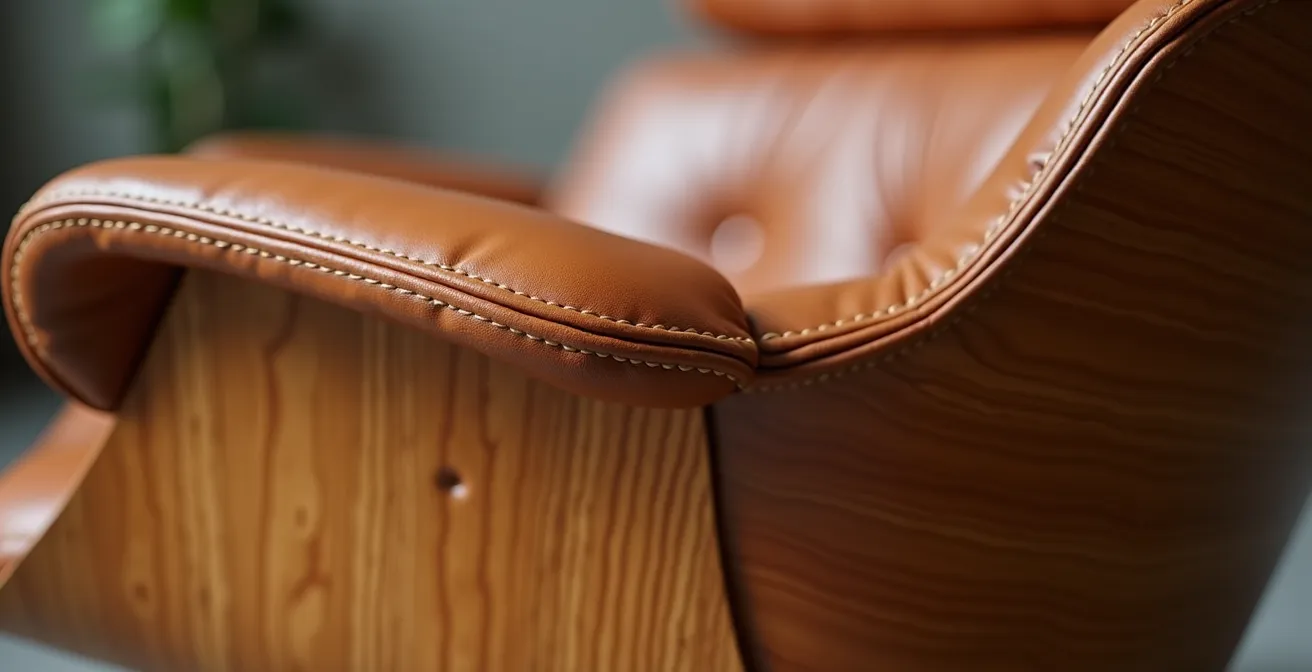
The details seen here—the grain of the plywood, the specific fold of the leather—are where authenticity lives. To start training your eye, follow these three critical forensic steps that I use myself:
- Check the Base Configuration: This is a classic tell. An authentic Eames Lounge Chair has a base with five legs. The matching ottoman has a base with four legs. Many replicas get this wrong, using four legs on the chair or five on the ottoman to save costs. The legs on an original also have a slight, elegant angle and do not sit flat on the floor.
- Examine the Functionality: Here’s a surprising fact that trips up many buyers: an authentic Eames Lounge Chair does not recline. It is built with a permanent, fixed tilt of about 15 degrees, designed for optimal comfort. It does, however, swivel a full 360 degrees. If the chair you’re looking at has a recline lever or mechanism, you can walk away. It’s a fake.
- Read the Label’s History: Now you can look at the label. An authentic piece will have a label, but its design tells a story. Between 1970 and 1990, Herman Miller used a black rectangular label. After 1990, this changed to a silver one with the brand name in all caps. Knowing this timeline helps you spot inconsistencies—for example, a seller claiming a chair is from 1985 but it has a silver label.
Vintage 1960s vs New Production: Which Is Better Quality?
Once you’ve confirmed authenticity, the next question for an investor is: “Do I buy new or vintage?” The common assumption is that new is better. In the world of iconic furniture assets, that’s often wrong. The “quality” of an investment is measured by its potential for value appreciation, and here, vintage pieces often have a distinct edge. The key is understanding that materials and manufacturing processes change over time, creating different “eras” of production, each with its own market value.
The Barcelona Chair is a perfect example. A new, authentic Knoll version is a fantastic, high-quality piece. But a vintage one from the 1960s tells a different story. As the market has evolved, so have the materials, and collectors prize these historical differences. The following table, based on expert analysis, breaks down the key distinctions you should be aware of.
This comparison, drawing from insights by the Rarify Design Authentication Team, highlights that vintage isn’t just “old,” it’s a distinct asset class.
| Aspect | Vintage 1960s | New Production |
|---|---|---|
| Materials | Chrome-plated steel frame | Stainless steel (since 1964) |
| Value Appreciation | Higher potential appreciation | Stable but slower appreciation |
| Collectibility | Highly sought after, especially early KP stamps | Standard market value |
| Authentication | Various period labels and stamps | Knoll logo with Mies signature |
The most astute collectors seek out pieces with a unique history. As the Rarify team points out, certain editions become grails for investors. They offer this piece of insider knowledge:
The most collectible examples of Barcelona Chairs from this era are the bronze-plated versions manufactured by Knoll after Mies van der Rohe’s death in 1969.
– Rarify Design Authentication Team, How to Authenticate a Knoll Barcelona Chair
This is the “Patina Premium” in action. A vintage piece carries the history of its era in its very materials. It has proven its desirability over decades, making its future value more predictable for an investor than a new piece that has yet to stand the test of time.
The Cleaning Mistake That Devalues Vintage Leather
You’ve acquired the asset. Now you must protect it. I’ve seen more value destroyed by well-intentioned owners with a bottle of household cleaner than by decades of regular use. This is the concept of Value Erosion: the gradual degradation of an asset’s worth due to improper care. For iconic chairs, this most often happens to the leather.
Vintage leather is not the same as the leather on a new sofa. It may be aniline-dyed, have a specific patina, or be of a type no longer in production. Using harsh, silicone-based chemicals or all-purpose wipes can strip its original finish, cause discoloration, and lead to drying and cracking. This kind of damage is often irreversible and can slash a chair’s resale value by a significant margin. A collector isn’t buying “clean”; they are buying “original condition.” Protecting that originality is your primary role as the asset’s custodian. This requires a gentle and consistent approach, not an aggressive attack on dirt.
Your action plan: Preserving the value of vintage leather
- Identify the enemy: Harsh chemicals are your primary threat. Never use all-purpose cleaners, window sprays, or silicone-based polishes on vintage leather or metal frames.
- Master the basics: Use a soft, dry or slightly damp microfiber cloth to gently wipe down all leather and stainless steel surfaces on a weekly basis. This prevents dust from settling and abrading the surface.
- Condition proactively: Apply a high-quality, pH-neutral leather conditioner specifically designed for aniline or semi-aniline leathers every 3 to 6 months. This keeps the upholstery supple and prevents cracking, preserving its material integrity.
- Control the environment: Position your chair away from direct sunlight, radiators, or heating vents. UV exposure is a primary cause of fading and drying, which is irreversible damage from an investor’s perspective.
- Audit for damage: Regularly inspect seams, buttons, and high-contact areas (armrests, headrest) for early signs of wear or cracking. Catching a problem early is far cheaper than a full restoration.
When to Sell: Identifying Peaks in the Vintage Furniture Market
Treating furniture as an asset means knowing not just when to buy, but also when to sell. The vintage market, like any other, has cycles, trends, and peaks. Selling at the right time can mean the difference between a modest return and a significant profit. Your job as an investor is to read the signals, not just react to personal need. This is the final piece of the dealer mindset: Market Timing.
The overall trend is highly favorable. According to market analysis, the home furnishings resale sector is expected to see dramatic growth. One report projects that the market is expected to rise by 29% over the next five years. This rising tide lifts all boats, but the most valuable “boats”—our iconic pieces—benefit the most. The key is to watch for signals that your specific asset class is peaking. These signals include a surge in media features, frequent appearances in high-end interior design projects, and rising prices for similar pieces at major auction houses. These are indicators of peak cultural relevance and demand.
Currently, the market for certain eras remains incredibly strong. As a leading auction platform notes, the appetite for post-war design is not waning. This insight from an industry leader is a powerful indicator for any investor holding such pieces:
Mid-Century Modern Furniture remains highly desirable, with pieces from designers like Eames and Herman Miller continuing to achieve significant price increases.
– LiveAuctioneers Market Analysis, Auctioneers share top selling antique & vintage trends in 2024
The takeaway? While the overall market is growing, the Mid-Century Modern segment is a hot asset class. If you own a prime example, you are in a strong position. Deciding to sell means weighing the current high demand against the potential for even further long-term appreciation. A dealer’s decision would be based on portfolio balance: sell a peaking asset to reinvest in an emerging one.
Why Cheap Taps Can Sabotage the Perception of a Luxury Bathroom
It may seem like a detour, but there’s a vital investment lesson in the world of luxury fittings. Imagine a bathroom renovated with thousands of pounds of Italian marble and bespoke cabinetry, but finished with a cheap, lightweight tap. The tap becomes the only thing you notice. Its poor quality undermines the perceived value of the entire space. It’s a small detail that broadcasts a cost-cutting mindset and shatters the illusion of luxury.

This principle applies directly to collecting furniture. A single replica or a poorly restored piece in a room of authentic icons does the same damage. It casts doubt on the entire collection. As Dario Reicherl, a leader at the iconic brand Fritz Hansen, stated, high-end manufacturers obsess over quality because their reputation is built on it: “We need to deliver high quality.” They understand that every component contributes to the whole. When you are building a portfolio of furniture assets, a single “cheap tap”—a fake Eames, a badly reupholstered Wegner—devalues the authentic pieces around it. It signals to other collectors and potential buyers that your standards are inconsistent. An investor’s collection must be curated with uniform quality to maintain its overall value and integrity.
How to Resell IKEA Furniture for 50% of Retail Price
To truly understand what makes an iconic chair a good investment, we must look at its opposite: disposable furniture. The IKEA resale market is a fascinating case study in the mass-market circular economy, but it operates on entirely different principles. While you might resell a Billy bookcase for a fraction of its cost through programs like IKEA’s own ‘Buy Back & Resell’, you are participating in a system of utility, not investment. The goal is to extend the product’s usable life, not to see its financial value appreciate.
The secondhand market for mass-produced furniture is booming, with some platforms seeing furniture brands sell 85% more units than the previous year. This indicates a healthy demand for used goods, but it’s a market driven by price-consciousness and convenience. The value of an IKEA item is tethered to its low initial retail price and depreciates rapidly. It serves a purpose and then is passed on for a lower price. This is the fundamental difference: you are trading a depreciating utility item, whereas the owner of an authentic Finn Juhl chair is holding an appreciating cultural asset. The former saves you money in the short term; the latter has the potential to make you money in the long term.
Key takeaways
- Authenticity is an investment in craftsmanship and material integrity, justifying the significant price premium over replicas.
- Verifying a piece’s “structural DNA”—like the number of legs or specific mechanisms—is more reliable than checking for labels.
- Vintage pieces often offer higher investment potential than new ones due to historical significance and proven collectibility.
Renting vs Buying Furniture: Is the Circular Economy Cheaper?
The conversation around the circular economy often brings up renting as an alternative to buying. For transient lifestyles or for furnishing with mass-market items, it can be a financially sound choice. It prioritizes access over ownership. However, when we apply this question to the world of investment-grade furniture, the logic collapses. You would not rent a portfolio of stocks. You would not rent a bar of gold. You own assets to benefit from their appreciation in value. Renting an iconic chair is, from a financial perspective, paying for the privilege of watching someone else’s asset grow in worth.
The modern consumer is becoming more deliberate. As Paula Newell, a C-suite executive in the furniture rental space, noted in an interview with Modern Retail, even in the broader market, there’s a shift: ” People are approaching resale and used furniture…with more ‘intention’ around what they want.” This growing intentionality is a signal. If the mass market is becoming more thoughtful, the true investor must be radically so. Your intention is not temporary use; it’s long-term value creation. Buying an authentic, iconic piece is your stake in a piece of cultural and financial history. It is the ultimate act of intentional buying.
Therefore, the next time you are faced with the choice, ask yourself not “Do I like this chair?” but “Is this an asset I am prepared to invest in, protect, and potentially profit from?” Approaching every potential acquisition with this dealer’s mindset is the only way to ensure your collection of beautiful objects becomes a portfolio of valuable assets.