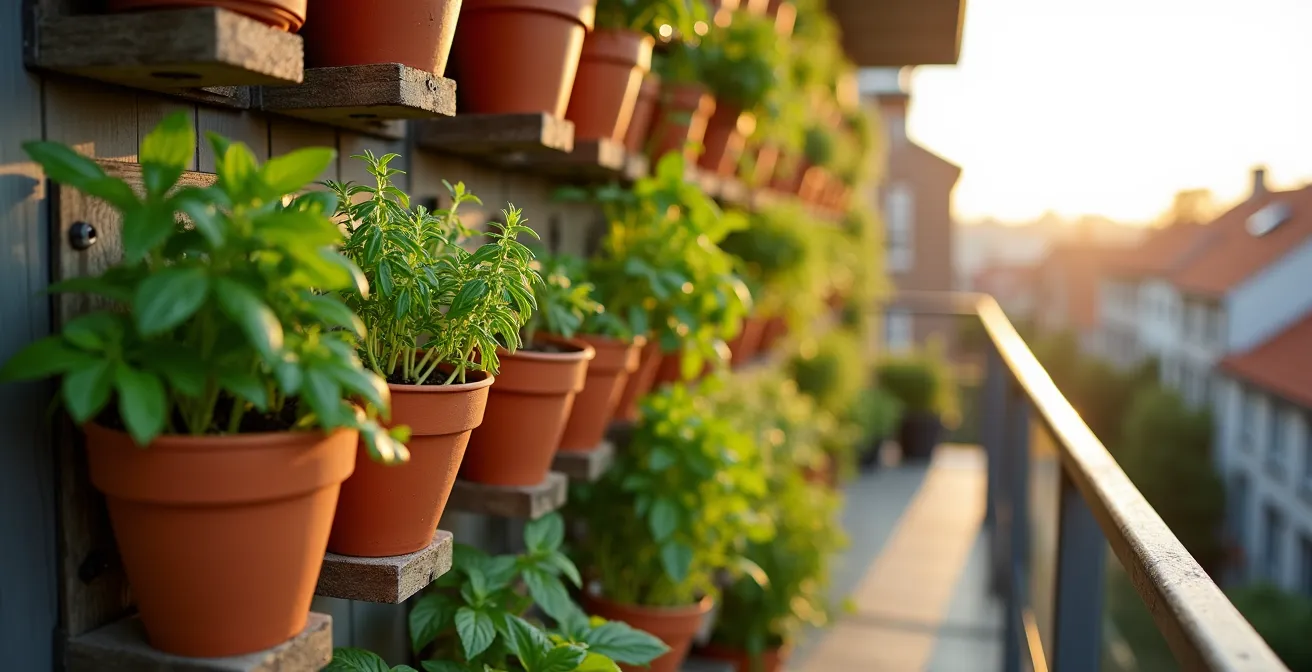
The fatal flaw in most vertical gardens isn’t a lack of water, but a failure to manage its physics; success lies in treating your wall as an engineered hydraulic system, not just a set of pots.
- Gravity and sun exposure create a “hydraulic gradient” that drowns bottom plants while desiccating the top.
- Material choice is a critical trade-off: felt offers evaporative cooling but dries fast, while plastic retains water but can bake roots.
Recommendation: Design your irrigation with multiple, smaller drip zones controlled by a timer, and select plants with a shallow root matrix to match your system’s limitations.
If you’ve tried to cultivate a lush, green living wall on a south-facing balcony, you likely know the frustrating story. The plants at the top turn crisp and brown, starved of moisture under the relentless sun, while their counterparts at the bottom become yellow and waterlogged, their roots slowly drowning. You’ve tried watering more, watering less, and maybe even given up entirely, convinced you lack a green thumb. The common advice—to use drought-tolerant plants or install a simple timer—often fails to address the core of the issue.
The problem isn’t your gardening skill; it’s a misunderstanding of physics. A vertical garden is not just a stack of containers; it’s a complex hydraulic and thermal system. The intense heat from southern exposure accelerates evaporation dramatically at the top, while gravity relentlessly pulls every drop of water downward, saturating the substrate at the bottom. This creates a fatal imbalance that no amount of haphazard watering can fix. But what if the solution wasn’t just about *when* or *how much* you water, but about designing a system that actively counteracts these forces?
This guide moves beyond generic tips to give you an installer’s perspective. We will deconstruct the engineering principles behind a successful vertical garden. We will analyze why they fail, how to select the right biological and material components, and how to build a resilient system that can withstand everything from summer heatwaves to winter freezes. By understanding the ‘why’ behind the failures, you can finally build the vibrant, thriving living wall you envisioned.
This article provides a complete roadmap to mastering your vertical garden’s ecosystem. Explore each section to understand the critical elements of design, from water dynamics to structural integrity.
Summary: How to Properly Irrigate a Vertical Garden on a South-Facing Balcony
- Why the Bottom Plants Drown While the Top Plants Die of Thirst
- How to Choose Plants That Survive Shallow Root Systems
- Felt Pockets vs Plastic Modular Pots: Which Retains Moisture?
- The Pipe Freezing Mistake That Bursts Irrigation Systems
- How to Reinforce a Fence to Hold 50kg of Wet Soil
- Living Walls vs Preserved Moss: Which Is Right for Low Maintenance?
- How to Secure Plants on a Windy High-Rise Balcony
- How to Create Privacy on an Overlooked Balcony Without Blocking Light?
Why the Bottom Plants Drown While the Top Plants Die of Thirst
The primary reason vertical gardens fail is a concept every irrigation specialist understands: the hydraulic gradient. On a vertical surface, water doesn’t stay where you put it. Gravity pulls it downward through the growing medium. Simultaneously, a south-facing wall acts like a radiator, causing intense evapotranspiration at the top, where air circulation and sun exposure are greatest. This creates two opposing and destructive zones. The top zone is in a constant state of drought, while the bottom zone becomes an anaerobic, saturated swamp where roots can’t breathe and begin to rot.
Simply increasing the watering time on a single-zone drip system only worsens the problem. You over-saturate the bottom in a futile attempt to get enough moisture to the top. The solution is not more water, but better distribution. A professionally designed system uses multiple, smaller irrigation zones. For example, the top third of the wall might be on a circuit that runs twice as long or twice as often as the bottom third. This targeted approach delivers water precisely where it’s needed to combat evaporation without waterlogging the base. Furthermore, the required amount of water is not static; it’s a dynamic variable. For instance, a case study of a vertical garden in Madrid showed daily water needs fluctuating from 6 litres per square metre in summer to just 1.5 litres in winter. Without adjusting for this, system failure is inevitable.
Ultimately, a successful system acknowledges these forces. By using smart zoning and soil moisture sensors, you can create a balanced environment. Properly engineered drip systems are incredibly efficient; studies have shown that vertical gardens with drip irrigation can achieve an 80% reduction in water usage compared to traditional watering. This isn’t just about conservation; it’s about the precision required to keep the entire wall alive.
How to Choose Plants That Survive Shallow Root Systems
The container of a vertical garden—whether a felt pocket or a plastic module—offers a very limited volume for root growth. Most systems provide only 4-6 inches of soil depth. This immediately disqualifies plants with deep taproots, like carrots or large perennials, which will quickly become root-bound and fail. The key is to select plants that have naturally shallow, fibrous, or rhizomatous root systems. These plants are adapted to spread out horizontally rather than vertically, making them a perfect match for the constraints of a living wall. This is what we call creating a shallow root matrix.
Excellent choices for this environment include most herbs (like mint, thyme, and oregano), lettuces, spinach, and decorative plants like succulents, ferns, and Heuchera. These species have fine, branching roots that form a dense mat, which not only helps them absorb water and nutrients efficiently in a small space but also helps hold the substrate together, preventing erosion. Understanding root type is fundamental. Plants with fibrous roots are ideal, while those with spreading rhizomes, like mint, can be aggressive but are well-suited to filling out pockets.
This macro photograph below shows the intricate network of a shallow root system, intertwined with beneficial mycorrhizal fungi. This is the kind of dense, web-like structure you want to encourage in your vertical garden for maximum resilience and water absorption.

The symbiotic relationship with fungi like mycorrhizae can be a game-changer, extending the reach of the plant’s roots to capture more water and nutrients than they could alone. You can encourage this by using a high-quality, living soil that contains these beneficial microbes. By choosing the right “biological hardware,” you are setting your garden up for success from the inside out, creating a resilient ecosystem adapted to its artificial environment.
Felt Pockets vs Plastic Modular Pots: Which Retains Moisture?
The material your vertical garden is made of is not just an aesthetic choice; it’s a crucial component of your irrigation system. The two most common options, felt pockets and rigid plastic modules, have fundamentally different thermal and hydraulic properties. The choice between them involves a critical trade-off between evaporative cooling and root baking. Felt, often made from recycled PET plastic, is porous. This allows for excellent aeration and permits evaporative cooling on the surface, which can protect roots from extreme heat—a significant advantage on a south-facing wall. However, this same porosity means it loses moisture rapidly from all sides, requiring more frequent and precise watering.
On the other hand, plastic modular pots are non-porous. They prevent water from evaporating through the sides, significantly improving water retention. This means you can water less frequently. The downside? On a sun-drenched balcony, the dark plastic can absorb immense heat, effectively “baking” the plant’s root ball and stressing or killing the plant. A hybrid system, which might use plastic containers set within a felt-faced structure, attempts to get the best of both worlds by retaining water while still offering some insulative protection.
This detailed comparison of material performance highlights the key differences:
| Material | Water Retention | Heat Management | Lifespan | Maintenance |
|---|---|---|---|---|
| Felt Pockets | Moderate – evaporative cooling | Protects roots via evaporation | 2-3 years | Can host algae, compacts over time |
| Plastic Modular | High – prevents side evaporation | Can overheat roots in direct sun | 3-5 years | UV degradation, becomes brittle |
| Hybrid System | Optimized – controlled evaporation | Balanced temperature control | 3-4 years | Moderate – best of both |
Your choice depends on your climate and commitment to maintenance. If you are in a very hot, dry climate, the evaporative cooling of felt might be a lifesaver, provided you can automate your irrigation precisely. If you prefer less frequent watering and are in a more temperate climate, plastic may be a better choice, but you should opt for lighter colors (white, grey, or terracotta) to minimize heat absorption.
The Pipe Freezing Mistake That Bursts Irrigation Systems
A sophisticated drip irrigation system is a vertical garden’s lifeline, but in climates with cold winters, it can become its biggest liability. This is a classic systemic failure point that many gardeners overlook until it’s too late. Water left in the thin micro-tubing, fittings, or main hose bib during a freeze will expand with incredible force, bursting pipes and cracking expensive timers and filters. A system that took hours to assemble can be rendered useless overnight, leading to costly and frustrating repairs in the spring.
Proper winterization is not optional; it’s a mandatory step in the annual lifecycle of your garden. The process is straightforward but must be done thoroughly before the first hard frost. The goal is to remove every last drop of water from the system. While disconnecting the main source is the first step, simply letting the tubes drain is not enough. Water will remain in low points and inside fittings due to capillary action. Using compressed air to blow out the lines is the only way to ensure they are completely empty and safe from ice damage.
Taking these preventative measures not only saves your equipment but also makes spring startup remarkably fast. A properly winterized system can be reassembled and running in minutes, allowing you to get a head start on the growing season. It transforms a potential system failure into a simple, predictable maintenance task.
Your Action Plan: Winterizing Your Balcony Irrigation System
- Disconnect the main water source and timer unit in early fall, bringing the timer indoors.
- Use a small air compressor or a bike pump with an adapter to blow all residual water out of the micro-tubing and main lines.
- Remove any compression fittings, emitters, or filters that can be easily detached and store them indoors.
- For any fixed outdoor PVC pipes or components that cannot be removed, wrap them with foam pipe insulation for an extra layer of protection.
- In spring, reinstallation is a quick dry-fit assembly process that should take no more than a few minutes.
How to Reinforce a Fence to Hold 50kg of Wet Soil
A fully saturated vertical garden is deceptively heavy. A medium-sized wall, covering just a few square meters, can easily weigh over 50kg (110 lbs) once the substrate is completely wet. Hanging this immense load directly onto a standard wooden or vinyl fence panel without proper reinforcement is another critical systemic failure point. The constant weight, combined with the force of wind, can cause fence panels to bow, warp, or even pull away from their posts, leading to a catastrophic collapse of your entire garden.
The key is to distribute the load across multiple structural points rather than concentrating it on a few screws in a single fence panel. For renters or those who want to avoid drilling, non-destructive methods are highly effective. A freestanding frame that simply rests against the fence, or a system of vertical battens wedged between the balcony floor and an overhead structure, can transfer the weight directly to the ground and ceiling, completely bypassing the fence itself. Another professional technique is to use horizontal tension wires.
This image demonstrates how tension wires create a strong, independent grid that supports the garden. The load is spread across several fence posts, vastly increasing the system’s stability without relying on the weaker fence panels.
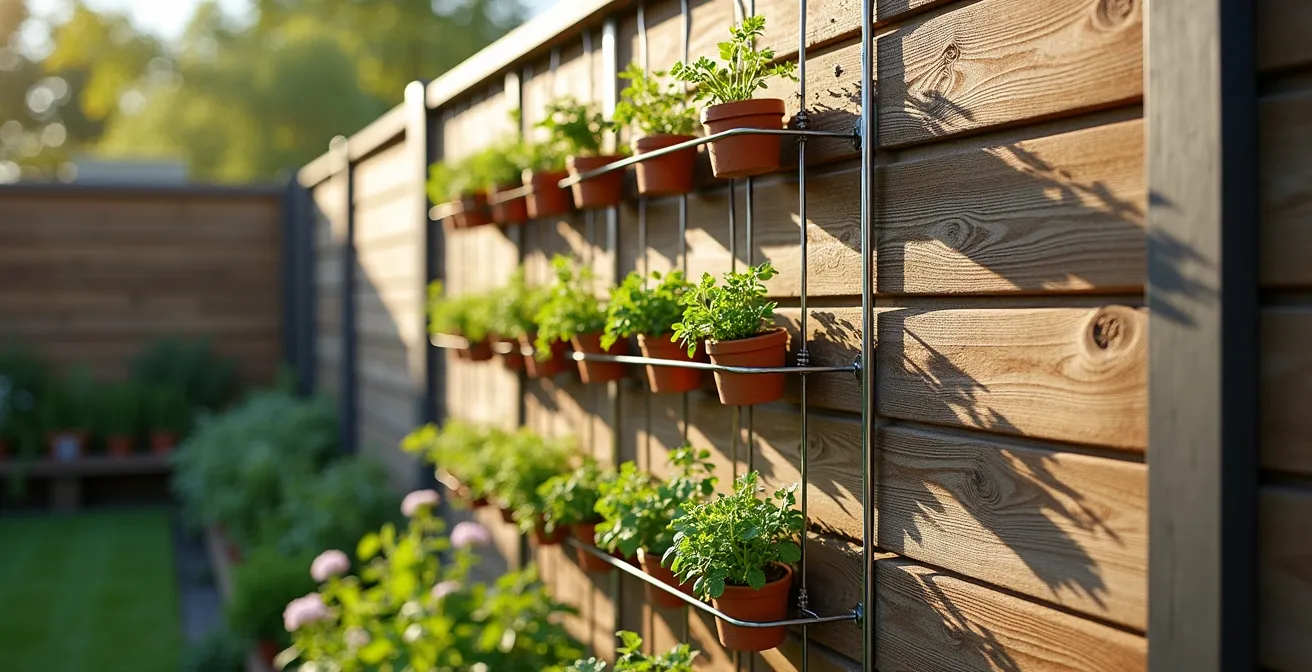
For a permanent installation, the best method is to secure horizontal support beams (such as 2x4s) directly to the fence posts, not the panels. You then mount your vertical garden system onto these beams. This ensures the load is borne by the strongest part of the fence structure. Reinforcing for weight is not about over-engineering; it’s about respecting the simple physics of a heavy, dynamic load. It’s the difference between a garden that lasts for years and one that ends up on the ground after the first big rainstorm.
Living Walls vs Preserved Moss: Which Is Right for Low Maintenance?
While a living wall offers dynamic beauty, it is fundamentally a high-maintenance horticultural system. The irrigation, pruning, and nutrient management require ongoing attention, especially on a demanding south-facing balcony. For those who love the green aesthetic but lack the time or desire for active gardening, a preserved moss wall presents a compelling, low-maintenance alternative. However, it’s crucial to understand that these two are not interchangeable, particularly in a high-sun environment.
A living wall is an active ecosystem. With the right irrigation and plant selection, it will thrive in the bright light of a southern exposure. Preserved moss, in contrast, is no longer alive. It has been treated with glycerin and dyes to maintain its color and texture. It requires no water, no soil, and no pruning. Its primary enemy is the very thing a living wall craves: direct sunlight. UV rays will cause the dyes in preserved moss to fade and bleach within months, turning your vibrant green wall into a sad, yellowed patch. Therefore, preserved moss is an excellent choice for indoor or deeply shaded outdoor areas, but a terrible one for a sun-drenched balcony.
A direct comparison of their maintenance needs reveals a stark contrast:
| Aspect | Living Walls | Preserved Moss |
|---|---|---|
| Maintenance Type | Active horticultural care | Passive environmental control |
| Watering | Daily with automated system | Never |
| Sun Exposure | Adaptable to conditions | Fades in direct sunlight |
| South-Facing Suitability | Excellent with proper irrigation | Poor – bleaches in months |
| Monthly Tasks | Pruning, checking irrigation | Dusting, humidity control |
The choice is a clear one based on your environment and lifestyle. If you’re committed to creating an automated, living ecosystem and have a sunny spot, the living wall is your goal. If you desire a zero-maintenance green feature and can provide full shade, preserved moss is the superior option. Attempting to use moss in a sunny spot is a recipe for disappointment.
How to Secure Plants on a Windy High-Rise Balcony
A high-rise balcony, especially one facing south, is subject to powerful and often unpredictable wind currents, including strong updrafts. This wind creates two problems: it can physically tear plants from their pockets and it dramatically accelerates dehydration, compounding the effects of the sun. Securing your garden against the wind requires a multi-layered approach involving both plant selection and physical reinforcement, a concept we can call microclimate buffering.
First, choose plants with wind-resistant characteristics. Look for species with flexible stems that bend rather than break, such as ornamental grasses. Plants with small, waxy, or leathery leaves, like succulents or rosemary, are also excellent choices as they lose less water to the wind. Second, you must physically secure the plants and their containers. For plants in pockets, soft plant ties can be passed through the back of the felt to anchor the root ball. For modular systems, a dab of silicone at the base of each pot can prevent it from being rattled or lifted out by strong updrafts.
Creating a windbreak is the next level of protection. Installing a trellis with a fast-growing vine about six inches in front of your vertical garden can create a buffer zone that dissipates the wind’s force before it hits your more delicate plants. In extreme weather, temporary covers made of weatherproof fabric can be deployed to shield the entire wall. When considering materials for the structure itself in such exposed conditions, durability is paramount. As experts point out, the best choices are often weatherproof materials like galvanized steel or powder-coated aluminum for maximum durability against the elements.
Key Takeaways
- The primary failure in vertical gardens is the hydraulic gradient, which starves the top of water while drowning the bottom.
- Success depends on an engineering mindset: use zoned irrigation, select plants with shallow roots, and choose materials (felt vs. plastic) based on your climate’s heat and humidity.
- Your garden is a heavy, dynamic system; it must be winterized to prevent burst pipes and properly reinforced to support its full, saturated weight.
How to Create Privacy on an Overlooked Balcony Without Blocking Light?
A vertical garden is an excellent tool for creating privacy on an overlooked balcony, but a dense wall of foliage can also block precious light, making your indoor space feel dark. The professional solution is not to build a solid green wall, but to create a layered, “breathing” privacy screen. This strategy uses different types of plants at varying depths to obscure the line of sight from neighbours without creating a total light-blocking barrier. It’s about cleverly filtering the view, not walling it off.
The strategy involves several layers. The outermost layer, closest to the railing, could be a simple trellis with fast-growing annual vines like morning glory. These create a quick, dense screen in the summer but die back in winter, allowing more light in during the darker months. The main vertical garden structure forms the second layer, planted with a mix of evergreen ferns and leafy perennials like Heuchera to provide a permanent, year-round base of privacy. This layer should be designed to have some gaps and texture, allowing dappled light to pass through.
To complete the effect, you can add a third layer of tall, slender ornamental grasses in planters placed at strategic points to block specific angles of view. Finally, positioning trailing plants like ivy or pothos at the top of your vertical garden allows them to cascade down, creating a natural curtain that offers privacy from above while still letting in a significant amount of ambient light. This layered approach results in a dynamic screen that feels lush and natural, provides the necessary privacy, and preserves the brightness of your balcony and home.
By approaching your vertical garden as an integrated system, you can move past the common frustrations and create a stunning, resilient, and functional feature for your balcony. The next logical step is to begin planning your system with these engineering principles in mind, starting with a sketch of your zoned irrigation layout and a list of suitable plants for your specific microclimate.
Frequently Asked Questions on How to Irrigate a Vertical Garden on a South-Facing Balcony?
Which plants have the best wind resistance for vertical gardens?
Plants suitable for vertical gardens are typically those with shallow root systems, compact growth habits, and a tolerance for limited soil volume. For wind resistance specifically, look for flexible stems and small leaves. Examples include ferns, succulents, herbs like mint and thyme, trailing vines such as ivy or pothos, and compact flowering plants like begonias or petunias.
How do vertical gardens handle extreme weather?
Vertical gardens can positively impact the environment by improving air quality through increased oxygen production and pollutant absorption. They also contribute to urban biodiversity, provide habitat for beneficial insects, and help mitigate the urban heat island effect by cooling surrounding areas. To handle weather, they must be properly secured against wind and the irrigation systems must be winterized to prevent freezing.
What materials work best for outdoor vertical systems?
Weatherproof materials like galvanized steel frames, powder-coated aluminum, or naturally weather-resistant cedar provide the best durability for outdoor vertical gardens exposed to wind and weather.