Contrary to popular belief, ‘teak oil’ is the fastest way to ruin your furniture’s golden hue, not preserve it.
- The silver-grey colour is caused by UV-induced lignin oxidation, a surface-level change, not decay.
- Most “teak oils” are linseed oil-based, which act as a food source for black mould and mildew, creating a sticky, dirty finish.
Recommendation: To maintain the golden colour, deep clean your furniture and apply a high-quality, water-based teak sealer annually, not an oil.
You invested in beautiful, high-quality teak garden furniture for its rich, golden-honey warmth. For the first few weeks, it’s the centrepiece of your patio. Then, slowly but surely, the inevitable happens: patches of silver-grey begin to appear, spreading until your once-vibrant table looks weathered and tired. The common advice is to grab a bottle of “teak oil” and start rubbing. It seems logical, a quick fix to restore that original lustre. You might also hear that you need to scrub it, sand it, or even pressure wash it back to life.
While well-intentioned, much of this common wisdom is not only ineffective but can be actively harmful to your investment. The fight against silvering isn’t a simple matter of applying a cosmetic product; it’s about understanding the fundamental chemistry of the wood itself. The key to preserving that coveted golden finish lies not in battling nature with endless sanding and oily coatings, but in working with it through precise, science-backed preservation techniques. It’s about managing moisture exchange and protecting the wood’s surface at a cellular level.
This guide will move beyond the superficial tips. We will explore the science of why teak changes colour, debunk the myths surrounding oils and sealers, and provide an expert methodology for cleaning, treating, and storing your furniture. By understanding the ‘why’ behind each step, you can build a simple, sustainable routine that keeps your teak looking exactly as you intended, year after year.
Summary: A Detailed Guide to Teak Furniture Preservation
- Why Teak Turns Grey and Is It Actually Damaging?
- How to Remove Water Stains from Teak Tables Without Sanding
- Teak Oil vs Sealer: Which Lasts Longer in Rainy Climates?
- The Pressure Washer Error That Destroys Wood Grain
- How to Store Teak to Prevent Cracking in Central Heating
- When to Oil Outdoor Wood: Spring or Autumn?
- Hard Wax Oil vs Polyurethane Varnish: Which Looks More Natural?
- Can Luxury Outdoor Furniture Survive a British Winter Outside?
Why Teak Turns Grey and Is It Actually Damaging?
The transformation of teak from a golden brown to a silvery grey is not a sign of rot or decay; it is a natural chemical process called lignin oxidation. Lignin is a complex polymer within the wood’s cell walls that gives it rigidity. When exposed to the ultraviolet (UV) rays of the sun, the lignin on the very surface of the wood oxidizes and breaks down, losing its colour. This process happens only in the top fraction of a millimetre and, in itself, is not structurally damaging. The resulting silver-grey patina is considered a desirable, low-maintenance finish by many.
However, it is crucial to distinguish this clean, uniform silver patina from other discolourations. The appearance of black spots or dark patches is not part of the natural weathering process. These are typically signs of mildew and mould growth. This biocidal contamination often occurs when the wood’s natural oils, or more commonly, applied finishing oils, trap dirt and moisture, providing a perfect breeding ground for fungi. While the silver patina is harmless, this black mould can stain the wood more deeply and indicates a moisture problem that needs addressing.
Case Study: The 96-foot Yacht Teak Rail Restoration Experience
The challenge of maintaining a golden appearance is significant even at the highest level. A professional skipper responsible for a multi-million-dollar 96′ yacht shared his experience. He noted that the vessel’s varnished teak rails, which must remain pristine, required constant weekend maintenance to prevent weathering and maintain their perfect golden look. This real-world example from the high-end marine world demonstrates that preventing silvering is not a one-time treatment but an ongoing commitment to surface protection, as professional experience shows that film finishes only last a year or two before needing maintenance.
Ultimately, whether the grey patina is “damage” is a question of aesthetics, not structural integrity. If your goal is to maintain the original golden-brown colour, you are not fighting decay; you are simply choosing to protect the wood’s surface lignin from UV radiation.
How to Remove Water Stains from Teak Tables Without Sanding
Before you reach for the sandpaper, it’s important to understand that many stains, particularly those from water, can be removed with less destructive methods that preserve the wood’s surface. Sanding should always be a last resort, as it physically removes a layer of wood. For fresh water rings or light spills, a simple, non-invasive technique using gentle heat can be surprisingly effective. Applying a hairdryer on a low to medium setting helps the trapped moisture evaporate from within the wood grain without causing damage.
For more stubborn, set-in dark stains, a chemical approach is necessary. Oxalic acid, often sold as “wood bleach,” is a mild acid that works by reversing the chemical reaction that causes the dark stain, particularly those caused by contact with iron and water. It is highly effective at restoring the wood’s natural colour without affecting its integrity. You apply a solution of the oxalic acid crystals dissolved in water, let it work its magic, and then thoroughly rinse it off, neutralizing the acid.
The following table provides a clear comparison of the most common non-sanding methods for stain removal, helping you choose the right approach based on the type and age of the stain.
| Method | Best For | Effectiveness | Time Required |
|---|---|---|---|
| Steam/Iron Method | Fresh water rings (< 24 hours) | Hair dryer on low/medium heat helps moisture evaporate from fresh spills | 10-15 minutes |
| Oxalic Acid Treatment | Set-in dark stains | Highly effective for deep stains | 30-45 minutes plus drying |
| Two-Part Cleaner System | Multiple or extensive staining | Professional-grade results | 1-2 hours total |
The visual below illustrates the powerful effect of a chemical treatment on a stained area, showing the restoration of the wood’s original golden tone.
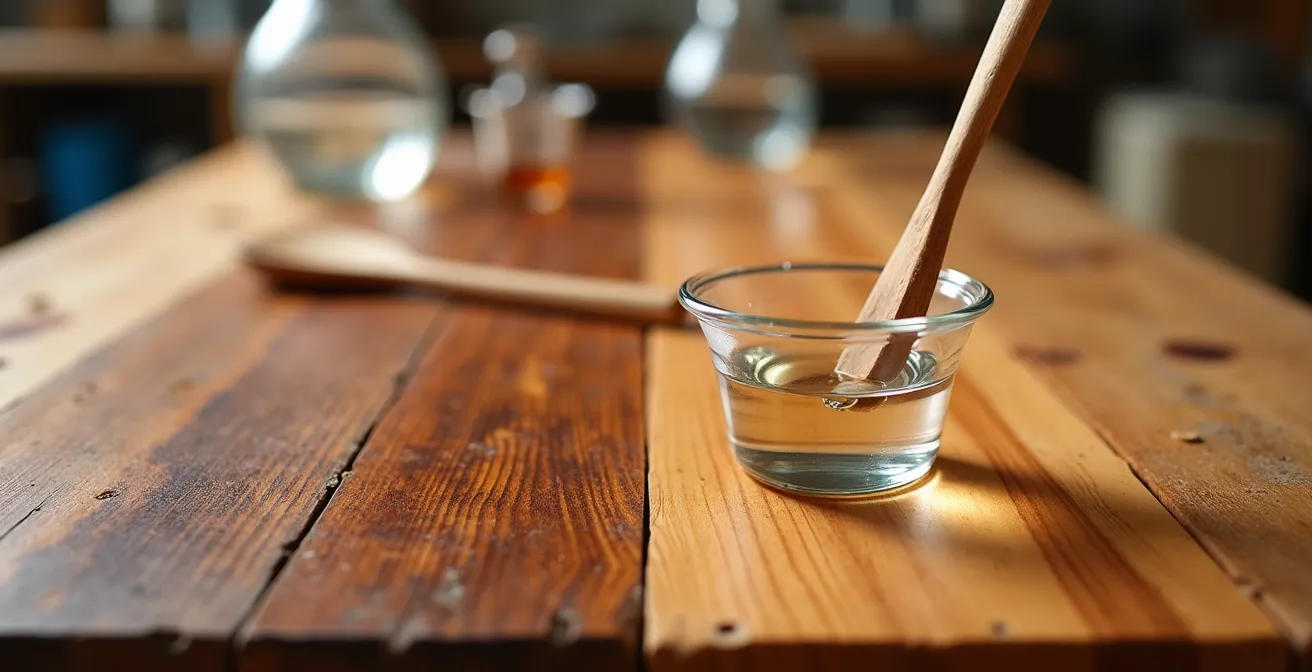
Using these targeted treatments allows you to address blemishes locally, preserving the overall integrity and patina of your furniture without resorting to aggressive, full-surface sanding. This targeted approach is a cornerstone of professional wood restoration.
Teak Oil vs Sealer: Which Lasts Longer in Rainy Climates?
This is perhaps the most critical decision in teak maintenance, and the one most surrounded by misinformation. The term “teak oil” is a misnomer; it is not oil from the teak tree. It is typically a mixture of linseed or tung oil, solvents, and sometimes varnish. While it provides a temporary golden wet look, it is a disastrous choice for long-term protection, especially in damp or rainy climates. The oil itself does not dry hard and acts as a food source for mould and mildew, leading to the characteristic sticky, black-spotted finish that is difficult to remove.
An authority in high-end teak furniture, Country Casual Teak, provides a stark warning on this very topic:
Teak oil is linseed oil mixed with other ingredients, primarily solvents – it is not oil from teak trees. It can cause more harm than good, leaving a sticky surface that collects dirt and debris which cause mold and mildew to grow. Furniture treated with teak oil often turns black and can feel gummy to the touch over time, especially in warm, humid climates.
– Country Casual Teak, Cleaning Teak Furniture Guide
A teak sealer, by contrast, is a modern, science-based solution. It is not an oil. A water-based sealer works by penetrating the wood and creating a microporous polymer barrier. This barrier contains pigments and UV inhibitors that block the sun’s rays, preventing lignin oxidation. Crucially, it does not act as a food source for mould. It seals the wood against moisture ingress while still allowing it to breathe, preventing the issues of cracking and peeling associated with thick varnishes. While it requires annual reapplication, the process is simple cleaning and recoating, not the laborious stripping and sanding required to fix a failed oil finish.
The long-term maintenance commitment is drastically different, as a data-driven analysis shows. An oil finish requires far more frequent attention to maintain its appearance, quickly becoming a significant time investment.
| Product Type | Reapplication Frequency | Annual Time Investment | 5-Year Total Hours | Climate Suitability |
|---|---|---|---|---|
| Teak Oil | Higher maintenance, requires more frequent applications, brings back rich colors | 4-6 applications | 20+ hours | Poor in humid/rainy |
| Water-Based Sealer | Once yearly | 2-3 hours | 10-15 hours | Excellent all climates |
| Natural Weathering | None required | Cleaning only | 5-10 hours | Universal |
For any homeowner in a climate with significant rainfall, the choice is clear. A quality water-based sealer offers superior protection, lower maintenance, and a cleaner, more durable finish that truly preserves the wood’s beauty.
The Pressure Washer Error That Destroys Wood Grain
In a quest for a quick cleaning solution, many homeowners are tempted to use a pressure washer on their teak furniture. This is a critical error that can cause irreversible damage. A pressure washer, even on a seemingly low setting, directs a concentrated jet of water that is powerful enough to blast away the softer wood fibres (the springwood) between the harder growth rings (the summerwood). This process, known as “raising the grain,” leaves the surface feeling rough, furry, and severely weakens the wood’s structure. This surface fibril damage creates millions of tiny crevices, making the furniture more susceptible to dirt accumulation and mildew growth.
If you absolutely must use a pressure washer for a very large area, it must be done with extreme caution, adhering to professional standards. The goal is to rinse, not blast. The professional guidelines for this process are very specific: you must use the lowest possible pressure setting, a wide-angle 40-degree nozzle, and keep the nozzle at least 30cm (12 inches) away from the surface at all times. Use long, even strokes, always moving with the grain of the wood. However, for most residential situations, the risk of damage far outweighs the benefit.
The correct and safe way to clean teak is manually, with a bucket of soapy water and a bit of elbow grease. This method effectively removes surface dirt without harming the wood itself. A proper cleaning protocol is the foundation of all other maintenance steps.
Action Plan: Safe Washing Protocol for Teak
- Regular Dusting: Use a stiff bristle brush at least four times a month to scrub the pieces and remove loose dirt, leaves, and cobwebs from the wood surface.
- Grain Direction: When scrubbing, always follow the wood’s natural grain to avoid creating cross-grain scratches on its smooth finish.
- Cleaning Solution: For a deeper clean, wash the furniture with a solution of heavily diluted dishwashing soap and warm water. Let the solution sit on the surface for about five minutes to break down grime.
- Rinsing: Thoroughly rinse the wood surface with a gentle stream from a hose or wipe it down with a clean, soft, water-dampened cloth.
- Complete Drying: Ensure the furniture is allowed to dry completely after each cleaning session, preferably in a sunny and airy spot, to prevent moisture from being trapped.
By avoiding the tempting but destructive power of the pressure washer and adopting a gentle, regular cleaning routine, you maintain the wood’s smooth finish and structural integrity for decades.
How to Store Teak to Prevent Cracking in Central Heating
While teak is exceptionally resistant to outdoor elements, improper indoor storage can cause more damage than a harsh winter. The primary danger is not cold, but a rapid and drastic change in humidity. Teak wood maintains an internal equilibrium with the moisture in its surrounding environment. When you bring outdoor furniture, which is accustomed to high humidity (50-100%), into a centrally heated home or garage where the humidity can plummet to 20% or lower, the wood loses its internal moisture too quickly. This rapid drying causes the wood to shrink, leading to surface checks and deep cracks, especially at the end grain of boards.
The ideal storage location is an unheated, sheltered space like a garage, shed, or basement. This environment provides protection from snow and ice while maintaining a more stable and higher relative humidity, similar to the outdoors. This minimizes the “moisture exchange” shock to the wood. If you must store furniture indoors in a heated space, you can mitigate the risk by placing a bucket of water or a small humidifier in the room to raise the ambient humidity.
Case Study: A Practical Chicago Winter Storage Strategy
Homeowners in climates with severe winters, like Chicago, have developed effective strategies. To ensure outdoor furniture remains in top condition for years, a proven method is to store it away during the harshest months—December, January, and February. Ice and snow can be particularly damaging. A practical tip is to choose furniture where table legs can be removed, allowing the pieces to be stored upright in a garage, minimising the storage footprint significantly.
Furthermore, always use a breathable cover. Never wrap furniture in plastic or a non-porous tarp. These materials trap condensation, creating a damp, stagnant environment perfect for mildew growth. A proper furniture cover, made from materials like WeatherMax or Sunbrella, will repel liquid water while allowing water vapour to escape.

Proper storage is a proactive measure that prevents the most common form of off-season damage, ensuring your furniture emerges in spring as beautiful as it was in autumn.
When to Oil Outdoor Wood: Spring or Autumn?
Given that we’ve established that “teak oil” is detrimental, let’s rephrase the question to be more accurate: “When should you treat outdoor wood with a sealer?” The timing of your maintenance is as important as the product you use. Applying a sealer is not a random task but a strategic intervention timed to counter the specific environmental threats of the coming season. A comprehensive care strategy involves treating the wood in both spring and autumn, with each application serving a distinct purpose.
A spring application is primarily for aesthetic preparation and UV protection. After cleaning off the winter’s grime, applying a fresh coat of sealer restores the rich, golden colour just in time for the high-use summer season. More importantly, this fresh coat replenishes the UV inhibitors that will have been depleted over the past year, providing a crucial shield against the intense summer sun that accelerates lignin oxidation and fading.
An autumn application, on the other hand, is all about winter protection. This is arguably the more critical of the two. As you head into the damp, cool months, the primary threat is no longer UV but persistent moisture, which encourages mildew and algae growth. Applying a full protective coat of sealer in dry autumn weather ensures the wood’s pores are sealed against moisture ingress. This hydrophobic barrier is the best defence against the damp conditions that define a British winter, preventing the wood from becoming saturated and turning into a breeding ground for fungi.
Always apply sealers on mild, overcast days if possible. Applying in direct, hot sun can cause the product to dry too quickly, before it has a chance to penetrate the wood properly, leading to a blotchy and less effective finish. Similarly, ensure the wood is completely dry before application; treating damp wood will trap moisture inside, causing more harm than good.
Hard Wax Oil vs Polyurethane Varnish: Which Looks More Natural?
When considering finishes that offer a higher level of protection than a basic sealer, homeowners often face a choice between penetrating oils and film-forming varnishes. For outdoor furniture, this choice has significant implications for both appearance and long-term maintenance. A hard wax oil is a penetrating finish. It soaks into the wood pores and hardens within the fibres, enhancing the natural grain and providing a tactile, “close to the wood” feel. It looks and feels more natural because it doesn’t form a thick layer on top of the surface. However, like other oil-based finishes, its durability outdoors is limited and it can still be susceptible to mildew if not properly formulated with biocides.
Polyurethane varnish, conversely, is a classic film-forming finish. It creates a thick, durable, plastic-like layer on top of the wood. This film is highly effective at sealing the wood from moisture and provides a high-gloss, smooth surface. While this offers excellent initial protection, it comes with two major drawbacks for outdoor use. Firstly, it looks unnatural, creating a ‘plastic-coated’ appearance that masks the natural texture of the teak. Secondly, and more critically, it will inevitably fail. No film finish can withstand the constant expansion and contraction of outdoor wood exposed to sun and rain. The professional experience of woodworkers confirms that these finishes will crack and peel, often within a year or two. Once the film is breached, moisture gets trapped underneath, causing catastrophic peeling and turning a simple recoat into a complete, laborious stripping and sanding project.
The appearance spectrum for teak finishes ranges from completely raw to a mirror-like gloss. Raw, silvered teak and wood treated with a penetrating matte sealer are at the most natural end of the spectrum, preserving the visible wood grain and texture. So-called ‘teak oils’ add a satin gloss, while high-gloss marine varnishes represent the highest maintenance and most artificial-looking option. For most homeowners seeking a balance of protection and natural beauty, a penetrating matte sealer is the superior choice, as it contains the necessary UV protectants and mildew inhibitors without creating a failure-prone film.
Key Takeaways
- The grey colour in teak is from UV-driven lignin oxidation on the surface and is not structurally harmful; black spots, however, are mould and must be addressed.
- Avoid “teak oil” at all costs; it is typically linseed oil that promotes mould and creates a sticky, dirty finish. Use a modern, water-based sealer instead.
- Never use a high-pressure jet on teak as it destroys the wood fibres. Clean gently with a brush and soapy water.
Can Luxury Outdoor Furniture Survive a British Winter Outside?
Absolutely. High-quality teak furniture is an investment in durability, engineered by nature to withstand the elements. The secret lies in the wood’s innate properties. As market analysis confirms, Grade A teak from the heartwood of mature trees contains a high concentration of natural oils and silica, which make it exceptionally resistant to water, rot, and insects. This inherent durability is why it has been the material of choice for centuries in shipbuilding and high-end yacht decks, environments far harsher than a typical garden.
However, “surviving” and “thriving” are two different things. While an untreated Grade A teak table will be structurally sound after a damp British winter, it will likely be covered in green algae and a dirty, uneven patina. To ensure it emerges in spring ready for use and looking its best, proactive protection is key. If bringing the furniture into an unheated garage or shed is not an option, the next best solution is a high-quality, breathable cover. It is vital to use custom covers made specifically for the furniture, crafted from advanced materials like WeatherMax or Sunbrella fabrics.
These specialized fabrics are designed to be highly water-resistant, shielding the furniture from rain and snow, but crucially, they are also breathable. This allows air to circulate and prevents condensation from being trapped underneath, which is the primary cause of mildew growth during damp winters. A cheap, non-breathable plastic tarp will do more harm than good, creating a perfect microclimate for mould. Investing in proper covers is investing in lower maintenance come springtime.
So yes, your luxury teak furniture is more than capable of surviving a British winter outside. Its fundamental quality gives you a huge advantage. By combining that inherent durability with a strategic, protective layer—either a robust autumn sealer coat or a high-quality breathable cover—you can ensure it not only survives but does so with grace, ready for the first sunny day of spring.
Now that you understand the science and strategy behind proper teak care, you can create a simple, effective annual maintenance plan to keep your furniture looking golden for years to come.