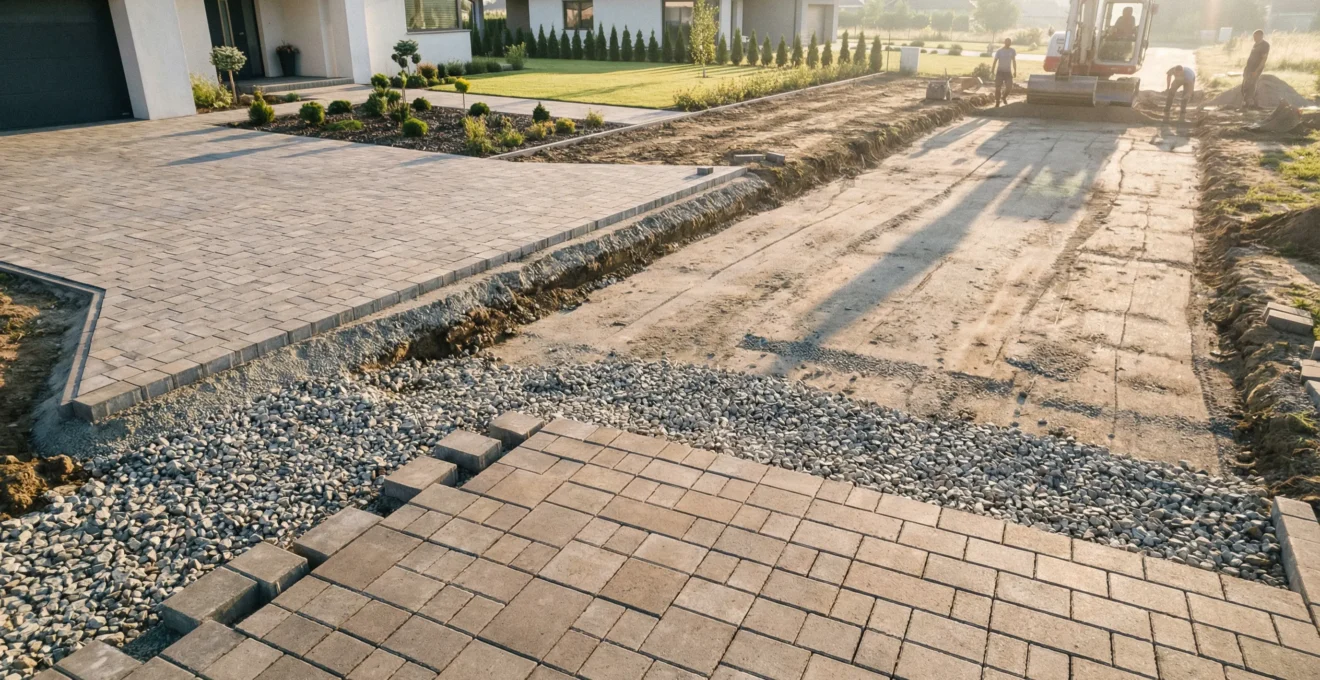
To avoid planning permission, your driveway must manage its own rainwater through a permeable sub-base system, not just surface gravel.
- Front gardens over 5m² require permeable materials or a soakaway to be SUDS compliant.
- Using MOT Type 1 sub-base is a critical failure; only MOT Type 3 allows correct drainage.
Recommendation: Audit your sub-base specification immediately to ensure it uses low-fines aggregate before laying any surface material.
For many homeowners, the dream of a new driveway turns into a bureaucratic nightmare when the local council enforces planning regulations. The assumption that you can pave your own land as you please is a costly misconception. If you are paving a front garden area larger than five square metres, the law requires you to manage surface water runoff to prevent it from overwhelming public drains.
Standard paving solutions often ignore the hydraulic reality of heavy rainfall. While most advice focuses on the surface aesthetic—block vs. resin—the engineering success of a driveway happens underground. SUDS (Sustainable Drainage Systems) are not just red tape; they are essential engineering protocols designed to handle water at the source. This guide moves beyond the basics of “gravel is cheap” to explain the specific engineering requirements of sub-bases, infiltration rates, and material choices that allow you to bypass planning permission legally and effectively.
The following sections detail the technical specifications required to ensure your installation is both legally compliant and structurally sound.
Table of Contents: Engineering a Compliant Driveway
- Why You Need Planning Permission for Non-Permeable Paving Over 5m²
- How to Lay Type 3 Sub-Base for Correct Drainage
- Resin Bound vs Porous Block: Which Drains Faster?
- The Maintenance Mistake That Blocks Permeable Paving
- When to Lay Resin Bound Paving: Avoiding Damp Days
- Why Your Pergola Cannot Be Taller Than 2.5m Near a Boundary
- The Trap Mistake That Causes Slow Draining Showers
- Wet Room Installation: How to Avoid Leaks on Timber Floors?
Why You Need Planning Permission for Non-Permeable Paving Over 5m²
The restriction on paving front gardens is a direct response to urban flooding. When non-permeable surfaces like concrete or asphalt seal off the ground, rainwater flows rapidly into the street sewers, causing surges that infrastructure cannot handle. This issue is significant; according to the Government’s planning policy review, paving over gardens contributes to flooding costs of £270 million per year. To mitigate this, legislation mandates that any new driveway over five square metres must be permeable or direct water to a permeable area within the property boundary.
If you ignore this, you risk enforcement action requiring the removal of the driveway. However, you can proceed under Permitted Development Rights—meaning no planning application is needed—if you utilize materials that allow water to soak into the ground. This requires a holistic system, not just a porous surface layer. The entire matrix, from the surface down to the soil, must be designed to accommodate hydraulic flow.
Compliance Audit Checklist: Is Your Plan Legal?
- Points of contact: Identify where rain hits and where it flows (e.g., towards the house, street, or lawn).
- Collecte: Measure the exact square footage of the proposed impermeable area; is it >5m²?
- Cohérence: Check if materials specified are inherently permeable (gravel, porous asphalt) or require a soakaway.
- Mémorabilité/émotion: Confirm the sub-base specification matches the surface permeability (avoid Type 1).
- Plan d’intégration: If using non-permeable blocks, design the drainage channel connection to a soakaway, not the sewer.
It is vital to distinguish between front and back gardens, as the rules differ significantly regarding permitted development.
Failure to adhere to these rules can result in costly retrofitting or removal orders from the council.
How to Lay Type 3 Sub-Base for Correct Drainage
The most common failure in DIY permeable driveways is the use of the wrong sub-base aggregate. Traditional driveways use MOT Type 1, which contains a high volume of “fines” (dust and small particles). When compacted, Type 1 becomes almost impermeable, creating a dam beneath your porous surface. For SUDS compliance, you must specify MOT Type 3. This open-graded aggregate has a reduced fines content, creating a stable structure with voids that allow water to pass through freely.
The illustration below highlights the open texture of Type 3, which is critical for vertical drainage.
As visualized, the gaps between the angular stones act as a temporary reservoir, holding water during heavy downpours before it infiltrates the ground. Without this specific layer, even the most expensive permeable surface will fail to drain.
To understand the technical differences, compare the specifications in the table below. This demonstrates why Type 3 is non-negotiable for SUDS applications, as highlighted by aggregate comparison data.
| Characteristic | MOT Type 1 | MOT Type 3 |
|---|---|---|
| Primary Use | Load-bearing foundations, roads, highways | Permeable paving, SuDS applications, sports pitches |
| Fines Content | High – significant fine particles and dust | Reduced – open-graded with fewer fines |
| Permeability | Low – compacts tightly, prevents water passage | High – allows water to drain freely |
| SuDS Compliance | Not compliant | Fully compliant (SHW Clause 805) |
| Recommended Depth for Driveways | 150mm standard | 125-225mm depending on soil conditions |
| Compaction Behaviour | Tight compaction due to fines | Stable yet free-draining structure |
Once the sub-base is correctly installed, the choice of surface material determines the final infiltration rate.
Resin Bound vs Porous Block: Which Drains Faster?
When selecting a finish, homeowners often weigh aesthetics against drainage performance. Resin bound surfacing creates a smooth, continuous surface where every square centimetre is permeable. The water drains through the matrix of the stone and resin immediately. In contrast, permeable block paving relies entirely on the joints between the blocks to drain water. If these joints are narrow or filled with incorrect material, surface water will pool.
From an engineering standpoint, resin bound offers superior hydraulic conductivity because the entire surface area is active. However, permeable block paving can be highly effective if installed with wide joints filled with 2-6mm clean grit (no sand). Data indicates that the infiltration rate of properly installed Hydropave permeable concrete block pavement is over 4,000mm per hour, which far exceeds UK rainfall averages.
The following table breaks down the operational differences between these two popular systems. This comparison is supported by industry installation guidelines.
| Feature | Resin Bound | Permeable Block Paving |
|---|---|---|
| Drainage Method | Water drains through entire surface matrix | Water drains only through joints between blocks |
| Permeability | Inherently fully permeable | Permeable only if specially designed with wide joints |
| SuDS Compliance | Automatically compliant when on porous base | Requires permeable blocks or gravel-filled joints |
| Base Requirements | Must be laid on permeable asphalt or concrete base | Laid on grit bedding layer over Type 3 sub-base |
| Long-term Drainage | Self-cleaning to some extent via rain | Joints prone to moss and silt accumulation |
| Maintenance Level | Low – occasional light pressure wash | Higher – regular joint cleaning required |
Resin Bound Base Layer Requirements for SuDS Compliance
A resin bound surface will only be SUDS compliant when laid onto a porous base, which can be special concrete or open textured Bitmac on top of Type 3 stone. Laying a resin bound system onto an impermeable base negates its permeable benefits entirely and will not meet SuDS requirements. This is a critical distinction that determines whether the installation qualifies for permitted development rights.
Even the fastest draining surface will fail over time if maintenance protocols are ignored.
The Maintenance Mistake That Blocks Permeable Paving
Permeable systems are living infrastructure; they interact with the environment. The primary enemy of these systems is silt and organic matter (detritus). Over time, fine particles from car tires, windblown soil, and decaying leaves can form a paste that seals the voids in resin bound paving or the grit joints in block paving. Once this seal forms, the driveway becomes impermeable, leading to surface flooding and potential non-compliance with the original drainage plan.
The most damaging mistake homeowners make is aggressive power washing. High-pressure jets can blast dirt deeper into the sub-base matrix or wash away the structural jointing grit in block paving. Instead, a regimen of light cleaning is required. Research suggests that without vacuuming maintenance, permeable systems typically become completely clogged within 5-7 years. Regular sweeping and occasional light washing prevent this accumulation.
For resin bound systems, the installation conditions are just as critical as the maintenance.
When to Lay Resin Bound Paving: Avoiding Damp Days
Resin chemistry is extremely sensitive to moisture during the curing phase. The catalyst in the polyurethane resin reacts with water, leading to a phenomenon known as “blooming” or foaming. This results in unsightly white patches and, more critically, structural weakness in the bond between the stones. A compromised bond can lead to surface fretting, where stones become loose, destroying the integrity of the paving.
Installation must be timed to avoid high humidity and dew points. Professional installers monitor the temperature and relative humidity closely. If the ground temperature is too close to the dew point, condensation will form on the curing surface. This implies that laying resin is often a seasonal activity, risky in late autumn or winter.
The image below captures the optimal dry conditions required for a flawless resin application.
Achieving a smooth, durable finish requires not just skill but strictly dry weather, ideally with a rising temperature to aid the chemical cure.
While paving rules are strict, regulations for vertical garden structures also trap the unwary.
Why Your Pergola Cannot Be Taller Than 2.5m Near a Boundary
Garden landscaping often includes structures like pergolas or decking to complement the driveway area. However, planning rules for these vertical elements are strict regarding boundary lines. Under Permitted Development, any outbuilding or enclosure located within 2 metres of a boundary must not exceed a maximum height of 2.5 metres. This rule is designed to prevent overshadowing and loss of amenity for neighbours.
A common trap involves installing a pergola on top of a raised decking area. The height is measured from the highest adjacent ground level, not the deck floor. If your deck is raised by 30cm and you add a 2.4m pergola, the total height from the ground is 2.7m, making the structure illegal without planning permission.
Raised Platform Height Measurement Trap
When building structures on existing decking, the height measurement is calculated from the highest ground level adjacent to the structure rather than the deck floor itself. This means a standard pergola kit that would normally be compliant could become illegal when placed on raised decking, as the total height from natural ground level exceeds permitted development limits.
Drainage issues are not limited to the outdoors; internal water management requires similar precision.
The Trap Mistake That Causes Slow Draining Showers
Inside the home, managing water flow in wet rooms or walk-in showers presents a hydraulic challenge similar to driveways: balancing inflow with outflow. A common error in DIY bathroom renovations is installing a waste trap that cannot handle the volume of water produced by modern high-flow showerheads. A standard 50mm seal trap may struggle to evacuate water fast enough for a “rain” shower head delivering 20 litres per minute, causing the shower tray to overflow.
Furthermore, “double trapping” occurs when a trap is installed on the shower waste while another trap already exists on the waste pipe run. This creates an airlock that drastically reduces flow velocity, leading to slow drainage and gurgling noises.
Refer to the table below to match your shower equipment with the correct waste infrastructure, as detailed in plumbing flow standards.
| Shower Type | Typical Flow Rate | Minimum Trap Size | Recommended Waste |
|---|---|---|---|
| Standard Shower | 8-12 litres/min | 50mm seal trap | Standard 90mm waste |
| Power Shower | 12-15 litres/min | 50mm seal trap | High-flow 90mm waste |
| Rainfall/Drench Head | 15-25+ litres/min | Hi-flow specialist | Large bore or dual outlet waste |
Beyond flow rates, the structural integrity of the floor itself is the final line of defence against leaks.
Key takeaways
- SUDS compliance prevents legal issues and flooding.
- Type 3 sub-base is mandatory for permeable driveways.
- Resin installation requires strictly dry weather conditions.
Wet Room Installation: How to Avoid Leaks on Timber Floors?
Installing a wet room on a timber floor introduces a high risk of leakage due to the natural movement of wood. Unlike concrete, timber joists and floorboards expand, contract, and deflect under load. Rigid waterproofing methods, such as painting liquid tanking directly onto plywood, often fail because they cannot accommodate this movement. The tanking layer cracks, breaking the waterproof seal.
The solution lies in decoupling. A physical decoupling membrane separates the tiled surface from the timber substrate. If the wood moves, the membrane absorbs the stress, leaving the waterproofing layer and the grout lines intact. This engineering approach ensures that the wet room remains watertight despite the inherent flexibility of the wooden structure.
Assess your property’s drainage needs today and consult a certified engineer to design a compliant, durable system.
Frequently Asked Questions about Permeable Driveways
What defines a permeable surface for planning permission?
A permeable surface is one that allows water to drain naturally through it into the ground below, rather than directing it into a public drain. Common examples include gravel, permeable concrete block paving, and porous asphalt.
Can I just use gravel to be SUDS compliant?
Yes, loose gravel is permeable. However, to be fully compliant and functional, it should be laid over a permeable sub-base (Type 3) to prevent the ground beneath from becoming compacted and impermeable over time.
Do I need planning permission for a patio?
Similar to driveways, if the patio is in the front garden and exceeds 5m², it must be permeable or drain to a porous area. In back gardens, there are generally no restrictions on the area of hard surfacing at ground level.