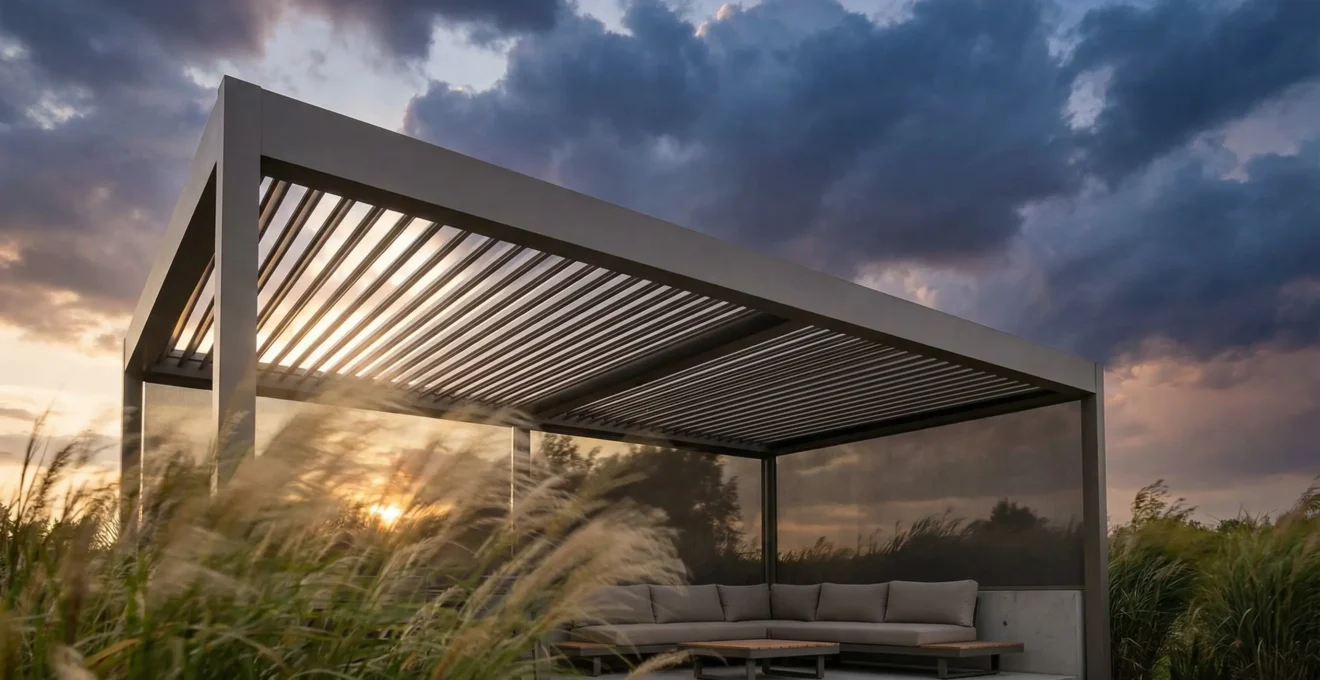
True storm protection relies on prioritizing wind sensors over rain sensors to prevent structural failure.
- Wind sensors must trigger a “system lockout” that overrides all other commands.
- Off-grid solar backups ensure safety protocols execute even during power outages.
Recommendation: Audit your automation protocol to ensure the “wind override” function is active and test your sensor placement for turbulence interference.
You have invested significantly in a luxury outdoor shading system. The fear of waking up after a storm to find twisted aluminum slats or a compromised drive mechanism is real, especially for homeowners in high-wind regions. While motorized pergolas are engineered for durability, they are not invincible against nature’s raw force if mismanaged.
The common advice is simply to “close the roof” when it rains or “open it” when it gets windy. However, this binary approach ignores the complex aerodynamics of uplift loads and the potential for conflicting automation signals. True protection involves understanding the hierarchy of sensors—why a rain sensor might actually endanger your structure during a hurricane—and how different communication protocols like Zigbee and RTS impact reliability.
But what if the key to longevity wasn’t just about structural strength, but about the intelligence of the code running it? By prioritizing specific automation logic and maintenance protocols, you can transform your pergola from a passive structure into a smart, self-protecting system.
This guide will walk you through the essential configurations, from sensor hierarchy to power redundancy, ensuring your investment weathers the storm.
The following sections detail the technical and practical steps to secure your system. Here is the roadmap for complete protection.
Table of Contents: Automated Protection Strategies
- Why Wind Sensors Are More Important Than Rain Sensors
- How to Run Power to a Pergola Without Trenching the Lawn
- Zigbee vs RTS: Which Protocol Controls Louvers Reliably?
- The Lubrication Mistake That Seizes Up Aluminum Motors
- When to Program ‘Sun Tracking’ for Maximum Shade
- Manual vs Electric Louvers: Are Motors Worth the Risk of Failure?
- How to Dim LEDs Without Flickering or Buzzing
- Pendant or Chandelier: Choosing Lighting for Low Ceilings?
Why Wind Sensors Are More Important Than Rain Sensors
A wind sensor is the primary fail-safe for any motorized structure. While rain sensors provide convenience, wind sensors provide structural survival. In a storm scenario, these two inputs often conflict: the rain sensor demands the louvers close to keep the patio dry, while the wind sensor demands they open to relieve uplift pressure.
If the louvers remain closed during high winds, the pergola acts as a solid sail, absorbing massive kinetic energy that can buckle the frame. Professional integrators configure a strict hierarchy where wind signals always override rain signals. For example, the Breeze Pro system utilizes a specific logic: when a wind threshold is met, there is a 4-hour lockout on automated controls, preventing rain schedules from re-closing the roof while the danger persists.
Wind Sensor Placement Audit
- Points of contact: Identify the proposed mounting location relative to the roofline.
- Collecte: Measure height; mount sensor minimum 13 feet from ground level for accurate wind speed measurements.
- Cohérence: Maintain at least 3 feet clearance from roofs and parallel surfaces to avoid turbulence interference.
- Mémorabilité/émotion: Position sensor in ‘clean air’ away from buildings, trees, or other obstructions that deflect airflow.
- Plan d’intégration: Avoid mounting on pergola posts where the structure itself creates wind shadows and inaccurate readings.
Proper placement is as critical as the logic itself. A sensor placed in a “dead zone” will fail to detect the gusts that threaten the louvers.
Once the sensor logic is established, the next challenge is ensuring the system has the power to execute these commands, even when the grid fails.
How to Run Power to a Pergola Without Trenching the Lawn
Standard hardwired installations are vulnerable to the very storms they are meant to resist. If a storm knocks out utility power, your wind sensor’s “open” command becomes useless, leaving the louvers locked in a dangerous position. Off-grid solutions offer a distinct advantage here.
By utilizing a solar-powered system with battery backup, you create a self-contained ecosystem. As seen in the image below, these systems integrate power storage directly into the structure.
This setup allows for a cleaner installation without trenching through landscaping, but more importantly, it provides energy resilience. A system like this ensures louvers can respond to wind emergencies even during extended grid outages common in storm events.
As illustrated, the battery integration is compact. A robust solar setup can provide up to 60 days of standby power, ensuring that the safety protocols discussed previously are always executable.
With power secured, the method of signal transmission determines whether the motor actually receives the command to protect itself.
Zigbee vs RTS: Which Protocol Controls Louvers Reliably?
Zigbee offers the bi-directional feedback that older RTS systems lack. In a high-stakes scenario, knowing that your command was received is crucial. Radio Technology Somfy (RTS) is a legacy one-way protocol; the remote sends a signal, but the motor does not confirm execution. If interference blocks the signal, you have no way of knowing your louvers are still closed.
Zigbee, by contrast, creates a mesh network. As noted by experts, a main benefit of Zigbee is its mesh network topology, which enables bi-directional communication for real-time shade and battery feedback. This means if a wind sensor triggers a safety command, the system can verify that the motor actually moved to the safe position.
Mesh Network Signal Relay
In a Zigbee mesh network implementation, data and communications are routed to every device, so each motor acts as a wireless receiver for the network. Unlike typical RF networks that depend on a single centralized receiver hub, this means wireless control range can be expanded because you don’t need to be near a central receiver—only within range of the furthest shade or other network device.
This redundancy is vital for large outdoor properties where a central hub might be far from the pergola.
However, even the best signal cannot move a motor that has physically seized due to improper maintenance.
The Lubrication Mistake That Seizes Up Aluminum Motors
A common error homeowners make is applying general-purpose lubricants like WD-40 to louver pivots. These oil-based products attract dust, pollen, and salt, creating an abrasive paste that eventually grinds the mechanism to a halt. For aluminum systems, cleanliness is more important than heavy lubrication.
Use only dry PTFE or silicone-based lubricants. These reduce friction without leaving a sticky residue. Regular maintenance is essential to ensure that when the automation system commands a safety movement, the physical hardware can comply instantly.
Due to powder-coated aluminum construction and sealed electronics, premium louvered systems need only minimal maintenance required. However, “minimal” does not mean “zero.”
- Step 1: Avoid WD-40 and oil-based lubricants that attract dust and pollen, creating abrasive paste.
- Step 2: Use only dry PTFE (Teflon) spray or silicone-based lubricants that coat without leaving sticky residue.
- Step 3: Apply lubricant to pivot pins every 6-12 months, more frequently in dusty or high-pollen environments.
- Step 4: Clean pivot points with mild soap and water before reapplication to remove any accumulated debris.
- Step 5: Inspect rubber weather seals for swelling or degradation caused by petroleum-based products.
With the mechanics moving freely, we can look at advanced programming that protects comfort as well as the structure.
When to Program ‘Sun Tracking’ for Maximum Shade
Intelligent sun tracking does more than block light; it manages thermal load. Rather than simply closing the roof completely on a hot day, which traps heat underneath, smart systems angle the louvers to block direct UV rays while allowing airflow. This is known as the “chimney effect.”
The image below demonstrates this precise angling. By tracking the sun’s position, the system maintains a cool environment automatically.
As shown, the louvers block the sun but remain slightly open. Integrated smart weather sensors automatically adjust louvers based on conditions—when hot sun is detected, louvers adjust to optimize airflow and shade rather than closing completely.
This level of automation raises a question: is the complexity of motors worth it compared to manual systems?
Manual vs Electric Louvers: Are Motors Worth the Risk of Failure?
While manual systems seem simpler and less prone to electronic failure, they introduce a significant human error factor. In a sudden storm, a manual roof requires a person to go outside and crank the mechanism—often 50+ turns—to secure it. Most damage occurs because the homeowner was not home or could not act fast enough.
Motorization acts as vacation insurance. As noted by Renson, the wind sensor automatically moves the pergola to its most secure position when wind speed exceeds safety thresholds—even when homeowners are away. This autonomous protection prevents structural damage that would occur if manual intervention were required.
Furthermore, the build quality often differs. Commercial-grade motorized units weigh significantly more than mass-market imports, with a 10×13 unit weighing approximately 1,800 lbs vs 250-450 lbs for manual kits. This weight reflects the structural density required to withstand wind loads.
As The Luxury Pergola points out:
Manual crank systems exist on some entry-level models, but the inconvenience of hand-cranking a large roof system means the louvers rarely get adjusted.
– The Luxury Pergola, Motorized Pergola Buying Guide
Once you commit to an electric system, integrating lighting is the next step, though it comes with its own technical hurdles.
How to Dim LEDs Without Flickering or Buzzing
Flickering LEDs are rarely a bulb issue; they are a compatibility issue. In outdoor pergolas, long cable runs and incompatible dimmers cause voltage drop and signal interference. Using a standard TRIAC dimmer on a low-voltage LED driver often results in strobing or buzzing.
For health and comfort, the quality of light matters. Research indicates that to avoid any health-related discomfort from LED flicker, PWM frequency should be higher than 3 kHz required. Achieving this requires matching the dimmer type (usually ELV or 0-10V) to the specific driver used by the pergola manufacturer.
Solving Voltage Drop
LED strip flickering at the far end of long runs is typically caused by voltage drop. The professional solution involves minimizing run length, powering strips from the middle of the run rather than one end, or breaking long runs into smaller parallel sections. Using 24V strips instead of 12V also cuts current in half, significantly reducing voltage drop issues.
Finally, the physical choice of fixtures must align with the structural realities of a moving roof.
Pendant or Chandelier: Choosing Lighting for Low Ceilings?
Hanging fixtures under a motorized louvered roof presents a unique collision hazard. When louvers rotate, they encroach on the headspace. A chain-hung chandelier can sway in the wind, shattering against the moving louvers or the posts.
Rigid stems and integrated channels are the safest options. Fixtures should never hang freely in a zone where wind can turn them into projectiles. Modern systems like the StruXure TraX integrate lighting components and wiring safely separated within dedicated channels within the pergola structure, eliminating dangling hazards entirely.
If you must use hanging lights, ensure they are rigid-stem fixtures to prevent wind-swing collisions. Furthermore, verify IP65+ rating for all outdoor fixtures—standard ‘damp rated’ bathroom fixtures fail when wind drives rain horizontally.
Key Takeaways
- Wind priority logic must strictly override rain sensors.
- Off-grid battery backups prevent failure during power outages.
- Proper lubrication with dry PTFE prevents motor seizure.
Summary: Securing Your Outdoor Investment
Protecting a high-end motorized pergola is not about fighting nature, but about adapting to it with intelligent automation. By establishing a sensor hierarchy that prioritizes wind safety, securing redundant power, and maintaining the mechanical integrity of the louvers, you ensure your investment survives the harshest conditions.
Now that your system is secure and responsive, the next logical step is to integrate it fully into your smart home ecosystem for seamless voice or scene-based control.
Audit your current sensor settings today to ensure your wind lockout threshold is active and correctly prioritized.