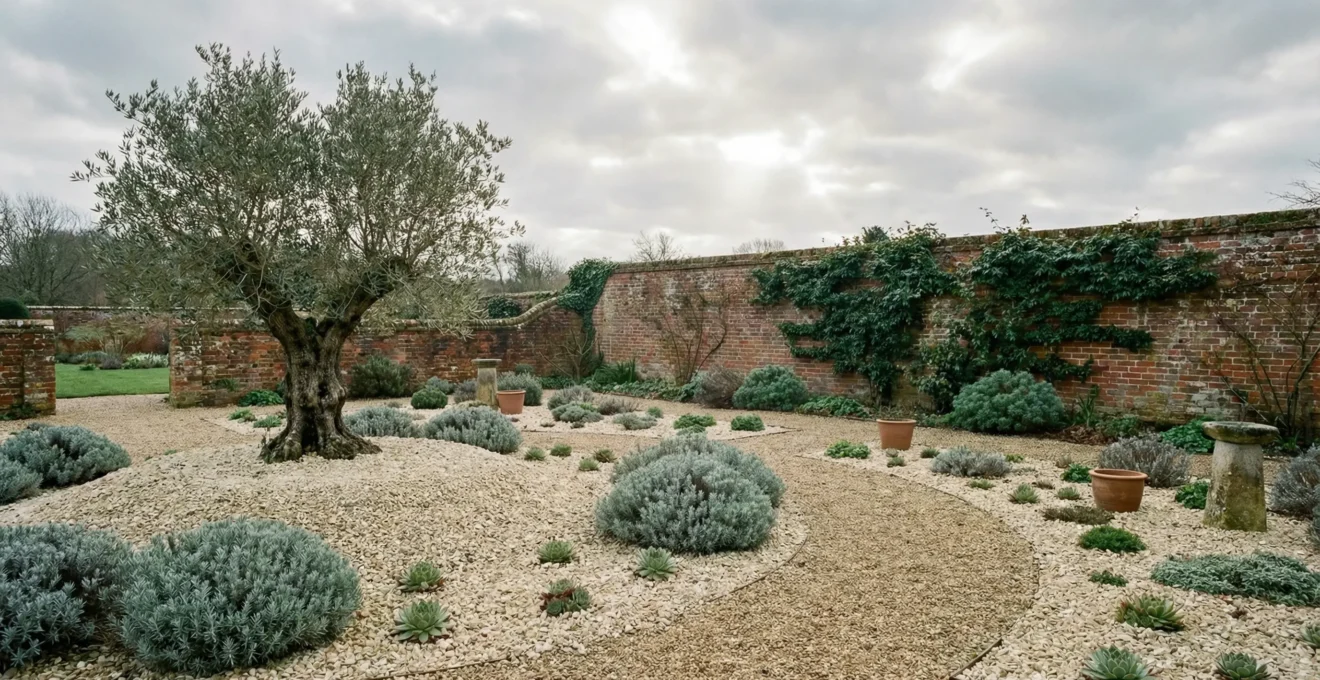
Success in British xeriscaping isn’t about how dry you can keep the soil in August, but how quickly you can drain it in January.
- Heavy clay soils require aggressive amendment with grit, not just organic matter, to prevent root rot.
- Weed membranes are often detrimental in wet climates; deep gravel mulch without a barrier is superior.
- Planning permission is now a legal requirement for non-permeable front garden surfaces over 5m².
Recommendation: Audit your soil drainage immediately and switch to open-graded aggregates (MOT Type 3) before planting any Mediterranean species.
For many British gardeners, the dream of a low-maintenance, drought-tolerant gravel garden often ends in a muddy, moss-covered nightmare by November. We see the pristine, sun-baked landscapes of the Mediterranean and try to replicate them, forgetting that while our summers are getting hotter, our winters remain relentlessly damp. The frustration is palpable when expensive Lavenders and Olives, which thrived in July, turn black and succumb to root rot at the first sign of persistent drizzle.
The standard advice usually revolves around “picking the right plant” or “watering less,” but these are platitudes that ignore the fundamental engineering challenge of the UK climate. It is not the cold that kills most xeriscape plants here; it is the combination of cold and wet—anoxic conditions that suffocate roots. To succeed, we must shift our focus from mere plant selection to total drainage management. This guide explores how to adapt rigid xeriscaping principles to work with our heavy soils and planning regulations, rather than fighting a losing battle against the rain.
From engineered soil amendments to legal compliance for driveways, we will break down the essential adaptations required for a thriving British dry garden.
The following guide details the structural and botanical adjustments necessary to make this aesthetic work in a wet climate.
Table of Contents: A Blueprint for British Xeriscaping
- Why You Must Add Grit to Clay Soil for Mediterranean Plants
- How to Mulch with Gravel Without Creating a Weed Mat
- Lavandula Angustifolia vs Stoechas: Which Survives UK Frost?
- The Fungus Risk of Crowding Plants in a Xeriscape
- How to Build a French Drain to Protect Dry-Loving Plants
- How to Choose Plants That Survive Shallow Root Systems
- Why You Need Planning Permission for Non-Permeable Paving Over 5m²
- How to Install Permeable Driveways to Comply with SUDS Regulations?
Why You Must Add Grit to Clay Soil for Mediterranean Plants
The biggest mistake in UK xeriscaping is underestimating the density of native clay soil. Mediterranean plants, such as olives and thyme, have evolved in rocky, porous substrates where water passes through almost instantly. When you plant these directly into heavy British clay, you are essentially placing them in a bucket. During winter, this “bucket” fills with water, displacing oxygen and causing the roots to rot. To counteract this, amending the soil is not just a suggestion; it is a structural necessity.
Simply throwing a handful of stones into the planting hole is insufficient and can actually create a sump effect, drawing water in. You must radically alter the soil structure across the entire bed. Professional nurseries emphasize that for effective drainage in heavy clay, the volume of aggregate needed is substantial. In fact, according to RHS guidance, the 250kg per square metre of grit required for effective clay improvement is often a shock to the average gardener, but it is necessary to break the bond of the clay particles.
By ensuring the sub-surface allows water to transit freely, we prepare the ground for the next critical layer.
How to Mulch with Gravel Without Creating a Weed Mat
A common misconception is that a gravel garden requires a geotextile membrane beneath the stone to suppress weeds. In a wet climate, this membrane often becomes a liability. Over time, silt and organic matter accumulate on top of the fabric, creating a shallow, sludge-like layer where weeds can easily root. Worse, the membrane prevents the gravel from integrating with the soil, which stops the natural vertical migration of worms and creates a slip plane for surface water.
The most successful British gravel gardens, such as the renowned Beth Chatto Gardens in Essex, forego the membrane entirely. Instead, they rely on a deep layer of gravel applied directly to the soil. This depth creates a dry zone around the “collar” of the plant (where the stem meets the roots), which is the most vulnerable point for rot. By allowing the gravel to touch the soil, you also facilitate better gas exchange, keeping the soil beneath aerobic even during wet spells.
This cross-section illustrates how a membrane-free approach functions:
As illustrated, the absence of a barrier allows water to percolate immediately, while the deep gravel layer protects the plant’s crown from damp soil contact.
Eliminating the membrane is a bold step, but it is the foundation for healthy plants.
Lavandula Angustifolia vs Stoechas: Which Survives UK Frost?
Not all lavenders are created equal, especially when faced with a British January. Many gardeners are seduced by the showy “bunny ears” of Lavandula stoechas (French/Spanish lavender), only to find them dead by March. The issue is rarely the cold alone, but the combination of freezing temperatures and wet roots. In our climate, hardiness ratings are only valid if drainage is perfect; however, genetics play a massive role in survival rates.
Lavandula angustifolia (English lavender) is far more robust, capable of withstanding lower temperatures and recovering better from damp conditions. It enters a deeper dormancy than its Mediterranean cousins. To ensure your garden returns year after year, it is vital to check the hardiness rating before buying. A plant rated H3 might survive a London winter but will perish in Yorkshire, whereas an H5 rating is generally a safe bet for the UK.
Before making a selection, consider the specific tolerances detailed below:
| Lavender Type | Scientific Name | UK Hardiness Zone | Minimum Temperature Tolerance | UK Winter Suitability |
|---|---|---|---|---|
| English Lavender | Lavandula angustifolia | H5 (Hardy) | -15°C | Excellent – survives prolonged wet winters |
| French/Spanish Lavender | Lavandula stoechas | H3-H4 (Half-hardy) | -5°C | Poor – struggles with damp British Januaries |
| Lavandin Hybrids | Lavandula x intermedia | H5 (Hardy) | -10°C | Good – combines hardiness with heat tolerance |
Hardiness is genetic, but health is environmental.
The Fungus Risk of Crowding Plants in a Xeriscape
In arid climates, plants are often spaced closely to shade the soil and retain moisture. In the UK, this technique invites disaster in the form of Botrytis (grey mould) and other fungal pathogens. Our high ambient humidity means that foliage stays wet longer after rain. If plants touch, air cannot circulate, creating stagnant pockets of humidity that are breeding grounds for disease. The “full” look must be sacrificed for the sake of plant health.
A successful British xeriscape relies on seeing the gravel between the plants. This negative space allows the wind to dry the foliage rapidly. Furthermore, woody herbs like Rosemary and Sage should be kept clear at the base. Implementing a strict airflow protocol is as important as watering.
Plan d’action : Optimising Airflow for Plant Health
- Points de contact : Space plants 30-50% wider than standard tags suggest to prevent foliage overlap.
- Collecte : Identify prevailing wind direction and orient rows to channel air through the bed.
- Cohérence : Strip the bottom 5cm of foliage from woody herbs to ensure air circulation at the soil collar.
- Mémorabilité/émotion : Check for ‘dead zones’ where air stagnates, often against walls or fences.
- Plan d’intégration : Replace organic mulches near stems with gravel to keep the crucial collar zone dry.
Airflow manages humidity, but groundwater requires active management.
How to Build a French Drain to Protect Dry-Loving Plants
When dealing with a garden that sits at the bottom of a slope or has a high water table, soil amendment alone cannot cope with the influx of water. In these scenarios, a French drain becomes the unsung hero of the xeriscape. This simple trench system intercepts water moving through the soil and redirects it away from sensitive root zones. Without it, your gravel garden effectively becomes a sump for the surrounding area’s runoff.
The construction must be precise to avoid clogging with silt, a common issue in British soils. The “burrito method,” where aggregate is fully wrapped in geotextile, ensures longevity. The impact of such water management systems is profound, not just for plant survival but for overall efficiency, proven by data showing a 30% to 50% reduction in annual water consumption when these systems are active and plants are healthy.
This image details the correct installation layers:
Properly installed, this system acts as a lifeline, ensuring that even during torrential downpours, the root zone remains oxygenated.
Engineering solves the deep water issue, allowing us to focus on the surface.
How to Choose Plants That Survive Shallow Root Systems
Not all drought-tolerant plants send roots deep into the earth. Many, like Sedums and Sempervivums, have adapted to thrive in thin, rocky soils with shallow root systems. In a UK context, these are incredibly valuable because they can inhabit the “improved” top layer of your garden without venturing into the cold, waterlogged clay beneath. By selecting shallow-rooting species, you effectively bypass the drainage limitations of your subsoil.
The Beth Chatto Resilience Model
The Beth Chatto Gravel Garden in Essex has demonstrated remarkable resilience with shallow-rooted drought-tolerant plants. During the summers of 1995 and 1997, the garden endured abnormally high temperatures and minimal rainfall, testing plant drought tolerance. The garden team held firm, trusting the plants’ ability to survive, and as soon as cooler weather and penetrating rain arrived, plants recovered and sent out fresh new growth. The garden survived over 50 days without rain in 2018, proving that properly selected shallow-rooted plants can thrive in one of the driest regions of the UK.
These plants can be sited in raised “pockets” of grit and compost, keeping them high and dry. This technique mimics the alpine trough environment but on a garden scale, providing a safe haven above the wet danger zone.
Planting strategy is one thing, but legal compliance is another.
Why You Need Planning Permission for Non-Permeable Paving Over 5m²
The trend for paving over front gardens to create parking or low-maintenance zones has contributed significantly to urban flooding. As a response, the UK government implemented strict regulations to manage surface water runoff. If you intend to cover a front garden area with traditional, non-permeable materials (like standard concrete or asphalt) and the water drains into the public highway, you cannot simply proceed. These rules are designed to keep rainwater within the property boundary.
Specifically, planning regulations apply if the surface to be covered is more than 5 square metres. This threshold is surprisingly low, catching many homeowners out. The goal is to encourage Sustainable Drainage Systems (SuDS). By using permeable materials, you avoid the need for planning permission entirely, saving time, money, and administrative headaches.
Like the legal experts at A-List UK Experts note in their 2025 Guide:
Since 2008, UK law has required homeowners to get planning approval for certain types of driveways—specifically those that aren’t permeable and drain onto public roads.
– A-List UK Experts, SuDS-Compliant Driveways 2025 Guide
Compliance protects you from legal action and helps the local environment.
Key takeaways
- Always use MOT Type 3 sub-base for permeable areas to ensure water flows through to the soil.
- Resin-bound surfaces are SUDS compliant; resin-bonded are not.
- Regular maintenance is required to keep permeable voids free of silt and moss.
How to Install Permeable Driveways to Comply with SUDS Regulations?
Creating a SUDS-compliant driveway or garden path is not just about the surface layer; it is about the entire sub-base structure. Traditional driveways use “MOT Type 1” aggregate, which contains a lot of fine dust (fines) that packs down hard to create a solid, impermeable base. For a permeable system, you must switch to “MOT Type 3” aggregate. This material has fewer fines, creating an open structure that allows water to pass through freely while still providing structural stability.
Whether you choose gravel, permeable block paving, or resin-bound surfaces, the sub-base is the critical component. If you place a permeable surface over an impermeable base, the water will simply pool underneath and cause the surface to fail. Understanding the difference between these materials is the key to a long-lasting, legal, and dry installation.
| Characteristic | MOT Type 1 | MOT Type 3 |
|---|---|---|
| Composition | Crusite with fines (dust) | Open graded, fewer fines |
| Water Permeability | Low – fines block drainage | High – allows water to pass through |
| SUDS Compliance | NOT compliant | Compliant |
| Typical Use | Roads, non-permeable surfaces | Permeable driveways, soakaways |
| Stability | Compacts firmly | Remains stable while permeable |
| UK Specification | Standard highway use | SHW Clause 805 for drainage |
Adapting xeriscaping for the UK is ultimately an exercise in hydrology. By respecting the flow of water through every layer—from the sub-base to the mulch—you create a system that remains resilient in both August droughts and January floods.
Assess your soil type today and invest in the right drainage infrastructure before planting your first lavender.