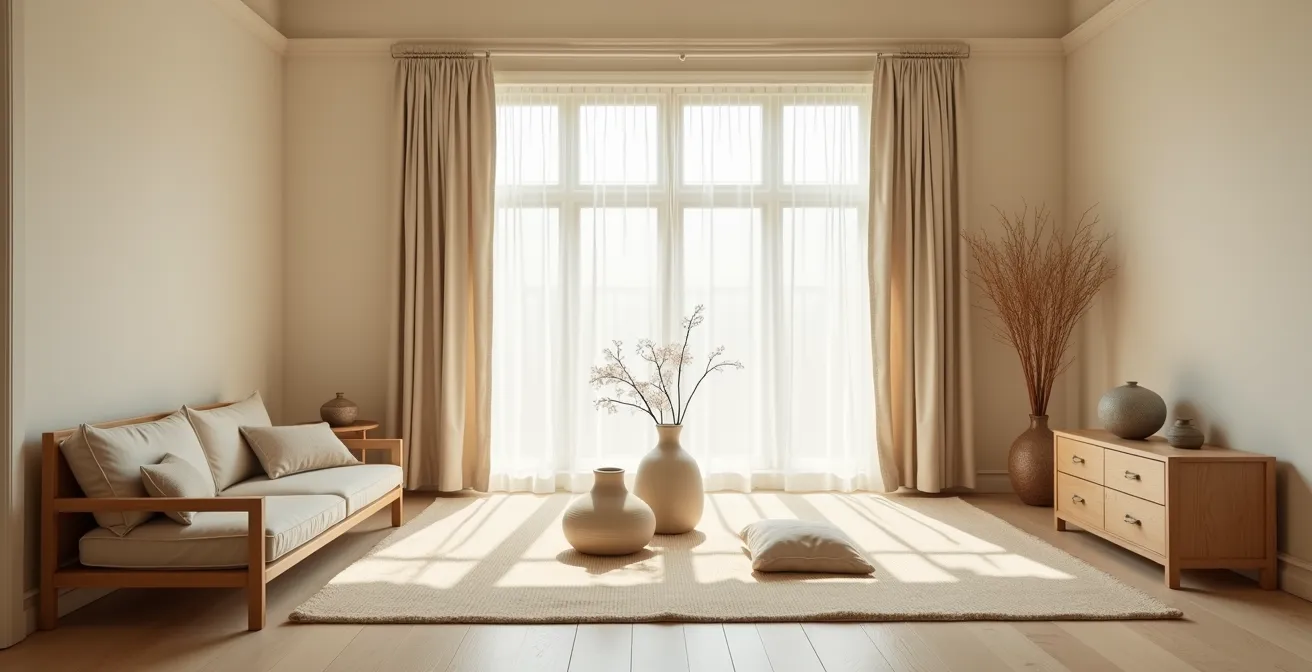
Contrary to popular belief, making a north-facing British room feel warmer isn’t about painting it stark white; it’s about embracing the moody light with complex, warm-toned neutrals and rich textures.
- Swap cold, brilliant whites for nuanced neutrals with red or yellow undertones to counteract the cool, grey light.
- Use materials like clay-based paint, unvarnished wood, and slubby linens to absorb light and add tactile warmth.
Recommendation: Instead of trying to make a dark room bright, focus on making it a deliberately cosy, enveloping, and personal sanctuary.
The Japandi aesthetic, a serene fusion of Scandinavian functionality and Japanese rustic minimalism, has captured the hearts of design-conscious homeowners across the UK. It promises a calm, uncluttered, and nature-connected haven—an ideal antidote to our often-chaotic lives. Yet, there’s a significant hurdle for many in Britain: our infamous north-facing rooms. The persistent cool, grey light can turn a palette of clean neutrals into a cold, flat, and uninviting space, a far cry from the warm sanctuary you envisioned.
The common advice is to fight darkness with brilliant white paint and mirrors, but this often backfires, merely amplifying the coldness of the light. Other typical suggestions include adding natural materials and plants, which are core to the style but don’t address the fundamental issue of light quality. The real challenge lies in translating an aesthetic born of different light conditions to the unique climate of a British home, particularly one with period features like high ceilings or awkward alcoves.
But what if the secret wasn’t to fight the darkness, but to work with it? The key to a successful British Japandi interior is to stop trying to force brightness and instead cultivate a deep, enveloping sense of warmth and character. This is achieved not through stark contrast, but through a sophisticated understanding of light absorption, textural layering, and the power of ‘complex’ neutrals. It’s about creating a room that feels intentionally moody and cocooning, rather than accidentally gloomy.
This guide will walk you through the strategic principles for adapting Japandi to your home’s specific lighting and architectural challenges. We will explore the psychology of the style, provide concrete solutions for layering colours and materials, and offer practical advice on furniture, storage, and zoning. By the end, you will have a clear roadmap to creating a Japandi space that is not only beautiful but also feels authentic and restorative, even on the greyest of days.
Table of Contents: How to Create a Warm and Authentic Japandi Home
- Why the Japandi Aesthetic Reduces Anxiety in Small Spaces
- How to Layer Neutrals Without Creating a Boring Grey Room
- Low-Profile Furniture: Is It Practical for Tall Residents?
- The ‘Catalog Look’ Error That Makes Japandi Feel Impersonal
- How to Zone an Open Space Using Slatted Wood Screens
- How to Execute the ‘One In, One Out’ Rule Successfully
- Clay Paint vs Chalk Paint: Which Covers Plaster Better?
- Minimalist Living: How to Hide Clutter in a Family Home?
Why the Japandi Aesthetic Reduces Anxiety in Small Spaces
The core appeal of Japandi design goes far beyond fleeting trends; it’s rooted in creating environments that actively promote mental well-being. In small or light-deprived spaces, which can often feel oppressive, this philosophy becomes particularly potent. The style’s emphasis on minimalism is not about sterile emptiness but about intentionality. By consciously curating a space with only purposeful or joyful objects, you reduce visual ‘noise’. This decluttering process has a direct impact on the mind, fostering a sense of control and calm in a world that often feels overwhelming.
Furthermore, Japandi’s deep connection to the natural world is a powerful tool for stress reduction. The use of natural materials like wood, bamboo, and stone, combined with an abundance of plant life, taps into our innate biophilic tendencies. It’s a design approach that brings the restorative qualities of the outdoors inside. As confirmed by recent research on interior design wellness, scenes with natural elements and views to the outside consistently rank as the most calming. Japandi design codifies this by prioritising uncluttered windows and organic forms.
In a small space, every element must work harder. The Japandi approach masters this through multi-functional furniture and an appreciation for ‘negative space’. This empty space is not wasted; it is an active design element that allows the eye—and the mind—to rest. A great example of this is the award-winning House FC project in Taipei. In a compact 700-square-foot apartment, the designers used darker, plaster-like walls not to shrink the space, but to create a sense of depth and intimacy. These deep tones become a quiet backdrop, making the tactile warmth of wood and the subtle sheen of handmade tiles even more pronounced, turning a small condo into a poetic and calming sanctuary.
How to Layer Neutrals Without Creating a Boring Grey Room
The single biggest mistake when applying Japandi principles to a north-facing British room is reaching for brilliant white or a simple, cool-toned grey. In the absence of warm sunlight, these colours will only reflect the cold, blueish quality of the ambient light, resulting in a space that feels clinical and unwelcoming. The solution is not to abandon neutrals, but to embrace their complexity. You need ‘dirty’ or ‘complex’ neutrals—colours with visible undertones of red, yellow, or even green—that carry their own intrinsic warmth.
As Farrow & Ball’s Global Brand Ambassador, Patrick O’Donnell, wisely notes, “White spaces love good light, and if the light isn’t good, more nuanced neutrals are required to bring either warmth or character.” This is the guiding principle. Instead of fighting the grey, you choose colours that harmonise with it. Think of colours like creamy off-whites, soft taupes with a hint of red, or earthy mushroom tones. These shades have enough pigment to stand up to the cool light and create a cocooning, sophisticated atmosphere rather than a stark, empty one. Authenticity is key, and more nuanced neutrals are required to bring warmth and personality.
Layering these complex neutrals with varying textures is what prevents the scheme from becoming flat. Combine a velvety, clay-based paint on the walls with the raw grain of an oak cabinet, the slubby texture of a linen curtain, and the smooth surface of a ceramic vase. Each material will catch the low light differently, creating a subtle, shifting interplay of light and shadow. This textural variation adds the depth and interest that bright, uniform colour might provide in a sunnier room. It’s a quieter, more sophisticated approach to creating visual appeal.
For British homes, several paint brands offer excellent options that work beautifully in dimmer, north-facing light. The key is to look at the undertones described by the manufacturer.
| Brand & Colour | Undertones | Best For | Why It Works |
|---|---|---|---|
| Farrow & Ball Slipper Satin | Creamy/beige | Living areas | Provides gentle warmth that brightens the space without feeling cold or clinical |
| Little Greene Stock | Yellow base | Bedrooms | This soft pastel white has a yellow base so it really warms up a north facing room |
| Farrow & Ball Dimity | Pale taupe with red | Open plan spaces | A pale taupe tinged with red… wants a little splash of red or yellow pigment |
| Dulux Perfectly Taupe | Earthy/brown | Cosy rooms | Adds a sophisticated warmth that works beautifully in dimmer, north-facing light… creates a cosy and elegant atmosphere |
Low-Profile Furniture: Is It Practical for Tall Residents?
A hallmark of the Japandi style is its low-profile furniture—sofas that sit close to the ground, low coffee tables, and floor-level seating. This design choice is rooted in the Japanese tradition of sitting on tatami mats, fostering a closer connection to the earth and creating a sense of groundedness and humility. In a design context, it creates strong horizontal lines that can make a room feel wider and more serene. However, for taller individuals or those with mobility issues, the practicality of this aesthetic can be a genuine concern. Is it possible to embrace the look without sacrificing comfort and accessibility?
The answer lies in balance and considered selection. You don’t have to commit to furniture that is only inches off the floor. Instead, look for ‘low-ish’ pieces. A sofa with a seat height of 16-18 inches still reads as low-profile compared to a traditional 21-inch high sofa, but it makes sitting and standing significantly easier. The key is to test the furniture in person. When trying a sofa, sit down and stand up at least three times. If you feel any strain in your knees or need to use your arms to push yourself up, it’s likely too low for your long-term comfort.
In many British homes, especially Victorian or Edwardian properties with high ceilings, low-profile furniture can create an issue of scale, making the furniture seem lost in the room. The strategy here is to create vertical harmony. Balance the strong horizontal lines of a low sofa or bed frame with tall, vertical elements. A towering fiddle-leaf fig plant in a corner, a slim, elegant arc floor lamp, or floor-to-ceiling slatted wood shelving can draw the eye upwards, connecting the lower and upper portions of the room and making the low furniture feel intentional and beautifully scaled rather than comically small.

As the image demonstrates, the juxtaposition of a low wooden sofa with a tall lamp and high ceilings creates a dynamic yet balanced composition. For those who find a piece of furniture they love is just slightly too low, a simple addition of firmer, custom-made cushions can add an extra 2-3 inches of height without compromising the overall aesthetic. Ergonomics and aesthetics can, and should, coexist.
The ‘Catalog Look’ Error That Makes Japandi Feel Impersonal
One of the greatest risks in adopting a minimalist aesthetic like Japandi is ending up with a space that feels sterile, impersonal, and more like a furniture catalog than a home. This often happens when the focus is solely on decluttering and adhering to a strict neutral palette, while forgetting the Japanese concept of wabi-sabi—the celebration of beauty in imperfection. A true Japandi home is not about flawless perfection; it’s about authenticity, craftsmanship, and telling a personal story.
To avoid this pitfall, you must consciously inject personality and history into the space. This means mixing new, minimalist pieces with items that have character and meaning. It could be a slightly worn antique wooden stool, a hand-thrown ceramic vase with a unique glaze, or even restored period features within the home itself. As designer Tom Rutt demonstrated in his Japandi-inspired Victorian restoration, the goal is to create a “harmonious retreat” by blending old and new, celebrating imperfection in a way that is “both timeless and deeply personal.” This philosophy of drawing inspiration from *kintsugi*—the art of repairing broken pottery with gold—is a powerful metaphor for honouring the history and ‘flaws’ that make a space unique, especially in older British properties. This approach is confirmed by a beautifully restored Victorian home that exemplifies the style.
Another key is to prioritise bespoke craftsmanship over mass-produced items. As Shanty Wijaya, founder of Allprace Design Studio, advises, you should create warmth by selecting “furniture with bespoke craftsmanship in natural elements (e.g., wood, stone), and valuing imperfection.” A hand-sanded oak dining table will have a texture and life that a flat-pack equivalent can never replicate. These pieces become the soulful anchors of the room. It’s also about curating art and objects that reflect your own journey—a framed photograph, a collection of stones from a favourite beach, or a treasured book. These are the layers that transform a ‘style’ into a ‘home’.
How to Zone an Open Space Using Slatted Wood Screens
Open-plan living is a cornerstone of modern home design, but it presents a challenge for creating the cosy, distinct zones that are crucial for a calm environment. The Japandi aesthetic offers an elegant and flexible solution drawn directly from traditional Japanese architecture: the use of screens. Unlike a solid wall, which permanently divides a space and blocks light, a slatted wood screen or *shoji*-inspired divider offers visual separation without physical isolation. It cleverly demarcates an area, suggesting a change in function while allowing light and air to flow freely.
In a typical British open-plan kitchen-diner-living area, a freestanding slatted screen can be used to brilliant effect. Placed strategically, it can shield the living area from the direct view of kitchen clutter, creating a more relaxing lounge space. It can also be used to carve out a small home-office nook, providing a psychological barrier that helps you ‘switch off’ from work at the end of the day. The beauty of these screens is their flexibility; they can be moved or repositioned as the needs of the household change, a principle that aligns perfectly with Japandi’s focus on adaptable living.
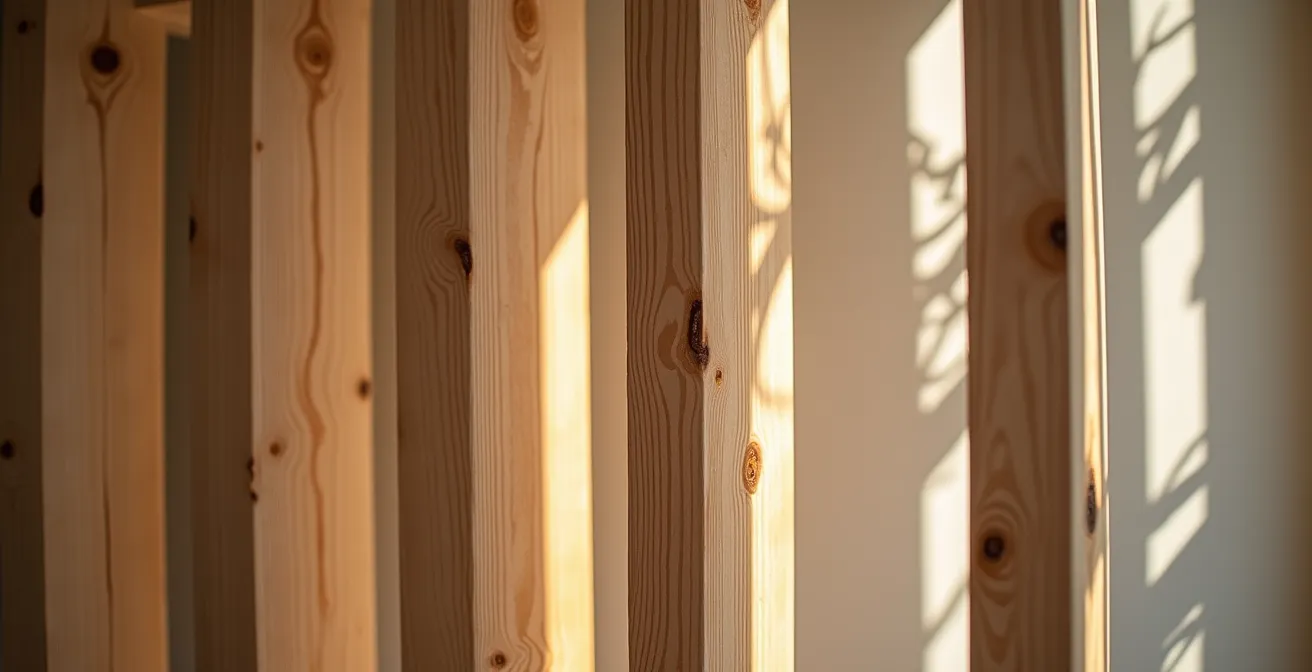
Beyond their practical function, these screens are a powerful aesthetic element, especially in a north-facing room. The interplay of light and shadow filtering through the slats becomes a design feature in itself. As the cool, diffuse light shifts throughout the day, the screen casts moving patterns on the walls and floor, adding a layer of dynamic, organic art to the room. This ‘intentional shadow’ brings depth and character, turning a potential negative (low light) into a celebrated positive. Choosing a wood like British ash or oak adds a layer of natural texture and warmth that complements the entire Japandi palette.
The principle is about suggesting boundaries rather than enforcing them. As seen in modern Japandi homes, a slatted wall panel can visually separate a workspace, showing that the corner has a different function even with no physical partition. This helps to subtly divide the space, maintaining the open feel while bringing order and calm.
How to Execute the ‘One In, One Out’ Rule Successfully
The ‘one in, one out’ rule is a simple yet powerful tenet of minimalist living, and it’s the engine that keeps a Japandi home from slowly reverting to a state of clutter. The principle is straightforward: for every new item that comes into your home, a similar item must leave. This applies to everything from clothes and books to kitchen gadgets and decorative objects. While the concept is easy to understand, successful execution requires a system and a shift in mindset from passive accumulation to active curation.
The first step is to stop impulse buying. Before purchasing a new item, ask yourself: Do I truly need this? Does it serve a purpose or bring me significant joy? And, crucially, what will I be willing to part with to make space for it? This pause for reflection is often enough to curb unnecessary consumption. The goal isn’t deprivation, but conscious choice. Studies on the psychology of design show that clutter in our homes can lead to clutter in our minds, while decluttered spaces enhance focus and relaxation. The ‘one in, one out’ rule is a practical tool for maintaining that mental clarity.
To make the ‘out’ part of the rule effective, you need a robust and accessible ‘decluttering ecosystem’. This is where a UK-specific approach is vital. Have a designated spot in your home—a ‘purgatory box’—for items you’re unsure about. If you haven’t missed an item after six months, it’s time for it to go. For items in good condition, know your local options:
- Charity Shops: Organisations like the British Heart Foundation often offer collection services for larger furniture items.
- Online Selling: Use platforms like Vinted for clothing, eBay for electronics, and Facebook Marketplace for furniture and homewares.
- Council Recycling Centres (HWRC): Your local ‘tip’ is the correct place for broken electronics, old paint, and non-reusable waste.
By establishing these clear pathways for items leaving your home, the process becomes a smooth, regular habit rather than a daunting annual task. It transforms home maintenance into a mindful practice of keeping your sanctuary balanced and serene.
Clay Paint vs Chalk Paint: Which Covers Plaster Better?
The choice of paint finish is as important as the colour itself, especially when aiming for the tactile, light-absorbing quality central to a warm Japandi aesthetic. In British homes, particularly period properties with original plaster or modern homes with newly plastered walls, the debate often comes down to two specialist finishes: clay paint and chalk paint. While both offer a desirable matte look, they have distinct properties that make one a superior choice for achieving the Japandi feel, especially on plaster.
The primary advantage of clay-based paint is its exceptional breathability. Older British homes with solid walls were designed to breathe, allowing moisture to pass through the structure. Modern, non-breathable paints can trap this moisture, leading to damp and peeling. Clay paint works in harmony with this construction, allowing the walls to regulate humidity naturally. Furthermore, its unique composition gives it a velvety, slightly textured finish that is incredibly effective at absorbing light. In a north-facing room, this is a huge benefit. Instead of reflecting the cool light, it soaks it up, creating a deep, soft, and immersive colour experience that enhances the feeling of a cosy sanctuary. Its superior adhesion also means it often covers imperfect lath-and-plaster or even textured Artex ceilings with fewer coats and without a primer.
Chalk paint, while also offering a beautiful matte finish, is less breathable than clay paint. It’s more akin to a decorative finish, excellent for furniture but less ideal for entire walls in a period property where moisture management is a concern. While it provides good coverage, it can be more reflective than clay paint and may require a primer on fresh plaster and more coats to hide significant imperfections. The Farrow & Ball Estate Emulsion is a great example of a chalky finish that can work beautifully, with colours like Pale Powder, which has an unparalleled softness and reads as a delicate, warm-toned grey in north-facing rooms due to its green pigment.
Ultimately, for covering plaster walls in a way that is both aesthetically authentic to Japandi and technically suited to British homes, clay paint is often the superior choice. Its combination of breathability, texture, and light-absorbing properties delivers that sought-after warm, enveloping feel.
| Property | Clay Paint | Chalk Paint | Best For |
|---|---|---|---|
| Breathability | Excellent – prevents damp buildup | Good but less than clay | Solid wall Victorian homes |
| Coverage on lath-and-plaster | Superior adhesion, self-priming | May need primer first | Period properties |
| Artex ceiling coverage | Hides texture well with 2 coats | Requires 3+ coats | 1970s homes |
| Light diffusion | Velvety, light-absorbing | Matte but more reflective | North-facing rooms |
| Moisture management | Regulates humidity naturally | Less moisture regulation | Bathrooms, basements |
Key Takeaways
- Ditch brilliant white in low light; opt for complex neutrals with warm undertones (red, yellow, cream) to counteract coolness.
- Balance low-profile furniture with vertical elements like tall plants, floor lamps, or shelving to suit the scale of British period homes.
- Use textures like clay paint, raw wood, and linen to add the warmth and depth that colour alone cannot provide in a north-facing room.
Minimalist Living: How to Hide Clutter in a Family Home?
The greatest challenge to maintaining a minimalist Japandi home is, simply, life. For families, the daily influx of toys, paperwork, school bags, and assorted paraphernalia can quickly overwhelm a serene aesthetic. The solution isn’t to live in a state of constant, stressful tidying, but to design intelligent, integrated storage that works with the realities of family life and the specific architecture of a British home. The principle is simple: if everything has a designated, easy-to-access home, clutter doesn’t get a chance to accumulate.
In many UK houses, period features that might seem awkward can be transformed into brilliant storage opportunities. The alcoves on either side of a chimney breast are a prime example. Instead of freestanding bookshelves that add visual clutter, installing floor-to-ceiling fitted cupboards, painted the same colour as the walls, creates a vast amount of seamless storage that simply disappears. The space under the stairs, often a chaotic dumping ground, can be fitted with deep pull-out drawers or a bespoke pull-out pantry, making every inch usable.
The Japandi philosophy also champions multi-functional furniture. An ottoman bench in a bay window provides both seating and a perfect hiding place for toys or blankets. A low media unit can house electronics while offering a clear, uncluttered surface for a few curated objects. In a family home, function and form are inseparable. The goal is to preserve that precious ‘negative space’ that allows residents to move freely, both mentally and physically, even in a busy household. Every piece of furniture should earn its place by serving multiple purposes.
Action Plan: Smart Storage for British Homes
- Chimney Alcoves: Install fitted cupboards painted to match the walls for invisible, high-capacity storage.
- Under-Stairs Space: Maximise depth and accessibility with full-extension pull-out drawers or a custom larder unit.
- Bay Windows: Use an ottoman bench or a custom window seat with built-in drawers for discreet storage of toys, shoes, or linens.
- Hallways: Mount sleek, wall-mounted hooks at varying heights for both adult and children’s coats to keep floors clear.
- Narrow Spaces: Utilise slimline shoe cabinets behind doors or in narrow alcoves to conceal footwear without impeding traffic flow.
Start transforming your space by auditing one room—not with the goal of making it bright, but of making it intentionally calm, personal, and restorative. Embrace the unique character of your home and its light, and you will create a Japandi sanctuary that is truly your own.