Protecting luxury furniture through a British winter isn’t about finding storage space; it’s about choosing the right materials from the start and mastering techniques to control moisture and wind.
- Powder-coated aluminium provides a rust-proof foundation that vastly outperforms organic materials like wicker in damp climates.
- Breathable covers combined with quick-dry foam cushions are non-negotiable for preventing the mould and mildew that thrive in trapped condensation.
Recommendation: Invest in the material science behind the furniture—its frame, finish, and fillings—not just its aesthetics, to guarantee year-round durability and peace of mind.
The thought of a brand new, high-end garden sofa facing its first sleet-filled November can be daunting for any homeowner. When you’ve invested significantly in creating a beautiful outdoor space, the question of its survival through the relentless damp and frost of a British winter becomes critical. The standard advice is often unhelpful: “store it in a garage or shed.” But what if you don’t have that luxury of space? Do you resign yourself to the inevitable decay of rust, mould, and rot?
Many simply resort to pulling a cheap, non-breathable plastic sheet over their prized possessions and hoping for the best. This approach, however, often does more harm than good, creating a perfect micro-environment for mildew and corrosion to flourish. The assumption is that the cold is the primary enemy, when in fact, the real battle is against two more insidious foes: persistent moisture and aerodynamic lift from gale-force winds.
The secret to ensuring your luxury furniture not only survives but thrives year after year lies not in hiding it, but in understanding the material science that allows it to withstand the elements. It’s about making informed choices on everything from the frame’s coating and the cushion’s internal foam to the specific technique used to secure a cover. This isn’t just about protection; it’s about outsmarting the weather with superior engineering.
This guide will deconstruct the essential elements of winter-proofing your outdoor furniture when bringing it indoors is not an option. We will explore the materials that are engineered to last, the covering methods that actually work, and the maintenance strategies that preserve both function and beauty, ensuring your investment remains a source of pride for years to come.
Summary: Your Guide to All-Weather Garden Furniture Resilience
- Why Powder-Coated Aluminium Outlasts Wicker in the UK
- How to Breathably Cover Furniture to Prevent Mould
- Quick-Dry Foam vs Standard Fill: Is It Worth the Extra Cost?
- The Aerodynamic Mistake That Sends Covers Flying
- When to Oil Outdoor Wood: Spring or Autumn?
- Teak Oil vs Sealer: Which Lasts Longer in Rainy Climates?
- Why Your Pergola Cannot Be Taller Than 2.5m Near a Boundary
- How to Maintain Teak Garden Furniture to Prevent Silvering?
Why Powder-Coated Aluminium Outlasts Wicker in the UK
When selecting furniture destined to face the UK’s damp climate, the choice of frame material is the single most important decision you will make. While natural materials like wicker or rattan offer a classic aesthetic, they are fundamentally organic. In a persistently moist environment, they absorb water, providing an ideal breeding ground for mould and eventually leading to rot and structural failure. Even synthetic wicker, while more resistant, can become brittle and crack after repeated freeze-thaw cycles.
This is where powder-coated cast aluminium establishes its dominance. Unlike steel, aluminium does not rust. However, it can still oxidise. The powder-coating process creates an impermeable protective barrier. This isn’t simply a layer of paint; it’s a dry powder applied electrostatically and then cured under heat. This creates a hard, durable finish that is far more resilient than conventional paint, shielding the metal from the elements and preventing corrosion.
The quality of this coating is paramount. Premium manufacturers have perfected this process specifically for harsh weather conditions, ensuring the finish resists chipping, fading from UV rays, and, most importantly, blistering from trapped moisture.
Case Study: Lazy Susan’s UK-Specific Weather Resistance
Garden furniture specialist Lazy Susan, for instance, utilizes a specialized powder-coating process on its cast aluminium furniture to create a robust protective barrier. Their finish is specifically formulated to resist UV fading and withstand the UK’s notorious temperature fluctuations and persistent damp, ensuring the furniture maintains its appearance and structural integrity over many years without rusting or corroding.
By choosing powder-coated aluminium, you are investing in material longevity. You are side-stepping the inevitable decay of organic materials and opting for a low-maintenance solution engineered to endure the very conditions that cause others to fail.
How to Breathably Cover Furniture to Prevent Mould
The most common mistake in protecting outdoor furniture is believing any waterproof cover will do. In reality, a cheap, non-breathable plastic or vinyl tarp is one of the worst things you can use. While it keeps rain out, it also traps moisture in. On a sunny winter afternoon, condensation forms on the underside of the cover, creating a humid, stagnant micro-environment—the perfect incubator for mould and mildew on your cushions and frame.
The solution is a high-quality, breathable cover. These are made from fabrics that are water-resistant but also microporous, allowing water vapour to escape. This constant air circulation prevents condensation from building up, keeping the furniture dry even when the cover is on for months. Look for covers with built-in vents, which further enhance this effect.
However, even the best breathable cover needs to be deployed correctly to work. If the cover lies flat on a tabletop or cushions, water will pool, creating pressure that can eventually seep through and prevent the area underneath from breathing. This is where the “tenting” technique is crucial. By creating a high point in the centre of the furniture, you allow water to run off immediately and maintain an air gap for ventilation.
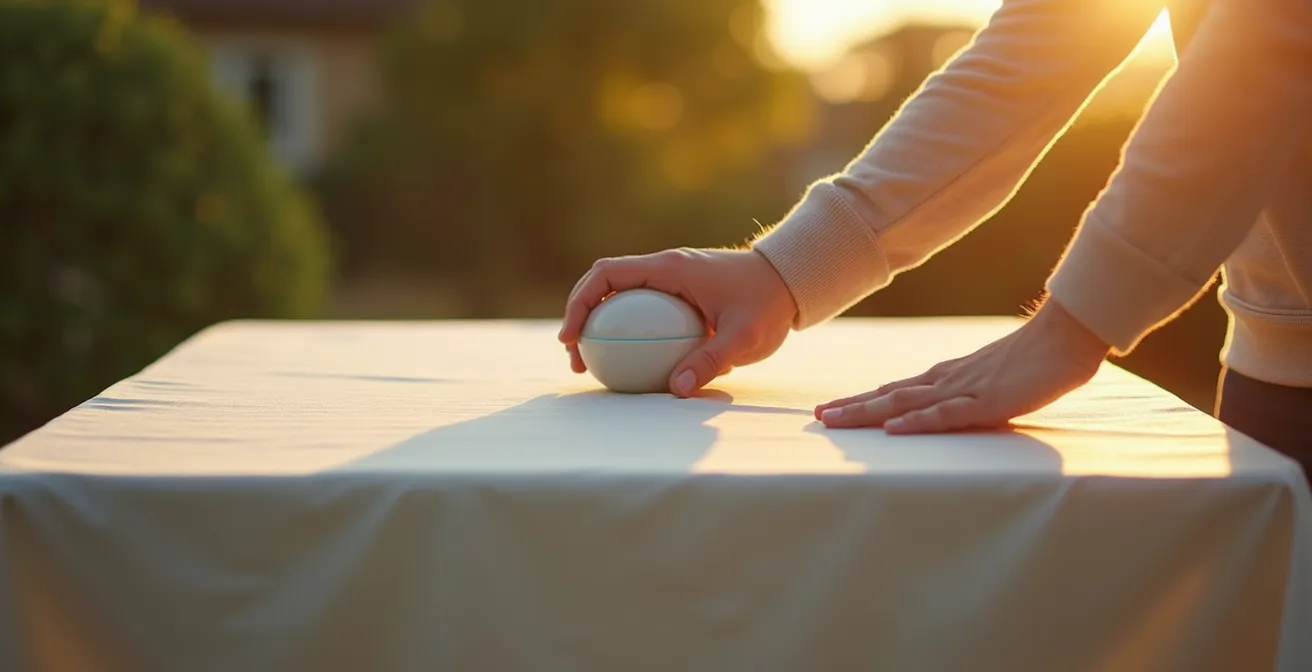
As you can see, a simple object like an inflatable beach ball or an overturned bucket placed on a table before covering creates the necessary pitch. This small step transforms the cover from a potential moisture trap into an effective, breathable shield, fundamentally winning the battle against mould.
Quick-Dry Foam vs Standard Fill: Is It Worth the Extra Cost?
Brand-new furniture can look 10 years old in just one winter season. It’s not unusual to see metals rust, wicker unravel, wood split and plastics crack because they were unprotected.
– Paul Knapp, Landscape designer with 20 years experience
Nowhere is this rapid degradation more apparent than in the cushions. Even with a breathable cover, some moisture is inevitable in the British climate. The type of foam inside your cushions determines whether this moisture becomes a catastrophic failure or a minor inconvenience. Standard upholstery foam is a dense, closed-cell material that acts like a sponge. Once wet, it holds onto water for days or even weeks, leading to a musty smell, mildew growth, and eventually, the complete disintegration of the foam.
In contrast, quick-dry foam, also known as reticulated foam, is the gold standard for outdoor furniture. It has a completely different, open-cell structure that resembles a sieve. Water passes directly through it instead of being absorbed. Paired with a mesh fabric base on the cushion cover, this allows a soaked cushion to drain almost immediately and air-dry completely, often within hours rather than weeks.
The initial cost is higher, but this is a clear case of investing upfront to avoid significant costs later. A set of standard foam cushions may be ruined after a single wet winter, requiring a costly replacement. Quick-dry foam, however, is built for exposure, making it a crucial component of truly all-weather furniture. The difference in performance is not incremental; it’s fundamental.
This comparative analysis highlights the long-term value of choosing the right cushion filling from the outset.
| Feature | Quick-Dry Foam | Standard Foam |
|---|---|---|
| Water Drainage | Open-cell structure allows water to pass through | Closed-cell structure retains water like a sponge |
| Drying Time | 24-48 hours | Several days to weeks |
| Mold Risk | Low – water drains quickly | High – retains moisture |
| Lifespan | 5-7 years with minimal degradation | 3-4 years before compression/mold damage |
| Initial Cost | £400 more for sofa set | Standard pricing |
| Replacement Cost | Rarely needed within warranty | £800+ after 3-4 years |
The Aerodynamic Mistake That Sends Covers Flying
Every owner of outdoor furniture knows the frustration of finding an expensive cover blown into a neighbour’s garden after a stormy night. Most people blame the wind, but the real culprit is a misunderstanding of physics. The common approach is to tie a cover down as tightly as possible with a simple rope. However, this often creates a flat, tight surface that acts like an airplane wing, a phenomenon known as aerodynamic lift. As strong wind passes over the top, it creates a low-pressure zone, and the higher-pressure air trapped underneath lifts the cover, straining the ties until they snap or the cover rips free.
Securing a cover against gales is not about brute force, but about managing wind energy. The key is to eliminate large, flat surfaces and use a method of dynamic tensioning. Instead of a rigid rope, using elasticated ties like bungee cords or ratchet straps allows the cover to absorb sudden gusts. The elasticity stretches to dissipate the force of the wind, then contracts to maintain tension, preventing the cover from billowing and catching the wind.
Furthermore, breaking up the ‘wing’ shape is vital. In addition to securing the perimeter, running a strap or bungee cord across the middle of the furniture (for example, under a table and over the cover) prevents the centre from lifting. Some owners also place smooth, heavy weights in the middle of a table cover to create a concave shape that is resistant to lift. This combination of breaking up the flat surfaces and using elastic, shock-absorbing ties is the professional’s method for ensuring a cover stays put, no matter the weather.
Case Study: POLYWOOD’s Dynamic Tensioning Method
To combat wind, outdoor furniture maker POLYWOOD recommends using bungee cords or ratchet straps instead of simple rope. Their testing shows that the elasticity of these ties allows them to absorb sudden wind gusts while maintaining tension without snapping. This prevents the billowing effect that leads to covers being torn off during heavy winds.
When to Oil Outdoor Wood: Spring or Autumn?
For owners of wooden furniture, particularly teak, the seasonal debate of when to apply oil is a frequent point of confusion. The answer depends on the goal: are you feeding the wood after winter or protecting it before winter? The most common mistake is to apply oil in late autumn, believing it creates a protective winter barrier. However, in the damp UK climate, wood is often not completely dry at this time of year. Applying oil to even slightly damp wood traps moisture inside, which can then freeze during a cold snap, causing the wood fibres to expand and crack.
Therefore, the primary and most important time to oil your outdoor wood furniture is in the spring. After a winter of exposure, the wood will be thirsty. A spring treatment replenishes the natural oils lost to the elements, nourishes the wood, and provides a crucial layer of UV protection ahead of the strong summer sun. This is the ‘feeding’ application.
An autumn treatment should only be considered a conditional top-up. The wood must be bone-dry, which may require bringing it indoors for several days to be certain. A simple water droplet test can help: if a drop of water beads on the surface, it’s still protected. If it soaks in and darkens the wood, an oil treatment may be needed, but only if you can guarantee the wood is completely dry throughout. For most, focusing on a thorough spring cleaning and oiling is the safest and most effective strategy.
Your Action Plan: Seasonal Wood Maintenance Audit
- Assess Protection Level: Perform the water droplet test. If water soaks in, treatment is needed. If it beads up, the wood’s protective layer is still intact.
- Perform a Deep Clean: Before any treatment, scrub the wood surface with warm water and a specialized oil-based soap to remove dirt and old residues.
- Ensure Complete Dryness: Allow the furniture to air dry completely for several days. Never apply oil or sealant to damp wood.
- Apply the Right Product (Spring Focus): In spring, apply a high-quality oil (e.g., teak oil for teak) to nourish the wood and prepare it for summer UV exposure. This is the main annual treatment.
- Execute an Autumn Check: In autumn, only re-apply oil if the water test fails AND you can ensure the wood is 100% dry to prevent trapping moisture that could freeze and cause cracking.
Teak Oil vs Sealer: Which Lasts Longer in Rainy Climates?
The choice between oiling and sealing teak is a fundamental one, with significant implications for maintenance, appearance, and long-term durability, especially in a persistently rainy climate. Understanding the difference is key. Teak oil is a penetrating finish. It soaks into the wood to replenish the natural oils, enhancing the golden-brown colour. It does not, however, form a durable surface barrier against water. Its protection is temporary and wears away, requiring reapplication multiple times a year to maintain the colour.
A teak sealer, by contrast, is a surface-level product. It forms a protective coating on top of the wood that acts as a barrier, preventing water from getting in and stopping the natural oils from evaporating. In a wet climate like the UK, a high-quality sealer offers much longer-lasting waterproof protection and UV resistance than oil, often requiring only one application per year. It is more effective at preventing the wood from weathering.
However, the failure mode of each is very different. When teak oil wears away, the wood simply begins its natural, graceful return to a silver-grey patina. The maintenance is a simple clean-and-reapply process. When a sealer fails, it can crack or peel, trapping water underneath and creating a blotchy, unsightly appearance. Before reapplication, the old sealer must be completely stripped and sanded off—a far more labour-intensive process. The choice is a trade-off: oil offers lower effort per application but requires more frequent work, while a sealer provides longer protection at the cost of much higher effort when it’s time to re-coat.
Why Your Pergola Cannot Be Taller Than 2.5m Near a Boundary
While protecting your mobile furniture is critical, creating a permanent, winter-proof outdoor ‘room’ often involves fixed structures like a pergola. A pergola can provide essential shelter from rain and sun, extending the usability of your garden. However, before you build, you must be aware of crucial planning regulations in the UK to avoid a costly order to tear it down. The key legislation to consider falls under “Permitted Development Rights,” which allow for certain home improvements without needing full planning permission.
For garden structures, height is the most critical constraint, especially when building near your property line. The rule is straightforward and strict: any part of the pergola or other outbuilding that is within two metres of a boundary with a neighbour cannot have an overall height of more than 2.5 metres (approximately 8 feet 2 inches). This rule is in place to protect your neighbours’ access to light and prevent imposing structures from looming over their property.
If you build your pergola further than two metres from any boundary, the height limit generally increases. For a pergola with a dual-pitched roof, the eaves height is restricted to 2.5 metres and the overall maximum height to 4 metres. For a flat-roofed pergola (or any other outbuilding), the maximum height is 3 metres. According to UK planning regulations, pergola height is restricted to 2.5m within 2m of a boundary, rising to 3m or 4m beyond that distance depending on roof style.
Ignoring this simple but absolute rule is a common and expensive mistake. Always measure your proposed location from all boundaries before you finalise any design or purchase materials. Ensuring your structure is compliant from the outset is far easier than dealing with an enforcement notice from your local council.
Key Takeaways
- Material science is paramount: The longevity of outdoor furniture in the UK is decided by its core materials. Powder-coated aluminium and quick-dry foam are engineered to defeat rust and mould where organic materials will fail.
- Moisture management beats simple waterproofing: A breathable cover used with a “tenting” technique to prevent condensation is more effective than a sealed plastic sheet that traps moisture.
- Maintenance is a strategic act: Understanding when to treat wood (spring, not damp autumns) and the difference between nourishing oils and barrier sealants is crucial for preserving its integrity and appearance.
How to Maintain Teak Garden Furniture to Prevent Silvering?
One of the greatest anxieties for new teak owners is watching their beautiful, golden-brown furniture slowly turn a silvery grey. The immediate impulse is to fight this process, seeing it as decay. However, it’s essential to reframe this thinking: the silver-grey patina is not rot. It is the hallmark of high-quality, weathered teak, a natural process where the surface oils oxidise due to UV and rain exposure. Many designers and connoisseurs even seek out this elegant, distinguished look. In fact, an authentic teak furniture’s silver-grey patina naturally develops over 9-12 months of exposure.
Therefore, the first step in maintenance is a decision: do you want to preserve the golden “new” look, or embrace the graceful degradation to silver? If you choose the latter, your maintenance is minimal: a simple annual cleaning with soap and water is all that’s required to keep it looking clean.
If you are determined to prevent silvering and maintain the golden hue, you must commit to a more active maintenance schedule. This involves shielding the wood from the elements that cause the patina. This does not mean using generic “teak oil.” As one expert notes, these products are often misleading.
Most products labelled ‘Teak Oil’ contain little to no actual teak oil and are often a mix of linseed oil and solvents.
– Marine finishing expert, Professional wood care analysis
To keep teak golden, you need to use a proper teak sealer with UV inhibitors. This creates a barrier against sun and rain. This must be applied annually after a thorough cleaning. If silvering has already begun, you can restore the colour by scrubbing the furniture with a two-part teak cleaner, which removes the grey layer, or by lightly hand-sanding with fine-grit sandpaper to reveal the fresh wood beneath before sealing.
Ultimately, ensuring your luxury furniture survives a British winter outside is entirely possible. It requires a shift in mindset—from simply covering it to actively managing its environment and understanding its material properties. Before you make your next significant investment, apply this durability checklist to the product specifications. By prioritising rust-proof frames, quick-drying cushions, and robust, breathable covers, you are choosing furniture built not just for style, but to conquer the challenges of the UK climate year after year.
Frequently Asked Questions About Teak Furniture Protection
Is teak oil or sealer better for UK weather?
For the persistently wet UK climate, a teak sealer is generally better for pure protection. It is typically water-based and creates a durable barrier that waterproofs the surface and prevents the wood’s natural oils from evaporating. It usually only requires a single application per year, making it more effective than teak oil, which wears away faster in the rain.
How does each product fail over time?
The failure modes are very different. Sealers fail by cracking, flaking, or peeling, which can trap water underneath and look unsightly. Oils, on the other hand, fail by simply wearing away gradually, allowing the wood to return to its natural silver patina. This is often considered a more graceful or natural form of degradation.
What maintenance is required for each option?
Sealers require high effort at the end of their life cycle; the old layer must be completely stripped and sanded off before a new coat can be applied. Oils require more frequent application (sometimes several times a year), but the process is much simpler, involving a straightforward clean-and-top-up without the need for stripping.