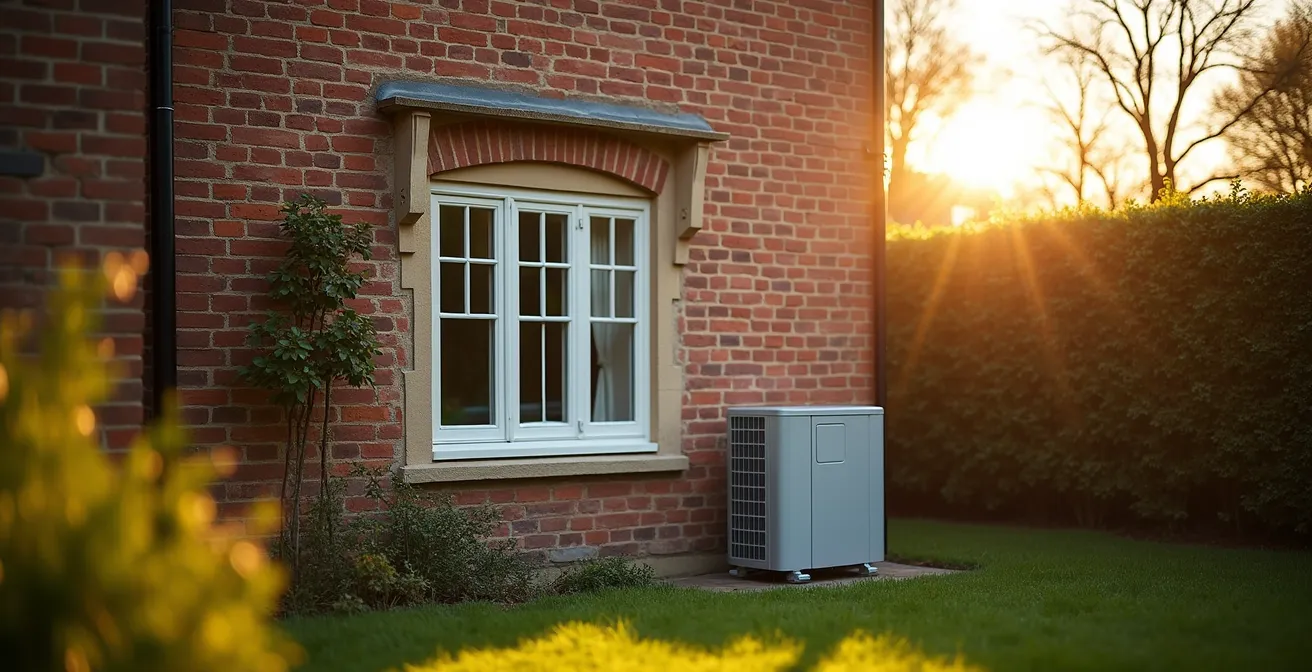
Yes, a heat pump can be highly effective in an older UK property, but success hinges entirely on a holistic system design, not just the unit itself.
- Poor performance is almost always due to inadequate insulation, undersized radiators, or a system not designed for lower flow temperatures.
- Financial viability is significantly improved by the £7,500 Boiler Upgrade Scheme (BUS) grant, which is applied for by your installer.
Recommendation: The first step is not choosing a heat pump, but commissioning a professional room-by-room heat loss calculation to determine your home’s specific insulation and heating needs.
For owners of older UK properties, the push to decarbonise home heating presents a significant dilemma. You’re likely comfortable with the roaring heat of a gas boiler but are increasingly aware of rising energy bills and the environmental cost. The proposed solution, an Air Source Heat Pump (ASHP), is often met with scepticism. You’ve probably heard the common refrains: they don’t work in draughty houses, they’re noisy, and you’ll need to spend a fortune ripping out all your pipes and radiators to stay warm.
While these concerns have a basis in reality, they often stem from poorly designed or mis-sold installations. The truth is more nuanced. The viability of a heat pump in a period home has less to do with the age of the building and more to do with a methodical approach to thermal engineering. It requires a shift in thinking: from the instant, high-temperature blast of a gas boiler to the continuous, low-temperature warmth provided by a heat pump. This isn’t just a simple boiler swap; it’s an upgrade to your entire heating ecosystem.
This guide, written from the perspective of a renewable heating engineer, moves beyond the simple “yes or no”. It unpacks the specific technical challenges—like microbore pipework and radiator sizing—and provides a realistic framework for assessing if an ASHP is the right choice for your home. We’ll explore the critical role of insulation, how to leverage grants and solar PV, and ultimately, how to ensure your transition to low-carbon heating leaves you comfortable and in control.
To navigate these crucial considerations, this article is structured to address each major question and concern you may have. The following summary provides a clear roadmap of the topics we will cover, from technical feasibility to financial incentives.
Summary: A Realistic Look at Heat Pumps for Period Homes
- Why Heat Pumps Fail to Warm Houses with Microbore Pipework
- How to Apply for the £7,500 Boiler Upgrade Scheme Grant
- Heat Pump vs Gas Boiler: How Loud Is the Outdoor Unit?
- The Radiator Size Error That Leaves You Cold in Winter
- How to Pair Solar PV with a Heat Pump for Free Heating
- Why Your Upstairs Rooms Are Freezing Despite the Heating Being On
- How to Calculate the ROI of Wall Insulation on Your Energy Bill
- External vs Internal Wall Insulation: What Is Best for Solid Brick Homes?
Why Heat Pumps Fail to Warm Houses with Microbore Pipework
One of the most persistent myths is that heat pumps are incompatible with microbore pipework (pipes with a diameter of 8mm or 10mm). This is a major concern for homeowners, as replacing pipework is disruptive and expensive. The issue is valid: heat pumps operate at a lower flow temperature (around 45°C) than gas boilers (60-70°C), requiring a higher volume of water to circulate to deliver the same amount of heat. Smaller pipes create more resistance, potentially starving the system. With up to 5 million UK homes fitted with microbore pipework, this is not a niche problem.
However, the blanket statement that it “can’t be done” is outdated. Modern heat pumps have sophisticated circulation pumps, and a proper system design can overcome these limitations. Research from leading manufacturers has shown that success is possible. In a 2024 white paper, Mitsubishi Electric detailed successful field trials where heat pumps were retrofitted into properties with existing microbore systems without replacing the pipework. The key was a thorough initial assessment of the system’s flow rate and pressure, combined with correct radiator sizing.
As Joanna Crown, Product Marketing Manager at Mitsubishi Electric, stated, “we’re pleased to demonstrate through our research that modern heat pumps can be effectively paired with these existing systems.” The conclusion is clear: while microbore presents a challenge that must be professionally evaluated, it is not an automatic disqualifier. A competent installer will perform flow rate calculations rather than simply demanding a full re-pipe.
How to Apply for the £7,500 Boiler Upgrade Scheme Grant
The significant upfront cost of a heat pump installation is a major barrier for many. Thankfully, the UK government’s Boiler Upgrade Scheme (BUS) provides a substantial subsidy to make the switch more affordable. The grant offers a fixed £7,500 reduction for an air source heat pump installation. It’s crucial to understand that this is not a cash grant given to the homeowner; it’s a voucher scheme managed by your installer.

The process is designed to be handled by your MCS-certified installer, who applies for the grant on your behalf and deducts the amount directly from your final invoice. For example, a typical £11,000 installation cost would be reduced to just £3,500. This scheme has been a significant driver of adoption, with over 40,000 installations supported by government subsidies in 2024 alone. To be eligible, your property must have a valid Energy Performance Certificate (EPC) issued within the last 10 years, with no recommendations for loft or cavity wall insulation outstanding.
Your Action Plan: Securing the BUS Grant
- Obtain an up-to-date Energy Performance Certificate (EPC) to prove eligibility. Some installers may offer this as part of their survey.
- Book a home survey with an MCS-certified installer. Only they can apply for the grant on your behalf.
- Let your installer submit the application. The grant is never given as cash directly to homeowners.
- Confirm the grant is deducted from your final invoice. Review the quote to see the £7,500 reduction clearly itemised.
- Ensure the installation does not begin before the voucher is formally issued, as this can lead to the application being rejected.
Heat Pump vs Gas Boiler: How Loud Is the Outdoor Unit?
The image of a large, noisy box churning away in the garden is a common concern, both for your own peace and for neighbourly relations. While early models could be intrusive, modern air source heat pumps are significantly quieter. The noise level is measured in decibels (dB), and for context, a quiet library is around 40 dB, a refrigerator is about 50 dB, and a normal conversation is 60 dB.
Reputable installers follow strict MCS guidelines for positioning the unit to minimise noise impact, ensuring it is a specified distance from neighbouring properties. Furthermore, the units don’t run at full power all the time. They modulate their output, and are often quietest when maintaining a steady temperature. Testing from suppliers like Octopus Energy shows that even their largest units operate at a maximum of 62 dB right next to the unit, with smaller models typically in the 58-60 dB range. At a distance of a few metres, this drops off to a level similar to a quiet fridge.
It’s also important to compare this to the existing noise profile of a home. A gas boiler isn’t silent; its flue and internal pump create noise. Many homeowners find that a well-sited, modern heat pump is no more intrusive than their old system. The key is correct siting and installation, avoiding placement directly under a bedroom window or in a reverberant alleyway between houses. A good installer will discuss siting with you as a priority during the survey.
The Radiator Size Error That Leaves You Cold in Winter
This is perhaps the most critical technical point to understand. A common reason for a “cold” heat pump system is not the pump itself, but radiators that are too small for the job. Gas boilers blast water at 60-70°C, so even small radiators can get very hot and radiate enough heat. Heat pumps, however, are most efficient when producing water at a lower flow temperature of 35-50°C. To get the same heat output into a room, you need a larger radiator surface area.
Simply swapping a boiler for a heat pump without addressing the radiators will leave you cold. A proper heat loss calculation will determine the heat requirement (in Watts) for each room, and your installer should then specify radiators that can meet that requirement at the system’s design flow temperature (e.g., 45°C). Often, older homes have single-panel “K1” type radiators which are completely inadequate.
The solution doesn’t always mean major upheaval. A common ‘halfway house’ solution is to replace single panel radiators with double (“K2”) or triple (“K3”) panel units of the same width and height. These provide double or triple the surface area and heat output without requiring changes to your pipework’s location. For rooms that are particularly hard to heat, fan-assisted radiators can provide a huge boost in output from a compact unit.
The following table, based on data from manufacturers like Viessmann, compares the suitability of different radiator types for low-temperature systems.
| Radiator Type | Suitability for Heat Pumps | Heat Output at 45°C |
|---|---|---|
| Single Panel (K1) | Poor – Usually needs replacing | Insufficient |
| Double Panel with Fins (K2) | Good | Adequate for most rooms |
| Triple Panel (K3) | Excellent | High output for cold rooms |
| Fan-assisted | Excellent | Maximum efficiency |
How to Pair Solar PV with a Heat Pump for Free Heating
An air source heat pump runs on electricity, so pairing it with a solar photovoltaic (PV) system is a powerful combination for reducing running costs. While a heat pump is already 300-400% efficient, using self-generated, free electricity from your roof to power it brings your costs down to almost zero during sunny periods. This synergy turns your home into a self-sufficient energy hub.
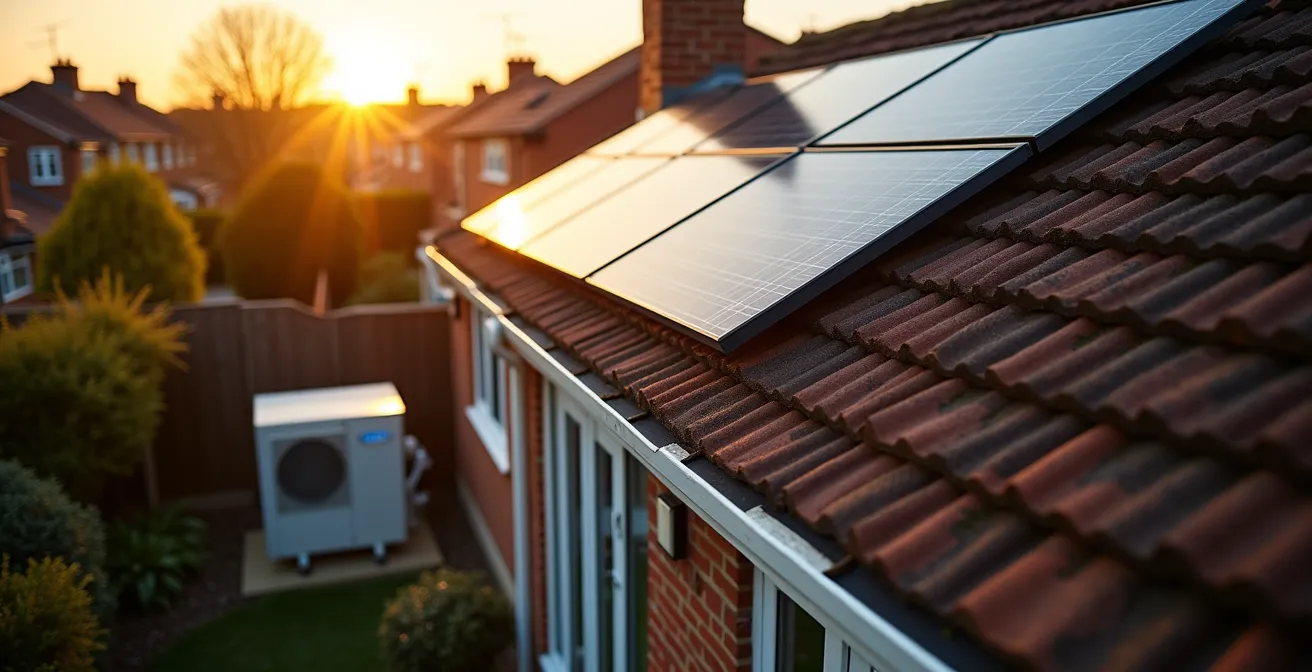
However, the real magic happens when you combine hardware with a smart energy tariff. Tariffs like Intelligent Octopus offer incredibly cheap overnight electricity rates (e.g., 7.5p/kWh). This allows you to “charge” your home with heat overnight when electricity is cheap. You can program the heat pump to heat your hot water cylinder and gently warm the house during these cheap periods, effectively using your home’s thermal mass as a battery. Any excess solar generated during the day can then be used to top up hot water via a solar diverter or stored in a home battery for use in the evening.
Because we’re running this system correctly, we’re saving loads of money compared to running our old gas boiler.
– Shan (UK Homeowner), Everything Home YouTube Channel
This intelligent management strategy is key to maximising savings. It requires a more hands-on approach than a simple gas boiler, but the rewards are substantial. Here are the core components of an effective strategy:
- Sign up for a smart tariff like Intelligent Octopus offering cheap overnight rates.
- Program your heat pump to run primarily during these cheap rate periods (e.g., 23:30-05:30).
- Install a solar diverter to automatically direct excess solar power to your hot water immersion heater.
- Consider a home battery to store cheap overnight or free solar electricity for use during peak times.
- Use advanced weather compensation controls to allow the system to predict solar generation and adjust its heating schedule accordingly.
Why Your Upstairs Rooms Are Freezing Despite the Heating Being On
A common complaint in older, multi-storey homes is that the upstairs rooms are always colder, even when the heating is on full blast. In many Victorian and Edwardian properties, this isn’t just an insulation problem; it’s a design feature. These houses were designed to “breathe” and create a natural airflow known as the stack effect. Cool air is drawn in downstairs (often through floorboards and vents) and, as it warms, rises through the house, eventually being vented out through sash windows or chimneys, taking heat with it.
A gas boiler, which operates in powerful on/off cycles, exacerbates this. It sends a surge of heat into the system, much of which quickly rises and is lost before it can properly warm the upstairs rooms. A heat pump, by contrast, provides a constant, low-temperature background heat. This “low and slow” approach is far better at combatting the stack effect, allowing a more even heat distribution throughout the property. This is why studies like the Electrification of Heat project found that heat pumps can maintain a stable and comfortable temperature, with a real-world Seasonal Performance Factor (SPF) of 2.7 or higher even in pre-1919 properties.
If you have specific cold spots, the quickest fix is often to “balance” your radiators. This is a simple DIY job involving adjusting the lockshield valve (the one usually covered by a plastic cap) on each radiator. By slightly closing the valves on the radiators that get hottest first (usually downstairs and closest to the pump), you force more hot water to flow to the colder radiators further away, ensuring a more even distribution of heat throughout the house.
How to Calculate the ROI of Wall Insulation on Your Energy Bill
Before you even think about a heat pump, you must think about insulation. A heat pump’s efficiency (its Coefficient of Performance, or COP) is directly linked to how much heat your house loses. Installing a heat pump in a completely uninsulated house is like pouring water into a leaky bucket; you’ll spend a fortune on electricity for very little comfort. The mantra should be: fabric first.
For a typical solid-wall older property, the most impactful measure is wall insulation. But the return on investment (ROI) varies dramatically depending on the type and cost. Calculating a precise ROI requires knowing the U-value of your walls before and after, but a good estimate can be made using average costs and savings. For a heat pump to work efficiently, the building’s heat loss needs to be minimised first. The lower the heat loss, the lower the flow temperature the heat pump needs to run at, which dramatically increases its efficiency.
The following data from the Energy Saving Trust provides a realistic comparison of payback periods for different insulation types on a typical 1930s semi-detached house. While the upfront cost is high, it’s a foundational investment for any low-carbon heating system.
| Insulation Type | Typical Cost | Annual Saving | Payback Period |
|---|---|---|---|
| External Wall | £15,000 | £400 | 37.5 years |
| Internal Wall | £8,000 | £380 | 21 years |
| Cavity Wall | £2,500 | £280 | 8.9 years |
The long payback periods highlight that insulation is a long-term investment in the comfort and future-proofing of your home, not a short-term money-saving trick. It is, however, an essential prerequisite for an efficient heat pump system.
Key Takeaways
- A heat pump’s success depends on the whole system design (insulation, radiators, controls), not just the brand of the unit.
- Insulation is not optional. A “fabric first” approach is essential to reduce heat loss and enable the heat pump to run efficiently at a low flow temperature.
- The £7,500 Boiler Upgrade Scheme (BUS) grant significantly changes the financial calculation, making the upfront cost more comparable to a high-end boiler.
External vs Internal Wall Insulation: What Is Best for Solid Brick Homes?
For the millions of UK homes built with solid brick walls, there are two main options for insulation: External Wall Insulation (EWI) and Internal Wall Insulation (IWI). EWI involves fixing insulating boards to the outside of your house and rendering over them. Its main advantage is that it causes no internal disruption and creates a “thermal envelope” around the entire house, reducing thermal bridging. However, it is expensive and dramatically alters the external appearance of the property, which can be an issue for attractive brickwork or in conservation areas.
IWI involves fixing insulation boards to the inside of the external walls. It’s generally cheaper and preserves the home’s exterior appearance. The main drawbacks are the loss of internal room space (typically around 100mm per wall) and significant disruption, as skirting boards, electrical sockets, and radiators need to be moved and re-fitted. Careful attention must also be paid to preventing moisture build-up behind the boards.
The choice often comes down to budget, aesthetics, and planning constraints. However, it’s a myth that you need to achieve a ‘new build’ level of insulation. Meaningful improvements that reduce drafts and major heat loss are often sufficient. The ultimate proof lies in successful real-world projects.
Case Study: Grade II Listed Sutton Dwellings Estate
A landmark project at the 1913 Sutton Dwellings estate in Chelsea, London, demonstrated the viability of heat pumps in challenging heritage buildings. The project successfully retrofitted 81 solid-brick, Grade II listed flats with ground source heat pumps without altering the historic facade. Through careful system design and targeted insulation upgrades that respected the building’s character, annual heating costs were reduced to just £300 for a one-bedroom flat and £700 for a four-bedroom flat, proving that even the oldest and most protected buildings can successfully transition to low-carbon heating.
Ultimately, transitioning an older UK home to an air source heat pump is a journey of careful planning and expert execution. By focusing on the fabric of your building first and working with a certified installer who understands holistic system design, you can create a comfortable, efficient, and low-carbon home for the future. The first logical step is to move beyond guesswork and get a precise understanding of your home’s needs through a professional heat loss survey.
Frequently Asked Questions on Heat Pumps in Older Homes
Why are Victorian homes harder to heat evenly?
Victorian terraces were designed to ‘breathe’ with natural ventilation. This creates a “stack effect” that pulls cool air in downstairs and vents warm air out through upper windows and chimneys, actively removing heat from the upper floors and making them feel colder.
Can heat pumps solve uneven heating in old homes?
Yes, in many cases. Heat pumps run continuously at lower temperatures, providing a more consistent and even heat distribution that can counteract the “on-off” cycling of a gas boiler, which often allows heat to escape before it circulates properly.
What’s the quickest fix for cold upstairs rooms?
The first and most effective step is often “radiator balancing.” By adjusting the lockshield valves on your radiators, you can ensure hot water is distributed evenly throughout the system, forcing it to reach the colder radiators upstairs rather than taking the path of least resistance to the hottest ones downstairs.